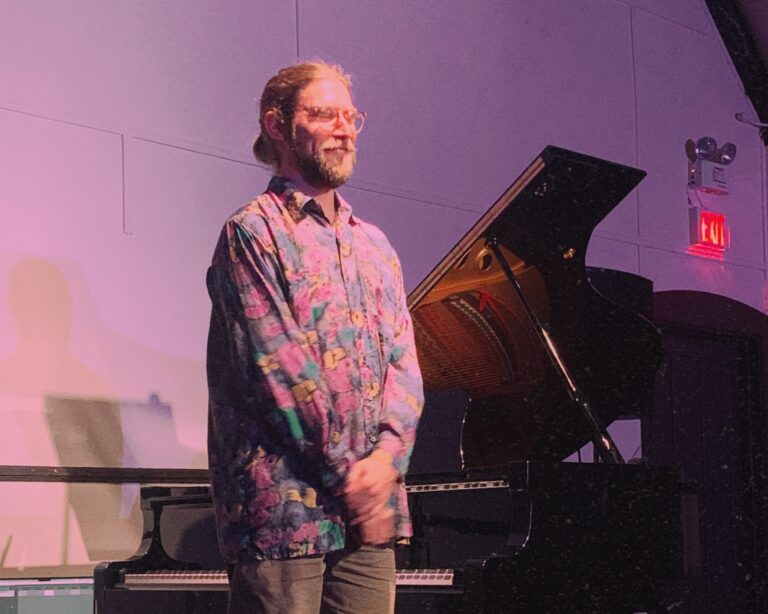
On a rainy October 7th, what could be better than taking shelter in the comfort of a chapel, letting the torrent flow by while listening to its gentle violence. Sometimes slow, sometimes like a thunder of chairs returning to their places at the bell, Joseph Houston’s piano wonderfully allowed us to discover what we could not have previously imagined on such an instrument.
With infinite precision, Joseph Houston cut the church’s resonance into a thousand pieces. Under the pounding rain, we traveled a winding path, from purely serial music at the opening to almost jazzy chords where melodies began to reveal themselves. Held together by detailed and dense scores, the rhythm gave way to changes of speed and carefully unregulated phrasing. A style he made his own with confidence.
This winding journey, ultimately, was not a coincidence, but rested on the superposition of forms whose outline the intellect could only barely define. After almost an hour of exponential growth, the tranquility of its ascent suddenly took on force. In Cassandra Miller’s piece Philip the Wanderer, Houston revealed her unrestrained virtuosity. Heavy as the ground and yet light as incense smoke, her spasmatic left hand created a low drone, while the right developed a floating melody with a romantic air. The whole thing rose in bursts of strums, played as if they had been forgotten, which were heard along a dynamic path: lost, found, then lost again in a din. Without our realizing it, the end of the piece revealed the main tune, which had resonated within us ever since like a distant memory.
Back on our orange chairs, the small red chapel could be heard from far away, for even the storm had joined us. The room, filled with contemporary music lovers, emptied as the audience dispersed, running. The storm, however, remained suspended, as if it wanted to prolong the last note.