It was in the intimacy of the Indigenous artist-run centre, daphne, that Tanner Menard and Martín Rodríguez presented two unique performances on Sunday evening as part of the Flux Festival.
While waiting for the performance to begin, we wander among the exhibits Prelude to the Return of the American Indian by Buffalo Boy and Ne Karahstánion. This place itself inspires a sense of peace of mind, a communion among those present.
A few minutes after eight o’clock, Martín Rodríguez appears wandering through the galleries, wearing a beige uniform, rain boots, and a black cap adorned with gold. Loud chirping can be heard from his bag. After several detours through the space, he stops in front of the kitchen and takes out two radios and two transmitters. He fetches a ladder, places one of the radios on it, and invites the audience to gather around this new altar.
Using sound archives: birds, bullfrogs, bells, bees, trucks, cars, human voices, several explorations of interference between radio-transmitter pairs unfold. Rodríguez then creates the interference by playing with the distance between the transmitters and the radios. Each of his gestures affects the broadcast: he leans, straightens, withdraws into space; he moves objects, combines them, opposes them; he creates the interference with his own hands, erecting his transmitters like a fragile house of cards.
His performance ends with a nap, wrapped in a white jacket decorated with colorful embroidery, cap pulled down over his eyes, abandoned among the urban sounds.
After a short break, Tanner Menard takes his place. At the intersection of sound and visual poetry, his work is rooted in a search for a post-polarity-unity life and a vision of the world based on interdependence and drawn from love.
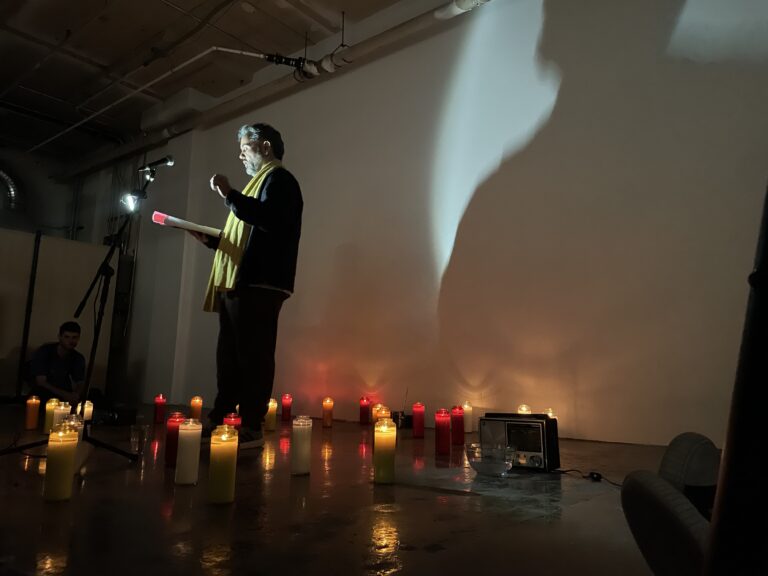
After a few shared breaths and our eyes closed, Menard recites his first poems. Around him, a pool of candles and four radios broadcasting white noise. In front of each, a bowl of water collects their waves. After this moment of poetic performance, he sits down at the computer, which projects these visual poems onto the wall. Everything is accompanied by his recorded voice and a musical score that embraces the texts’ forms in their intentions and intensities.
His words tell us about the fragility of contemporary existence and our common isolation: “The only “we” that exists is the common experience of multiplicitous isolation.”
Finally, he hands us the candles that came with him, consciously placing them in our hands. Then, with a ritual gesture, he sprinkles us with a few drops of water.
As we leave the place, the street appears different. This shared listening invites us to rethink our common individuality.
This shared moment invites us to rethink what connects us, our overall way of being alone.