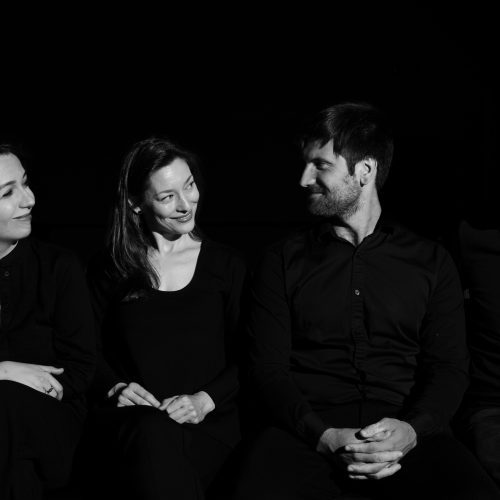
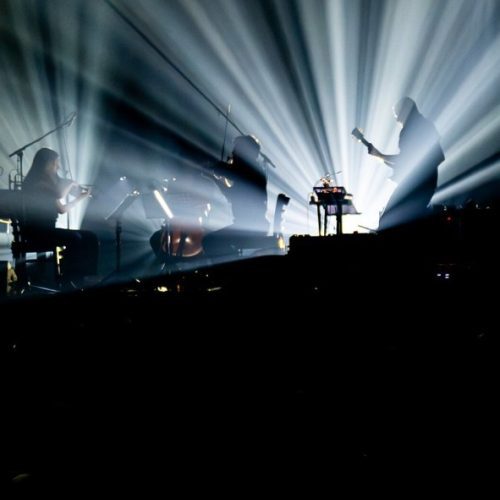
A quartet on one side, a trio on the other. Four Montreal-based saxophones (Quasar) there, an accordion, percussion and a txistu from Basque country (Trio Zukan) on opposite. Sorry? A what? A txistu, a traditional Basque flute, played vertically like a recorder. In short, all these people gathered on Thursday evening, September 18, 2025, at the Orange Space of the Wilder in Montreal, in the Quartier des spectacles. Chambre d’écoute (Listening Room), the title of the concert but also of the first piece in the program order, offered five compositions by four composers, three of whom unified the two ensembles. If the title piece, by Chantale Laplante, was interesting, ambient-wise, it was the two works by the Quebecer Émilie Girard-Charest that most impressed your humble chronicler.
Firmly rooted in a well-educated contemporary soundscape, Girard-Charest’s music possesses a quality that too few of her equivalents claim: an attention to stimulating and captivating narrative construction. Atonal, experimental, fragmented, the young artist’s pen is nevertheless attached, at least that’s what I perceived, to the construction and expression of a story. Which one? That’s up to you, but what is certain is that music lovers are taken somewhere, and this is thanks to a generally easily understandable architecture, both for seasoned ears and for the simply curious/bold, without expertise.
In the two scores proposed by the composer, Artefaktuak and Quantum Statistical Zero-Knowledge, it was the first one that made the best impression on me. Written specifically for the Zukan trio, Artefaktuak is made up of two sections with simple and effective textural contrasts, followed by a short and lively conclusion. The first of the sections is built with pointillist sounds that are accentuated by the gestures of the artists on stage. The physical gesture leading to the sound is just as important here as the sound itself. The second part uses rubbed sounds, more sustained over time, like a bow on the vibraphone, for example. Each of the sections is deployed in a dynamic and energetic crescendo leading to its end.
Quantum Statistical Zero-Knowledge is written for the unified quartet and trio, in a tripartite structure of intense-calm-intense where the two outer movements are particularly dense, even saturated to the point of noise, while the central movement provides a desirable dose of soothing. Quantum mechanics, this scientific branch that accounts for the mechanisms existing in the infinitely small, sub-atomic levels, reveals astonishing realities, such as entanglement or the simultaneity of contrary states. If Quantum Statistical Zero-Knowledge does not offer a particularly destabilising incarnation of musical possibilities, it is nevertheless a piece that knows how to maintain the interest of listeners, even the most profane. In itself, it is already a success, especially in the field of very complex music.
The Concerto grosso by Miguel Matamoro is full of colours, just like the compositions of the same type from the Baroque era, while Jalkin by Ramon Lazkano, with quite predictable sound dots and strokes, seemed to me to be the most conformist work of the lot.