Additional Information
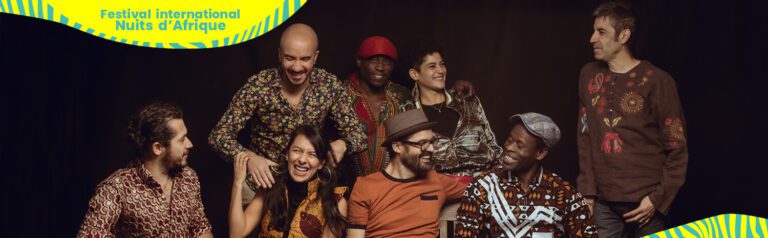
The Bongo Hop is a dynamic band that refuses to be categorized by any generic label. Its members hail from the four corners of the globe, and their distinctive sound bears witness to this: the group’s songs are resolutely international and mixed. French trumpeter Étienne Sevet, who wrote the instrumental compositions for The Bongo Hop, is the driving force behind this unique project, which originated in Cali, Colombia. The group is frequently joined by Nidia Góngora, a Colombian-born singer and one of the most prominent voices of Afro-Colombian culture.
Just hours before The Bongo Hop’s concert at the Festival international Nuits d’Afrique, PAN M 360 caught up with Étienne Sevet and Nidia Góngora by phone to find out more about the group’s origins.
PAN M 360: Hello! Tell us a little about the origins of the band. How did you arrive at this musical fusion?
Étienne Sevet: It all started when I was in Cali, Colombia. I was there to make a documentary on salsa. Then I discovered Pacific music first, and then other styles. That’s what made me want to stay. Then I started working as a music journalist, organizing parties. It was only after that that I started learning music and composing.
PAN M 360: The Bongo Hop often collaborates with Nidia. How did this collaboration come about, and what does it involve?
Étienne Sevet: I first got to know Nidia musically, when she was part of one of her first traditional music groups. Originally, I was putting together The Bongo Hop project for a rap group in Cali. When I met Nidia in person, I thought it would be interesting to include vocals in my project. And that’s when I simply proposed a track to Nidia, and then another, which mixed my experience in Colombia, inspired by the West African music I love.
Nidia Góngora: For me, there’s a dynamic that has to do with collective creation. I write the lyrics for the songs I collaborate on. And the instrumental part is done by Étienne. There’s a process in which we talk, we look at the music. We listen to the instruments, and then we have a discussion about the theme we’re going to choose. How will it interact and create musicality to build the whole? There’s an important aspect: in every song, in every sound, there’s the sign of each of us. We’re trying to give The Bongo Hop a distinctive sound that’s consistent with my own.
PAN M 360: How would you describe this distinctive sound you are talking about?
Étienne Sevet: The identity of The Bongo Hop is that it’s not just one musical genre. Often, when people describe us, they talk about Afrobeat. Or, even worse, some people say cumbia, which has nothing to do with it. Because it says Colombia, people think Cumbia. But no, that’s not it. So I try to make music that isn’t tied to any particular genre. That doesn’t mean I want to do just anything, either! It does mean that I have influences from West African and Colombian music. But I don’t particularly want to do a particular style. When I do a Congolese samba, I add a Haitian colour, for example.
I’m always looking for a kind of imaginary journey that’s created in the tension between two places, without being exactly in one place or the other. That’s where the imaginary works.
PAN M 360: So, you draw your inspiration from international music, and your music transcends musical genres?
Nidia Góngora: I believe that music transmits and nurtures diversity. I believe that this diversity, our origins, is transposed into a sound proposal. The project is based on collaboration between African, French and Colombian musicians. This is clearly evident in the group we’ll have with us tonight in Montreal. These diverse origins are reflected in the musical proposal and in the melodies.
Étienne Sevet: I agree. All the members of the group have travelled a lot, and the inspiration is almost geographical. It’s geographical poetry or poetic geography. We see this back-and-forth between our origins and the places to which we’ve been transplanted.
PAN M 360: What are your favourite subjects when you write songs? What do you sing about?
Nidia Góngora: Generally speaking, I write music that has to do with reality, with my experiences and my environment. Anything to do with everyday experiences, whether positive or negative. I like to sing about nature and all it has to offer. I talk about the respect due to nature and humanity.
PAN M 360: Finally, what does your presence at Nuits d’Afrique mean to you?
Étienne Sevet: For me, it’s the culmination of a lot of things. We’ve been in discussions with the Nuits d’Afrique team for a very long time, even well before COVID. We’ve been wanting to come here for several years, but it hasn’t worked out. What’s more, we’re currently wrapping up a short tour of Canada. It’s nice to be able to finish this tour in Montreal, which I think is very significant in terms of the music. We’ll be back, no doubt about it! We love being at these big “world music” festivals because we get to meet some really interesting artists.
Nidia Góngora: It’s always a great joy for me to take part in festivals that show a diversification of music, and to be able to share with great artists and reconnect with our roots through music. When I hear about places where there’s Africanness, if you can put it that way, it’s important for me to be there, but also to come back. There’s a visible connection in these spaces that connect us with Africa, albeit outside Africa. It’s a pleasure to be able to share music in this kind of context. These are universal spaces, with other sounds, and other cultures. That’s precisely one of the main aims of music, and spaces like Nuits d’Afrique make it possible.
The Bongo Hop ft. Nidia Gongora, July 18 at 9:30 PM on the TD – Radio-Canada Stage. INFO HERE!