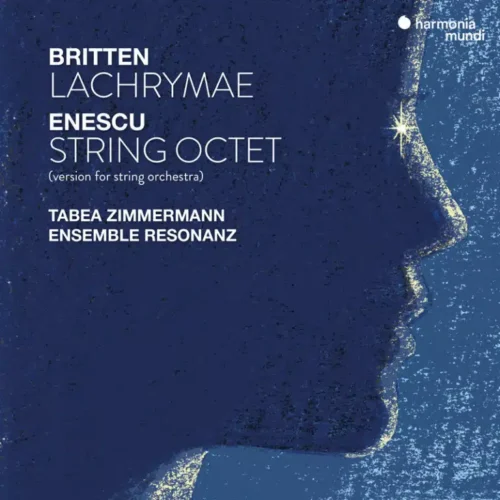
A masterpiece of rare creative power and fantastic precocity: George Enescu’s Octet op. 7 is the product of a 19-year-old young man. It’s a magnificent work, structurally complex and melodically rich, but one that, surprisingly, remains somewhat outside the standard repertoire. It is not unknown either, it is just that it is not played and recorded as often as its quality demands.
In a version for string orchestra, this release offers a clear and fully developed vision of the themes and multidimensional architecture of the work. The excellent Ensemble Resonanz with Tabea Zimmermann on the viola here meets the expectations of enthusiastic music lovers. This reading articulates the remarkable contrapuntal skeleton that underpins the entire score with exceptional clarity. Moreover, the sound is beautiful, supple and warm, which elevates this gem of Romanticism on the cusp of Modernism to thrilling heights. What a wonderful breath Ms. Zimmermann and her colleagues from Resonanz give to Enescu’s main melody, which serves as the basis for the entire piece.
For the string orchestra version, this new rendition surpasses that of the Kremerata Baltica, which is less holistic. If you want to return to the chamber nature of the work and its eight performers (the original), the recent version by Vilde Frang is a must. There is also the Alcan Quartet version with the Quebec Quartet, to appreciate a local interpretation, which has something historical to it.
As a complement to the programme, another gem, Lachrymae – ‘Reflections on a song by John Dowland’ Op.48a, by Benjamin Britten, here also offered in an arrangement for viola and string orchestra (the original is for viola and piano). In this expanded format, one is reminded of the Nash Ensemble, on Hyperion. The music, which feeds off Dowland’s song If my complaints could passions move (and on another occasion: Flow my tears) is more austere than the previous one. Half a century separates them, it should be noted.
That’s where the Resonanz ensemble seems to win out for me, as they seem more precisely attuned to modernity than the Nash. The mastery of textural subtleties combined with the inflexible perfection of timbral colours and tight harmonies make this reading an essential version.
The coupling is brilliant and the execution, memorable.