Country : Germany / Italy Label : Harmonia Mundi Genres and styles : Baroque Year : 2025

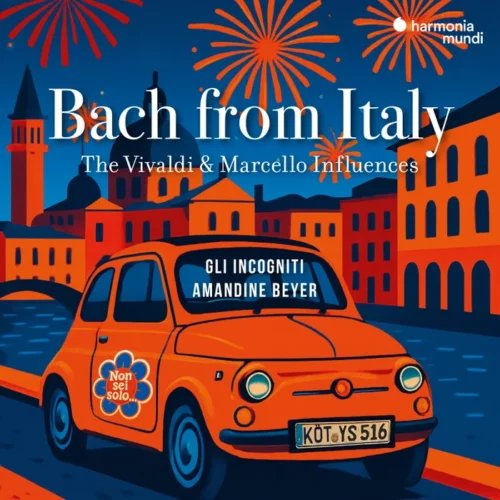
Gli Incogniti/Amandine Beyer – Bach from Italy: The Vivaldi and Marcello influences

· by Frédéric Cardin

Italians playing Bach’s “dry,” “scholarly,” and “outdated” music, very few 18th-century Latins would have imagined it. Germans themselves would mostly have seen it as a waste of time. Because, you know, Bach was far from being the musical superstar he is today. Time has done its work, fortunately, and what seemed antithetical is now celebrated as a shared heritage in which kinship ties are found.

There is nothing new in knowing that Bach, from the beginning of his career, showed a lot of curiosity and interest in the musical style coming from the peninsula further south. We know he had fun transcribing and arranging scores by Vivaldi and the Marcello brothers (among others). The “Concerto for Four Violins” by the Red Priest (Vivaldi) is actually one of the best examples of this attraction, Bach having transformed it into an exciting Concerto for… four harpsichords.

If at the time the “sharing” was rather one-sided, as the centuries passed, the German Cantor became the musical god we know and today even Italian hedonists recognise his incomparable genius. So, why not place the two worlds side by side (once again, we will say, since this kind of juxtaposition is not new)?

That’s what Amandine Beyer and her ensemble Gli Incogniti do excellently in a program that goes back and forth between Bach and Vivaldi and Marcello. The program includes well-known titles, strung together in a spirit of commentary on the influences the Italians had on the German master. The direct ascendancy is rarely explicitly presented (with the exception of the Concerto for Four Violins/Harpsichords mentioned earlier). Why not, for example, juxtapose Marcello’s Oboe Concerto with Bach’s keyboard version? But that might have been too much of a “rehash,” since we’re already doing the same exercise with the four violins.

The result is that the thematic or melodic links are often tenuous. Where Beyer beautifully recovers is in the interpretive style infused into Bach’s works (the Brandenburg Concertos 3, 4, and 5 and the “Concerto for Two Violins BWV 1043,” among others), in which we feel here the strong bow strokes, there a certain lyrical portamento, elsewhere the singing character of the solos, in short, Italianism in the German’s scores.

Whether you perceive these details, which are quite subtle most of the time, or not, the program of this double album has the distinct advantage of being impeccable in terms of appeal but above all, yes above all, of being delivered with a quite delightful sparkle, and a charm that is matched only by the rigour of the technique.

One cannot remain indifferent in the face of so much beauty that is both radiant and spirited.

Latest 360 Content

Lanaudière 2026 | Saskia Giorgini : The Italian Piano

Lanaudière 2026 | Saskia Giorgini : The Italian Piano

Lanaudière 2026 | The Romantic Exaltation of Beethoven to Tchaikovsky: Veronika Eberle Speaks to Us About It

Lanaudière 2026 | The Romantic Exaltation of Beethoven to Tchaikovsky: Veronika Eberle Speaks to Us About It

Concerts au Îles du Bic – Boldness and community feeling, on the banks of the Bas-du-Fleuve

Concerts au Îles du Bic – Boldness and community feeling, on the banks of the Bas-du-Fleuve

Nuits d’Afrique 2026 | Somos Más: A Celebration of Memory, Community, and Resistance

Nuits d’Afrique 2026 | Somos Más: A Celebration of Memory, Community, and Resistance

Steve Lacy – Oh yeah?

Steve Lacy – Oh yeah?

Nuits d’Afrique 2026 | Suraras dos Tapajós: Connecting Us to the Amazon Forest Through Music

Nuits d’Afrique 2026 | Suraras dos Tapajós: Connecting Us to the Amazon Forest Through Music

Réka Csiszér & Radwan Ghazi Moumneh – Le Révélateur

Réka Csiszér & Radwan Ghazi Moumneh – Le Révélateur

Yiddish Glory – The Silenced Songs of World War II

Yiddish Glory – The Silenced Songs of World War II

Lanaudière 2026 | Explosion of colours and emotions thanks to Payare, Weilerstein, Ortiz, and Shostakovich

Lanaudière 2026 | Explosion of colours and emotions thanks to Payare, Weilerstein, Ortiz, and Shostakovich

Nuits d’Afrique 2026 | Chris Combette: the groovy elegance of the Guyanese troubadour

Nuits d’Afrique 2026 | Chris Combette: the groovy elegance of the Guyanese troubadour

Nuits d’Afrique 2026 | Forro das Comadres: the Women’s Forro

Nuits d’Afrique 2026 | Forro das Comadres: the Women’s Forro

Kim Petras – Detour

Kim Petras – Detour

Nuits d’Afrique 2026 I African Circus Courtesy of Kalabanté Hits Different

Nuits d’Afrique 2026 I African Circus Courtesy of Kalabanté Hits Different

Nuits d’Afrique 2026 | Azara, the voice of flamenco takes root in Montreal

Nuits d’Afrique 2026 | Azara, the voice of flamenco takes root in Montreal

Nuits d’Afrique 2026 | The Two Enriches its Creole blues

Nuits d’Afrique 2026 | The Two Enriches its Creole blues

PRIMAVERA SOUND – PORTO 2026 : The Big Little Festival on a Human Scale

PRIMAVERA SOUND – PORTO 2026 : The Big Little Festival on a Human Scale

Real Farmer – Two Wrongs Don’t Make A Right

Real Farmer – Two Wrongs Don’t Make A Right

knitting, frown line, and Fireball Kid Tear Up Sala Rossa

knitting, frown line, and Fireball Kid Tear Up Sala Rossa

Nuits d’Afrique 2026 | Celebrate with Labess

Nuits d’Afrique 2026 | Celebrate with Labess

Nuits d’Afrique 2026 | The virtuoso balafon of Seydou Diabaté, at the heart of the Kanazoé Orkestra

Nuits d’Afrique 2026 | The virtuoso balafon of Seydou Diabaté, at the heart of the Kanazoé Orkestra

Nuits d’Afrique 2026 | MTELUS Falls to Grand Lamine Touré

Nuits d’Afrique 2026 | MTELUS Falls to Grand Lamine Touré

Subscribe to our newsletter

Inscription
Infolettre

"*" indicates required fields

Type of Suscribers