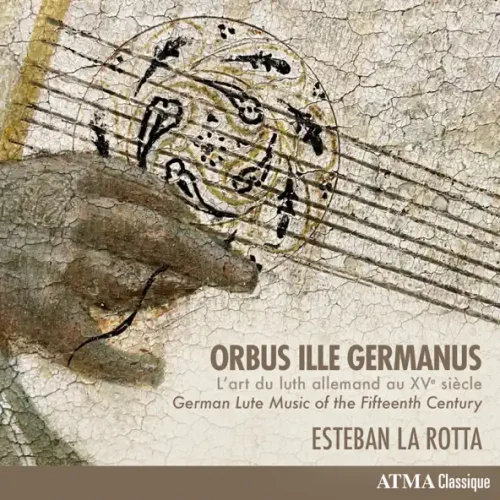
It is not only an album of very beautiful music that the lutenist Esteban la Rotta offers us, but also a fascinating lesson in the history of the beginnings of solo lute music in Europe, somewhere around the end of the Middle Ages/beginning of the Renaissance. It was the Germans who, at that time, developed the modern technique of lute playing, allowing the expression of multiple voices in polyphony. The Germans themselves had actually been inspired by Italian innovations, which they would later redistribute, enriched, to the Italians to create the pan-European style of the Renaissance and Baroque. Fascinating story, which the lutenist Esteban La Rotta recounts in detail in the interview I conducted with him.
Almost no lute scores from that era have survived. It is known from testimonies that German lutenists/composers were admired for their impressive abilities. One of them is known only by his nickname: Orbus ille Germanus, the ‘’Blind German’’. He was apparently astounding, displaying exceptional technique, a genius for improvisation, and memorable musicality. Musicological research allows us to think that the one who hid behind this pseudonym was a multi-instrumentalist named Conrad Paumann. This Paumann, although excellent on the lute, was above all an organist, and as such, he left behind a few scores that are documented today.
Based on this observation, Esteban La Rotta decided to reconstruct a program that could have been played by Paumann, or at least that would have probably sounded like it. And he did this in two ways: first by relying on the scant historical knowledge of lute practice in the 15th century, concentrated in a collection of score fragments discovered in 2011, the Wolfenbüttel Lute Tablature Fragments. Then by drawing on Paumann’s own keyboard compositions, gathered in two collections: the Buxheimer Orgelbuch and the Lochamer Liederbuch.
Thus equipped, La Rotta has constructed a vast program largely informed by documentation that is certainly partial, but reliable. We find ourselves with pieces that certainly do not have the polyphonic richness or the timbral roundness of Weill’s subsequent masterpieces, for example. But we are still fascinated by these echoes of a time forgotten by History, because it is undocumented. To our modern ears, the foundation of these constructions seems a bit simple: two voices with chords on adjacent strings, followed by melodic runs. But La Rotta more often than not enriches this foundation with the more advanced polyphonic style that Paumann demonstrates in his keyboard pieces.
The relative slenderness of the harmonic muscle is accentuated by La Rotta’s light and precise fingering. The flaws of its advantages. Nevertheless, one is satisfied with the finesse of the lines and the spontaneity of the ornamentations, in addition to rejoicing in witnessing the rediscovery of a repertoire that was thought to be lost (although La Rotta does not claim to bring out any “rediscovered pieces”. Let’s not forget that these are studied reconstructions, but still approximate).
An important and very instructive research work, as well as an enrichment of our knowledge that Esteban La Rotta conducts with great care and musicality.