For lovers of impressive orchestrations that are also refined and overflowing with ideas and surprises, the music of the British composer Havergal Brian (1876-1972) will be a lasting source of satisfaction. His most “famous” work is the monumental Gothic Symphony, which lasts almost two hours. Since then, his reputation has been that of a composer of excess. Which is false. The Gothic is an exception rather than the rule. Most of his scores are of quite reasonable temporal dimensions. For example, the two symphonies presented here, each of which is about 20 minutes long. What doesn’t change, however, is the quality of Brian’s orchestral writing. One thinks of Mahler, one thinks of Prokofiev, one thinks of Britten, but one quickly realizes that we are elsewhere, because Brian has a strong and assertive personality.
His hallmark is that of grand, sweeping, panoramic gestures, set against a backdrop of chromatic harmonies, sometimes modal, on which he embroiders numerous melodic or simply coloristic motifs that often surprise and delight. Brian uses the entire orchestra in a hyper-detailed manner (hence the mistake of some who compare him to Bruckner, who works more with sound masses), instrument by instrument, section by section, with tutti that do not linger. His music is also very active, propelled by a palpable and exciting intrinsic energy, despite moments of tranquility that can be delicate and very seductive. Here, I am reminded a bit of another modern Englishman, Robert Simpson.
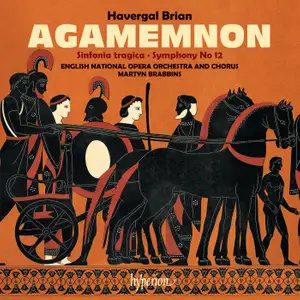
Brian has always shown a keen interest in playwriting. He loved opera (and wrote five) and literature. He said that most of his symphonic works sprang from some literary or dramatic source. This is the case with the two symphonies on this album, beautifully recorded and performed by the English National Opera Orchestra.
The Sinfonia tragica (the sixth in Brian’s catalog, which includes 32!) comes from an opera project that was never completed. The envisioned prelude became a symphony, this Tragic, trembling with an active inner life. Imagine that Brian wrote it at the age of 72! He was going to write 26 more before he died. It is a continuous piece, like Sibelius’s Seventh, for example. Its dramatic character shines through from beginning to end, from the first measures that evoke a nocturnal and mysterious cavalcade, to the surprising conclusion, passing through episodes of beautifully pastoral English beauty, then moments of melancholic introspection and abrupt dynamic rebounds. All of this in a fine, chamber-like writing, but rich and velvety.
I would like to be able to describe to you, to the best of my impressions, the aesthetic quality of this music. I will simply suggest that you listen to the first movement of the Sinfonia tragica, at the bottom of the page. You will be quickly convinced and charmed.
Symphony No. 12, like the Tragica, was written as the prelude to an opera, this one very real: Agamemnon, which I will tell you about right after. Darker but just as sparkling with contrasts and narrative energy, the twelfth is the work of an 81-year-old artist, who with this piece launched the final part of his professional life: an unprecedented creative rush in modern music with the writing, by an octogenarian and in the following decade, of around twenty symphonies! Ultra concise, this symphony brings together an impressive array of textures and contrasting themes in less than ten minutes. A small tour de force.
Agamemnon, the opera which is technically the reason for the existence of Symphony No. 12, retells the myth of the murder of the king of Mycenae after his return from Troy, by his wife Clytemnestra and her lover Aegisthus. About forty minutes, if one takes it slow, Agamemnon could serve as a contextual introduction to Strauss’s Elektra. The musical material, although more angular than Strauss’s score, would still make it an appropriate companion.
Aesthetically, although the changing harmonies and vocal style do not outrageously deviate from Strauss’s masterpiece, the sound colors used more often evoke winds and urgent, veined phrases than the dark sumptuousness of Elektra‘s strings and brass. That said, like Strauss, Brian (as a good heir of Victorian society) portrays the character of Clytemnestra in a negative light, almost entirely ignoring the reasons that drove her to assassinate Agamemnon: the sacrifice by the latter of their daughter Iphigenia, given as a holocaust to the gods to favor his victory over the Trojans. In the male-dominated society of ancient Greece, as in that of the Victorian 19th century, women counted for little. Sacrificing a young girl to the gods can be justified, but assassinating a king, even by a grieving mother, remains unacceptable. It would be time to revisit these myths from a more feminist perspective and put these reproachable gentlemen in their place! Well…
Agamemnon, musically speaking, is denser, more demanding than the previous two symphonies, even downright austere. The vocal lines often tend to be separated from the orchestral accompaniment, which makes them not easy to follow. Agamemnon may not be the best introduction to Brian’s universe, but if you are already a bit more familiar with him, it will be worth giving it a careful listen. Moreover, according to all likelihood, this is the only professional recording available at the moment.
The soloists are adequate, except for tenor Robert Murray in the role of the Watchman, who overuses an unpleasant vibrato.
For the curious, Havergal Brian’s music will provide stimulating and complex listening moments.