Colonial Shadows, Ancestral Light: The Politics of “Wayqeycuna”

by Stephan Boissonneault

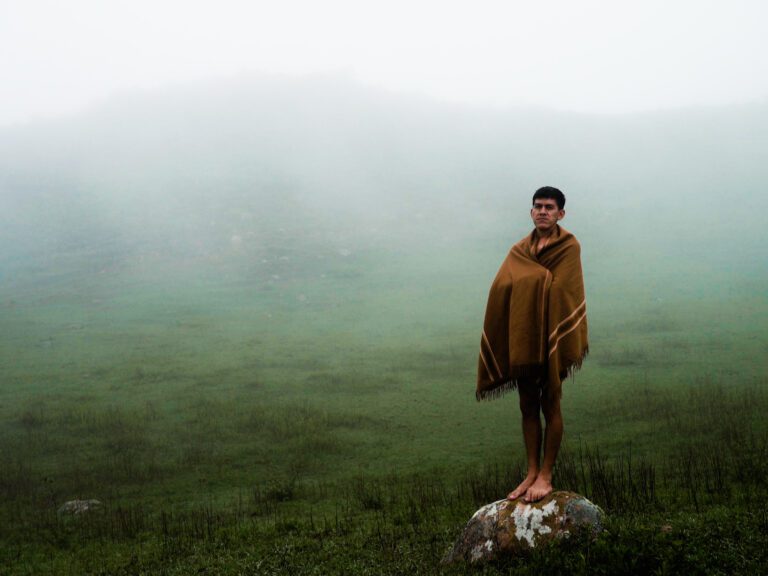
As the audience files into the theatre, a sharp, persistent bell cuts through the room. Off to the side of the stage, Tiziano Cruz crouches in a colourful poncho, waiting. No grand entrance—just presence. A stillness settles. He begins to ring the bell, slowly, deliberately, calling in a flock of sheep across the Andean mountains of his youth. With Wayqeycuna, Cruz doesn’t seek applause—he demands witness. This solo work, part of his autobiographical trilogy, marks a return to his Indigenous community in northern Argentina, where personal memory becomes collective ritual.

“You probably came to see the guy in the colourful clothing. Consume me,” he states, confronting the audience with the gaze they brought with them. Then he speaks of his village, living beside a lithium mine, caught between beauty and exploitation. “I live in a world of white power,” he says, slipping deliberately into a white jumpsuit. Traditional melodies blend with haunting synths and a tender a cappella duet with a village boy, shaping a sonic world that’s both sorrowful and whimsical.

The stage, divided by sheer curtains and bathed in shifting projections of mountains and sea, transforms into both sanctuary and confessional. Cruz doesn’t move like an actor—he inhabits the space as a witness, channeling generational trauma, ancestral strength, and the lingering stain of colonial violence. “The customs officer still views me as a danger, and I wear colourful linens,” he says, voice steady. Through poetic language and striking visual cues, Cruz builds a heartbreaking, fiercely symbolic journey—one where nothing is ornamental, and everything has menaing. Every image in Wayqeycuna carries weight: the recurring wolves as a metaphor for capitalism, the bread and poncho as loaded symbols of both cultural pride and pain.
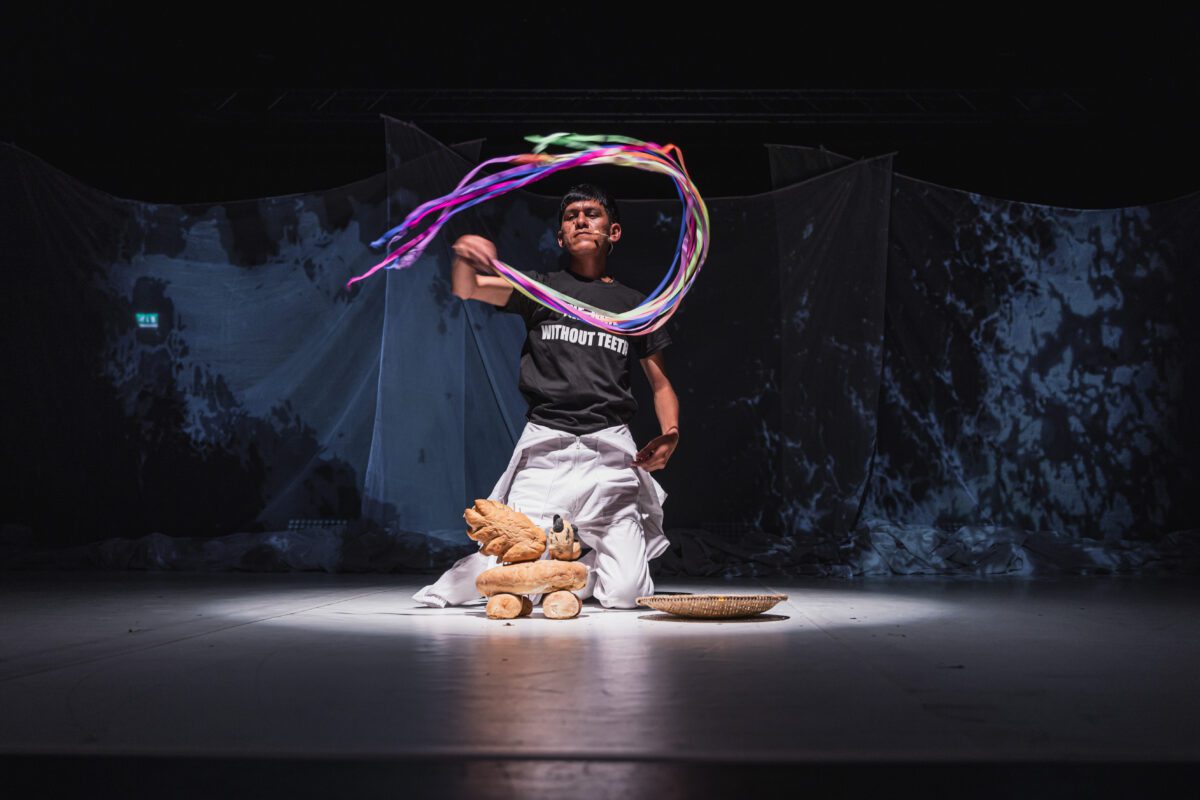
Wayqeycuna / Akseli Muraja

Cruz avoids spectacle entirely. He summons the Andes with vivid language, revives childhood games through precise gestures, and lays bare systemic oppression with a tense, deliberate stillness. One moment, he soothes with memories of village festivals; the next, he hurls the audience into harsh scenes of poverty, exclusion, missing teeth, and a village engulfed in flames—whether metaphor or memory, the wound is real.

Wayqeycuna—“my brothers” in Quechua—isn’t just a title; it’s a call. A quiet yet urgent invocation for collective memory and solidarity. Midway through, Cruz lifts his phone and snaps a photo of the crowd. It’s a small breach of theatre etiquette, but it hits hard, reversing the gaze, shattering the illusion of passive spectatorship, and implicating us in the frame of oppression. Simply by existing, Wayqeycuna becomes political art—less something to watch, more something to endure.

Latest 360 Content

mary in the junkyard – Role Model Hermit

mary in the junkyard – Role Model Hermit

Présence autochtone 2026 | We talk about the Programming with the Director

Présence autochtone 2026 | We talk about the Programming with the Director

Concerts aux Îles du Bic | Samaqani Cocahq Gives Voice to Wolastoq Traditions

Concerts aux Îles du Bic | Samaqani Cocahq Gives Voice to Wolastoq Traditions

Yard Act – You’re Gonna Need A Little Music

Yard Act – You’re Gonna Need A Little Music

Concerts aux Îles du Bic | Pierre-Luc Lecours and the Ensemble Modulaire: Between Sound, Image, and the Moment

Concerts aux Îles du Bic | Pierre-Luc Lecours and the Ensemble Modulaire: Between Sound, Image, and the Moment

Charli xcx – Music, Fashion, Film

Charli xcx – Music, Fashion, Film

Concerts aux Îles du Bic | Andrea Stewart: “We’re always creating”

Concerts aux Îles du Bic | Andrea Stewart: “We’re always creating”

Lanaudière 2026 | Saskia Giorgini : The Italian Piano

Lanaudière 2026 | Saskia Giorgini : The Italian Piano

Lanaudière 2026 | The Romantic Exaltation of Beethoven to Tchaikovsky: Veronika Eberle Speaks to Us About It

Lanaudière 2026 | The Romantic Exaltation of Beethoven to Tchaikovsky: Veronika Eberle Speaks to Us About It

Concerts au Îles du Bic – Boldness and community feeling, on the banks of the Bas-du-Fleuve

Concerts au Îles du Bic – Boldness and community feeling, on the banks of the Bas-du-Fleuve

Nuits d’Afrique 2026 | Somos Más: A Celebration of Memory, Community, and Resistance

Nuits d’Afrique 2026 | Somos Más: A Celebration of Memory, Community, and Resistance

Steve Lacy – Oh yeah?

Steve Lacy – Oh yeah?

Nuits d’Afrique 2026 | Suraras dos Tapajós: Connecting Us to the Amazon Forest Through Music

Nuits d’Afrique 2026 | Suraras dos Tapajós: Connecting Us to the Amazon Forest Through Music

Réka Csiszér & Radwan Ghazi Moumneh – Le Révélateur

Réka Csiszér & Radwan Ghazi Moumneh – Le Révélateur

Yiddish Glory – The Silenced Songs of World War II

Yiddish Glory – The Silenced Songs of World War II

Lanaudière 2026 | Explosion of colours and emotions thanks to Payare, Weilerstein, Ortiz, and Shostakovich

Lanaudière 2026 | Explosion of colours and emotions thanks to Payare, Weilerstein, Ortiz, and Shostakovich

Nuits d’Afrique 2026 | Chris Combette: the groovy elegance of the Guyanese troubadour

Nuits d’Afrique 2026 | Chris Combette: the groovy elegance of the Guyanese troubadour

Nuits d’Afrique 2026 | Forro das Comadres: the Women’s Forro

Nuits d’Afrique 2026 | Forro das Comadres: the Women’s Forro

Kim Petras – Detour

Kim Petras – Detour

Nuits d’Afrique 2026 I African Circus Courtesy of Kalabanté Hits Different

Nuits d’Afrique 2026 I African Circus Courtesy of Kalabanté Hits Different

Nuits d’Afrique 2026 | Azara, the voice of flamenco takes root in Montreal

Nuits d’Afrique 2026 | Azara, the voice of flamenco takes root in Montreal

Subscribe to our newsletter

Inscription
Infolettre

"*" indicates required fields

Type of Suscribers