Those who are familiar with European classical music will understand the significance of the capital letter in the term Romantic from the title. For others, allow me to explain: the term Romantic with a capital letter refers to the period of Romantic music, which encompasses almost the entire 19th century and continues until the early 20th century, even to the present day as this aesthetic continues to be practiced (in great film music, for example). The word does not refer to romantic sensuality (although it is very possible), but rather to personal and individual affirmation, intense expressiveness, and other specific characteristics that make the Romantic Period one of the most emblematic of Western music. Think of Tchaikovsky, think of Brahms, think of the operas of Puccini, Verdi, think of Mahler, think of Rachmaninoff, etc., etc. There you go.
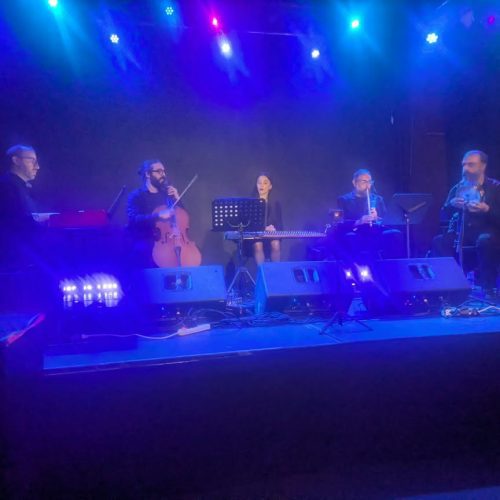
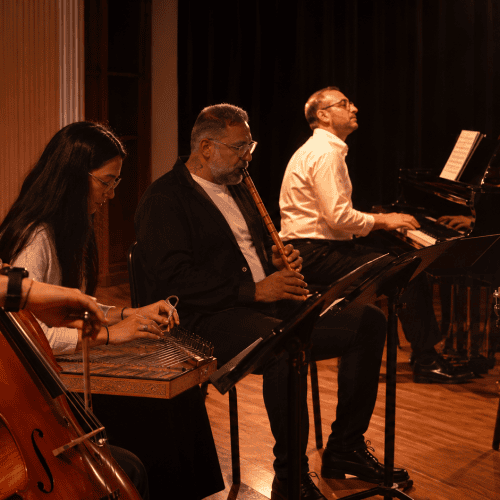
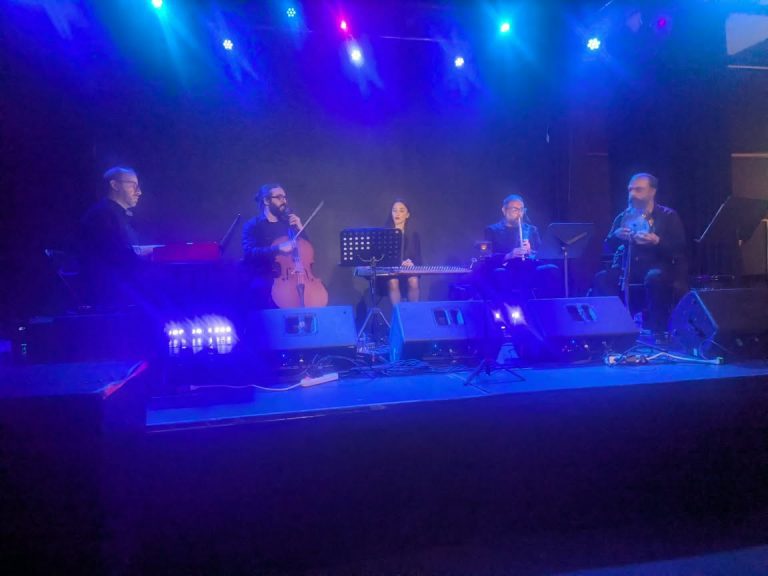
MaqaMorphose offered an atypical chamber quintet reinterpretation (piano, cello, qanun, ney, and percussion) of the iconic music of Mohammed Abdelwahab on Sunday evening, a composer who wrote numerous hits of the great classical Arab song, and who also wrote others for famous divas like Fairouz, Warda, and Oum Kalthoum.
Informed reinterpretations driven by the desire of the two initiators of the project, the qanun player Chaima Gaddour and the cellist Samih Souissi, to create a dialogue between Arab music and Western music, in an aesthetic close to transcultural scholarly classicism. Abdelwahab was well-suited to this initiative because he himself had sometimes drawn from Beethoven and others, out of respect and openness.
READ THE INTERVIEW WITH CHAIMA GADDOUR AND SAMIH SOUISSI
We are first struck by the sound system, powerful. Personally, I find it too much. I would like to hear these instruments in their authentic personality, and their intertwined relationships without constraints. In this forced amplification, we lose the natural grain of the cello. Of the ney too. I enquired: due to the use of a synthetic piano, inevitably amplified, it was necessary to amplify the others. Fine. That said, when you have an acoustic piano, let me know, I would be very pleased to savour the true essence of this lovely chamber music. Samih Souissi also tells me that it’s a work-in-progress. Adjustments still need to be made.
Finally putting this detail aside, I focus on the music itself, of course. The first part focuses on the songs that Abdelwahab himself performed, as well as on his film music and some pieces he called “instrumental symphonies.” Beautiful compositions that sometimes overlay quarter-tone inflections, typical of Arabic music, and Eastern music in general, with the equal temperament imposed by the presence of the piano. Friction that will initially seem strange, sometimes giving the impression that one is playing out of tune, but which requires patience until their resolution.
It is in the second part of the concert that the music truly lifts the Ausang Plaza. MaqaMorphose then offers a series of medleys in tribute to the songs that Abdelwahab created for the most popular female singers of the golden age of Arabic music. Fairouz, Warda, Oum Kalthoum, three names that have crossed into the West, but still resonate as idols in the Arab world. A bit like Billie Holiday, Sarah Vaughan and Ella Fitzgerald in jazz, a Trinity of collective memory. The arrangements are lively, pleasantly polyphonic, and the melodies evoked are often sung in unison by the knowledgeable audience that fills the intimate space of the Ausgang Plaza.
Between the pieces, beautiful texts recited by the various musicians, which set the stage for an enhanced appreciation of what we are about to hear. At the beginning, these pieces were almost all sung. The lyrics, in Arabic music, are central to the artistic approach. Poetry, in general, remains a royal discipline, unlike in the West where it has become marginal. In the end, even if MaqaMorphose wishes to emancipate this music from its subordinate link to the text, the artists cannot completely disregard its omnipresent spirit behind these compositions.
You can feel that the material is coming through. Not only for the nostalgic, but, for my part, for the curious music lover inspired as much by European classical music as by non-European traditions. Abdelwahab here dons the garb of a Romantic imbued with a unique creative personality and filled with beautiful riches.
Beyond this tribute to a well-known composer of the Arab tradition, it is a universe of encounters and transcultural and scholarly dialogues (in a very positive sense, anything but pedantic) that the approach of the group, largely based in Montreal (except for the cellist, based in Paris), reveals.
In the meantime, find a good Yamaha of a high-end classical range (no need to chase after Steinways), and bring us this music in a purely acoustic setting, in a room designed for it, so that we can fully enjoy this stimulating offering.
MaqaMorphose:
Chaima Gaddour, qanun
Samih Souissi, cello
Arden Arapyan, piano
Mohsen Achour, percussion
Aymen Trabelsi, ney