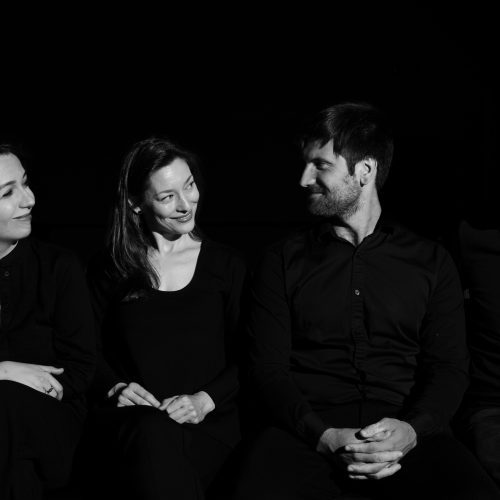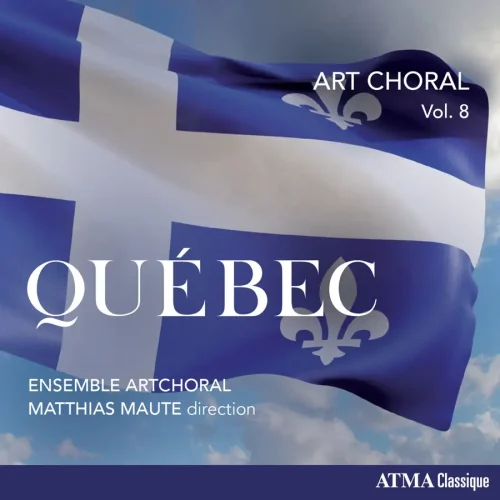
This most recent volume of the grand historical journey of choral singing by the ArtChoral Ensemble, conducted by Matthias Maute, is going forward with this issue dedicated to the repertoire of Quebec.
If the previous volumes showcased difficult choices due to the vast repertoire, this one presents a different kind of challenge: sorting through works from vastly different periods as well as very diverse styles. The period from the 17th to the 19th century is not rich in creations, given the colonial and underdeveloped nature of the Quebec nation then. The 20th century (and the nascent 21st) are more abundant, but there is also the entire folk repertoire, in sometimes quite refined arrangements, which deserves attention. In the end, the chosen program could only be partial and somewhat disjointed, even though Matthias Maute still managed to construct a coherent framework, on which he imposed a significant quality of sound and interpretation.
The menu is therefore divided into three main courses, whose elements intertwine in a non-chronological progression: French polyphonic works from the 17th century, skilfully harmonised folk music, and modern/contemporary music.
The two polyphonic works are by the hand of serious French little masters, Henri Frémart (Missa Verba mea auribus) and Artus-aux-Cousteaux (Missa Grata sum harmonia). These works were part of the collection of sheet music at Petit Séminaire de Québec in the 17th century, thus their inclusion. Maute has chosen composers with the advantage of being obscure, with the result (at least as far as I’m concerned) that one wonders for a moment if they could be natives of here. But no. The three excerpts from each of the masses testify to a very classical, even conservative style for that time, which, let us not forget, saw the first flamboyances of the Baroque emerge! Nothing surprising, but beautiful constructions well rendered by the choristers.
Three folk songs, two of which could be considered essential, illustrate the second stylistic group, all beautifully arranged by Jean-François Daigneault: À la claire fontaine, Quand j’étais chez mon père and Isabeau s’y promène.
Finally, four works from the 20th and 21st centuries complete the (largely insufficient) journey of this program: Maison fermée by William Kraushaar (born in 1989), which evokes the pandemic with a text by Saint-Denys Garneau, Outremont by Matthias Maute (born in 1963), an excerpt from his cycle Noncerto de la Montagne, Ja de longtemps by Maurice-Gaston Du Berger (born in 1987), which is largely inspired by the polyphony of Renaissance counterpoint (with mysterious murmurs in the introduction that illustrate waves on a rock), and finally Jesus erbarme dich by Claude Vivier (1948-1983), by far the most substantial piece of the album, despite its two and a half minutes!
We must acknowledge that Matthias Maute (and the ArtChoral Ensemble) have successfully met the challenge of commenting on four centuries of choral music in Quebec, skilfully bridging the gap between scholarly and popular traditions.