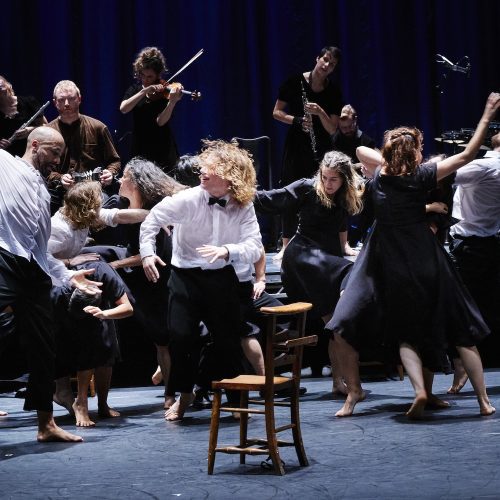
For a long time, I had been dreaming of music that would dare to mix the sounds of modern keyboards (old-school synths, B-3 organ) with the sonic richness of a classical orchestra, in refined, serious compositions. Until Mathieu David Gagnon offered me (but not just me, of course) exactly that with his first iteration of Flore laurentienne.
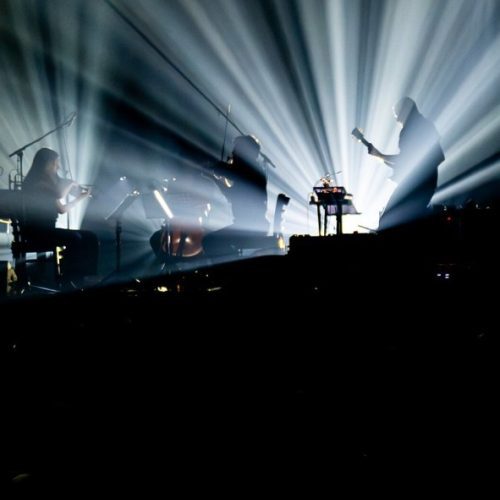
We had some beautiful strings, about fifteen, combined with synthetic/electric keyboards, like the B-3, but also a Minimoog and various commercial Yamahas. The experience had been quite conclusive in impressing almost everyone, from the strict classical purists to the film music enthusiasts and those more inclined towards instrumental pop music. It was in 2019.
Then, in 2022, Volume II was released. We found the same mutual benevolence between “artificial” keyboards and natural strings, with the addition of a clarinet, which brought a touch of sonic individuality.
Now, Volume III arrives and bears witness to a new compositional fabric. You can notice it right from the first track (magnificent Fleurs), from which emanate distinct scents, more “worked” and “composed,” symphonically speaking. Violin solos, minimalist arpeggios, tinkling sounds from the keyboards, pizzicato strings—basically, we are elsewhere in the evolution of composer Mathieu David Gagnon’s confidence.
The young man understood that his acoustic instruments can be more originally expressive thanks to something other than just warm melodies and chords. This is, in truth, only the basic level of the possibilities of a classical orchestra. There are also textures, colours, dynamics of contrasting nuances, etc. And this Volume III reflects an acquisition of maturity that is expressed through the use of all these notions.
The strings glide and create astonishing ripples (Petit matin), a harp brings a refreshing, airy pointillism (Le temps). The keyboards are less dominant, more interwoven in the acoustic fabric, but they have their moments of Reichian glory (exciting Régate) and ambient pose (Fleuve VIII).
And to those who fear a betrayal of the romantic and contemplative soul of the first two volumes, Gendron responds with emotionally powerful and orchestrally sumptuous pages (Fleuve VII).
The final track, (À travers les) Chablis, far from leaving us with an easy and reassuring conclusion, rather opens a door to another possible world of Flore. Against a backdrop of seemingly free percussion, without precise rhythm or pulse, the keyboards appear and gradually swell into an increasingly insistent sound tide, through which the entire acoustic orchestra finally emerges in a powerful climax, which resolves and disappears into the night.
The Flore Laurentienne trilogy ends here, in a very beautiful success, with a farewell that feels more like a goodbye.
Flore laurentienne is in the midst of a European tour as these lines are being written, but the Quebec soundtrack will return to the province with a grand concert on June 26, 2026, during the Montreal International Jazz Festival. Next, it will be Ottawa (on the 27th), Petite-Vallée on the 30th, and later in the fall, Otterburn Park and Sherbrooke. Other dates may be added. Check the artist’s website.