Additional Information
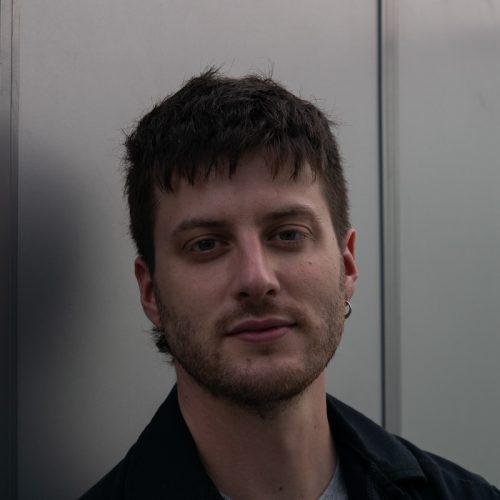
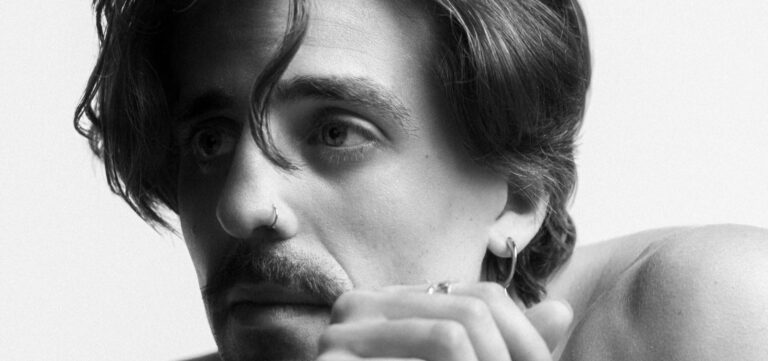
Presented this Monday, March 23 at 7:30 p.m. at Chapelle Saint-Louis – Le Saint-Jean-Baptiste, Battements brings together three emerging artists from the world of creative music. PAN M 360 has chosen to introduce them one by one before the concert; we continue with Emmanuel Jacob Lacopo and his two works on the program: Home and I Never Want To See That Day.
“Home, for classical guitar, electronics, and voice, is an intimate work that explores vulnerability through musical form and an experimental sound design inspired by the rock and pop musical background of composer-performer Emmanuel Lacopo. I Never Want To See That Day is a large-scale chamber work for electric guitar, electronics, strings, tenor saxophone, and drums. Inspired by Godspeed You! Black Emperor and Julius Eastman, it builds evolving textures and lyrical melodies with a live-processed guitar that shapes the ensemble.”
PAN M 360: Remind us who you are, your training, how you came to composition, and what you have created so far.
Emmanuel Jacob Lacopo: I am a guitarist and composer based in Montreal. I started playing guitar at the age of six with the help of my brother and brother-in-law, and my first musical influences came from listening to and playing in rock and metal bands during my teenage years. Even before I really understood the instrument, I was already writing music; composition has therefore always been a natural part of my relationship with music from the very beginning.
When I discovered the classical guitar, I immediately fell in love with the instrument and decided to pursue music seriously. However, during my studies I began to feel creatively limited by the traditional expectations surrounding the guitar, and for a time I even considered moving away from it.
A turning point came when I received a full scholarship to pursue a master’s degree at Yale University. My teacher Ben Verdery encouraged me to reconnect with my musical roots and to explore the instrument more freely, especially by writing my own music. I also had the opportunity to attend composition classes, which greatly broadened my understanding of sound and musical form.
I then returned to Montreal to undertake a doctorate in music with Steven Cowan at McGill University. My doctoral research explored new possibilities for classical music in the 21st century by combining classical guitar with alternate tunings, electronics, and contemporary production techniques.
Since then, several of my works have been published by Productions d’Oz, I have received new commissions, and I continue to develop projects that blur the boundaries between composition and performance. This year I will also release a new album, Dreamscapes & Our Modern Contradictions, with Watch That Ends the Night Records. I was also selected for the Pôle Relève cohort with Le Vivier with my ten-musician ensemble project Il Buio, which will allow me to develop and present my music on its largest scale so far.
PAN M 360 : Home is described as “an intimate work that explores vulnerability through musical form.” How does this translate through the guitar and the electronic approach? How does your rock/pop background contribute to the piece? Could you give us some elements regarding its structure and performance?
Emmanuel Jacob Lacopo: Home is a piece that pushed me further outside my comfort zone than anything I had written before. It combines guitar, electronics, improvisation, and voice—elements I had always wanted to explore but had never fully integrated into a single work. While preparing the piece, I even began taking voice lessons so that the voice could become an organic part of the musical language rather than just an added element.
The piece moves between several worlds: moments of written guitar drawing on the virtuosity of the classical tradition, sections that leave room for improvisation with electronics, and passages where the voice appears in a way closer to what one might hear in a band context. In many ways, it reflects the musical environments in which I grew up, where playing music with friends often meant freely experimenting with sound, pedals, and textures.
My background in rock and pop is especially present in the electronic setup and the use of pedals. The piece incorporates looping and layered textures that evolve in real time, creating small indeterminate “micro-loops” that change according to how the pedals are manipulated during performance. This type of sonic environment is common in ambient or post-rock music, and I was interested in bringing that sensibility into a composed work for classical guitar.
Structurally, the piece alternates between more fragile, intimate moments and broader sonic landscapes created by electronics. This contrast between vulnerability and expansion is central to the idea of the work: the guitar and voice remain very exposed at times, while the electronics allow the sound to unfold and create a more immersive atmosphere around them.
PAN M 360 : For I Never Want To See That Day, what is the connection between the post-rock of GY!BE and the approach of the late African-American composer Julius Eastman (1940–1990) in this context?
Emmanuel Jacob Lacopo: Never Want To See That Day is probably my most ambitious composition project to date. One of my initial goals was to create a vast, almost anthemic sonic landscape inspired by the music of Godspeed You! Black Emperor. Their music often builds emotional intensity through long structures and gradual accumulations of sound. I was interested in translating this approach into an ensemble context by combining the iconic duo of distorted electric guitar and drums with classical strings and a saxophone, creating a sonic world that is both orchestral and rooted in the language of post-rock.
The second major influence comes from the work of Julius Eastman. In 2023 I released an album reimagining his music for guitar, and while preparing my arrangement of Gay Guerrilla, I spent a lot of time studying his compositional language. Eastman’s idea of “organic music,” where musical ideas gradually appear, transform, and disappear without clear boundaries, strongly influenced my approach to form in this piece.
In I Never Want To See That Day, much of the music unfolds through a continuous rhythmic propulsion built on repeated quarter-note and eighth-note patterns, while different instrumental ideas gradually accumulate and dissolve. Some elements are also left open to the performers, allowing the structure to remain fluid. In this sense, the piece sits at the intersection of these two influences: the slow, cumulative energy of post-rock and Eastman’s organic approach to musical form.
PAN M 360 : Why this octet instrumentation? What role will electronics play? Are you working with post-rock-style saturation in this context, somewhat like Godspeed does? What are the challenges of collective interpretation as well as individual performance?
Emmanuel Jacob Lacopo: My goal with this instrumentation was to create a massive sound. Lately I’ve been very drawn to the timbre and power of multiple cellos, so having three of them in the ensemble became a key element of the piece’s sonic identity. That depth in the lower register creates a kind of weight and resonance that naturally aligns with the aesthetic I wanted to explore, strongly inspired by post-rock and bands like Godspeed. At the same time, I wanted to merge that sonic universe with the colors and precision of classical chamber music.
Electronics play a central role in this blend. In the ensemble, the guitar is the only instrument using live electronics, while the rest remain acoustic, creating an interesting contrast between the two worlds. The main tool is a pitch-shifting delay that transforms the guitar’s arpeggios and melodic lines into a kind of evolving wall of sound, acting as a harmonic and textural background on which the other instruments can interact.
One of the main challenges in performing the piece is the collective energy. The music needs to feel cathartic and driven by momentum—somewhat like a post-rock concert—rather than rigid or mechanically precise. Of course, the ensemble must remain synchronized, but the interpretation depends on maintaining a sense of propulsion and intensity, something the drums help sustain.
Balancing the ensemble is also a constant challenge, especially with such dense textures. Ultimately, a successful performance depends on the musicians listening closely to one another and on how they shape the sound together so that the piece feels unified and immersive.