Dylan Robinson is a member of the Skwah First Nation and an associate professor at the University of British Columbia School of Music. His creative work and research focus on Indigenous activism and the arts. He is part of a movement that advocates for Indigenous people to break free from tradition by embracing contemporary music and the arts.
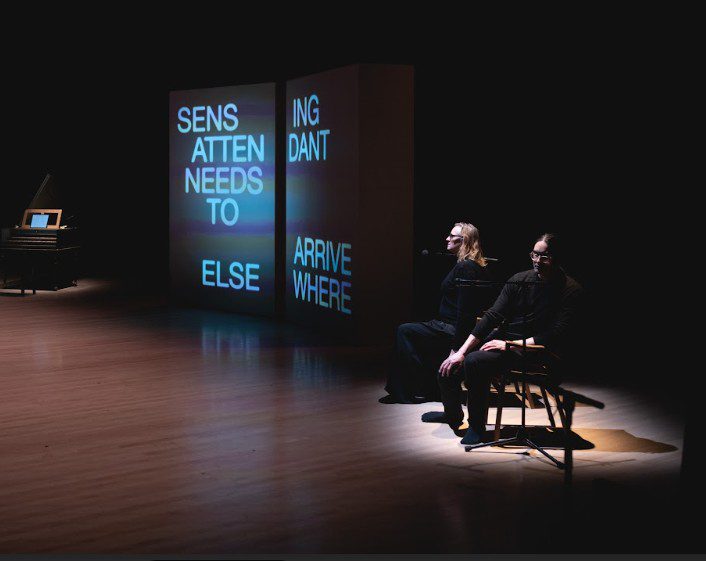
“Sxelxéles te tl’etla’axel” is a performance that combines visuals, choreography, and music to “define a new performance space inspired by Indigenous (xwélmexw) values of relationship and gathering protocols,” according to the program for La Semaine du Neuf.
I’ll be honest with you: as a music journalist, I’m completely out of my element in the world of contemporary music, and this performance isn’t going to help me feel any more at home there. I would have much preferred to cover the Bozzini Quartet or the Quasar Saxophone Quartet, which are more explicitly focused on music.
For here, the music is minimalist in every sense of the word: a piano, a harpsichord, and a viola, played only sporadically. The pieces were composed by Anna Höstman and Linda Catlin Smith, including the very minimalist yet lovely “Brocade” for piano and harpsichord.
On stage, there are also two screens displaying text or images, as well as three chairs on which the three performers take turns sitting; they also play instruments and read us stories, all of which begin with “once upon a time.”
In these narratives and on-screen texts, the idea of a transition between two worlds seems to emerge—of corridors to traverse, of taking the other with you. Of wounds, of resistance, of complicated paths. Water is also frequently mentioned. We hear a very beautiful text about a color that seems to possess emotions. There are also two parallel stories that offer different perspectives on life.
Here’s my take on it. Yours might have been different. What should we take away from this very slow performance, where the choreography basically consists of having the performers walk around? I’m not sure. At the end of the performance, the applause was polite. The woman sitting next to me, who is well-known in the contemporary music scene, seemed very ambivalent in her assessment.
But we left wondering. Maybe that was the point…
Photo Credit: Philippe Latour