Additional Information
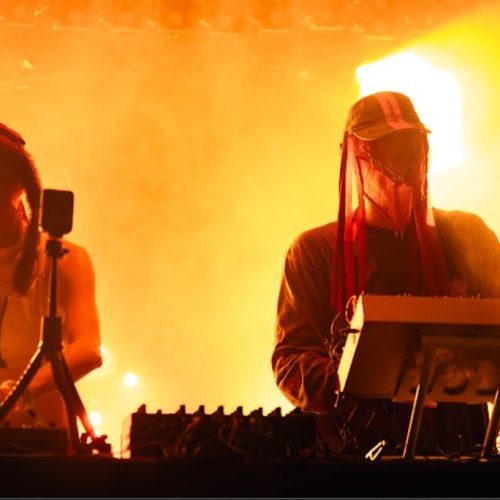
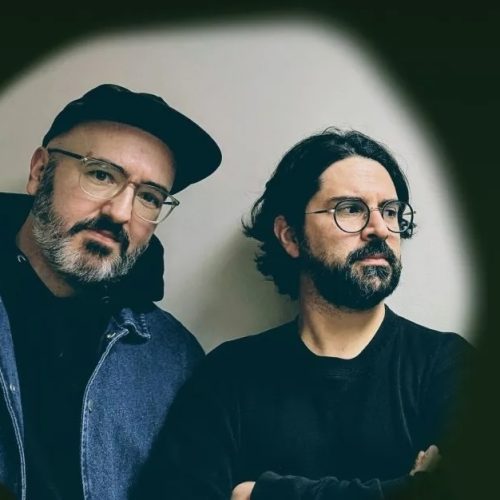
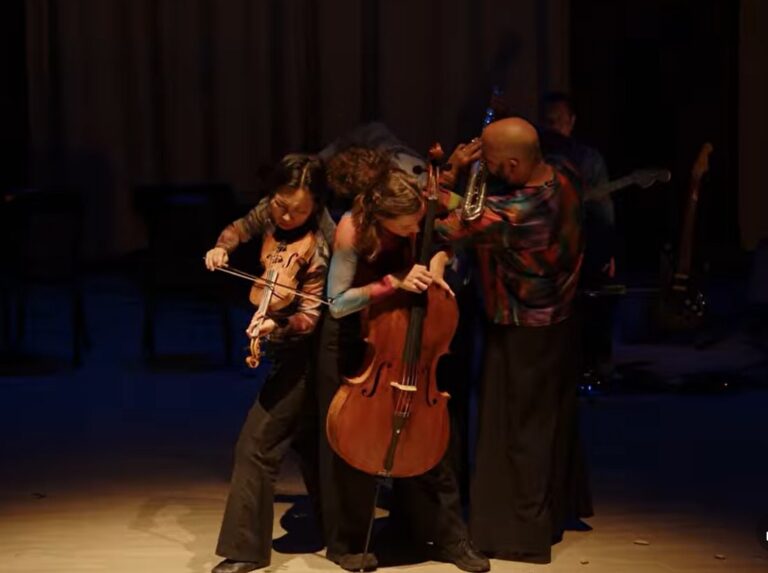
From Strasbourg, the collective Lovemusic will perform the project Protest of the physical for the first time in Montréal. From this encounter between bodily movement and music, PAN M 360 speaks with members of the collective, Finbar Hosie, Adam Starkie, and Emiliano Gavito. The aim of this conversation is not only to discuss the ensemble itself and provide an overview of the Montréal program, but also to reflect on the importance given to movement, a central theme of this Semaine du Neuf.
PAN M 360 : You are visiting Montréal for the first time, so let’s take a moment to introduce the collective to the Montréal audience: what is Lovemusic?
Adam Starkie : Lovemusic is a collective based in Strasbourg, France. We’re about ten musicians. Next year we’ll celebrate our tenth anniversary, so we’re still at the beginning of the adventure. Our goal was to found a collective where perhaps there is less hierarchy than in other ensembles. That means less separation between artistic direction, the musicians, administration, and so on—so that everyone really contributes to everything.
Above all, we want to create projects in which each musician has the possibility to contribute freely to the artistic process.
It’s also about creating processes with composers with a bit less hierarchy involved. We really work collaboratively. We try to take the time to get to know the composers we work with, rather than commissioning pieces one after another and finishing after the performances. We aim to build relationships that last over time.
And of course we also want to offer something meaningful to hear, while paying attention to the visual dimension of what we do—lighting, videos, staging, costumes.
PAN M 360 : What kind of backgrounds do your members generally have?
Adam Starkie : It’s quite mixed, in the sense that we come from all over the place, and everyone now lives where the collective was founded. So we are all expatriates, and that’s something that comes up quite often in conversation.
In terms of education, we all went through the classical conservatory system. But because of our diverse experiences within that system—and also because it connects us—we quickly specialized in musical creation and contemporary performance.
Finbar Hosie : And we also bring very diverse musical backgrounds. Since we all ended up in this rather small world of contemporary creation, some members have done a lot of improvisation, others play different kinds of music. That definitely contributes to the diversity of the ensemble.
PAN M 360 : Let’s talk about your concert presented at Semaine du Neuf, Protest of the physical. This program connects music and movement. Where did this desire to combine these two aspects come from?
Adam Starkie : It’s actually something we had wanted to do for quite a long time. We had experimented with it through different pieces and concert formats where physical gesture often played a role. But this time, for the first time, we decided to work with a choreographer, Anne-Hélène Kotoujanskiy, who created one of the four tableaux of the concert together with the composer Annette Schlünz.
She also helped us tremendously throughout the entire process of the project.
For us it was very important to take a step toward something that is more physically explicit, but also to have someone with an external perspective—someone very sensitive to the fact that we are not dancers, but who still wanted to work in this way. The goal was to find a meeting point between the two.
Finbar Hosie : What’s great about Anne-Hélène is that she doesn’t try to hide this vulnerability that exists very directly in the bodies of musicians. It’s very interesting how she approaches that relationship without creating anything artificial or something that doesn’t resemble us individually.
Adam Starkie : Because when you watch it, it doesn’t feel like musicians trying to dance. That’s not the idea. The movement was created for and with us. We spent a lot of time together doing workshops.
Emiliano Gavito : Yes, and it also comes from the need to express that as musicians we are also performers. We are not just there to produce sound—we produce sound using our bodies.
What does it physically produce in us to use our bodies to make music? Historically, the musician’s body was something people tried to erase. The musician’s body is considered less important than the dancer’s or the actor’s body, for example. But we are still a presence on stage. We are producing sound, but our body has a presence and it communicates something.
You don’t only listen to a concert—you watch a concert.
PAN M 360 : Let’s go through the program of the evening to give the audience an idea of what they will see at the concert on Thursday.
Annette Schlünz, Anne-Hélène Kotoujansky — In die Ferne, dem Berg zu, 2025, for flute, clarinet, violin, cello, electric guitar and gestures — création
Adam Starkie : Annette Schlünz wrote the music, while Anne-Hélène Kotoujanskiy created the movement. They really worked as a duo, because we wanted to avoid something that happens quite often: adding gestures to music that already exists, or the other way around.
The goal was to create both elements in parallel, which required a lot of time working together.
Finbar Hosie : It’s a piece about loss—the heaviness of loss. There are moments where stones appear on stage, manipulated by the musicians. They create a sense of gravity, something tactile, but they also produce sound.
It reflects how the two artists worked together. As Adam said, we didn’t want music first and choreography afterward. They continuously shared their ideas and work in progress, and we were present throughout the process doing workshops with them.
That’s what makes it interesting: the two aspects are intrinsically linked.
Adam Starkie : The stones play an important role. All the gestures revolve around them. Their meaning remains somewhat ambiguous: we try to push them away, but then we start searching for them again after losing them.
At one point there are lines of stones that trace a path or a thought. The whole action revolves around this idea. It’s never completely clear what this loss represents or what exactly we are trying to remove or recover, but those ideas are strongly present.
Nik Bohnenberger — hands, drum—three bones, 2025, for flute, clarinet, violin, cello, electric guitar, electronics and video — création
Adam Starkie : The project was premiered at Rainy Days, a festival at the Philharmonie de Luxembourg. The Philharmonie asked if we would be open to selecting another composer with them to add a new work to the program.
So there was a call for Luxembourg-based composers, and Nik won the selection.
We gave him a fairly specific brief, because the project already had a clear structure. But he decided to shift the physical action toward the audience.
We were very excited about that idea, because it changes the energy in the room. The experience is no longer passive. At one point in the piece, the audience must perform actions in order to listen to it.
There is a video in which Nik himself demonstrates different gestures that filter the sound.
Finbar Hosie : He explores everything you can do with your ears—blocking sound, filtering sound. There are also very pointillistic moments where the rhythm of the audience’s gestures interacts with the rhythms played by the musicians, who are spatialized throughout the hall.
This opens the space between audience and musicians. The boundary between receiving sound and producing sound disappears.
So you feel completely immersed inside the sound.
It’s also very funny for us on stage to watch the audience performing the gestures together.
Bethany Younge — Seed, 2025, for flute, clarinet, violin, cello, electric guitar —création
Adam Starkie : Bethany Younge is a composer we had wanted to work with for a long time. We had already performed some of her pieces, and this project gave us the opportunity to collaborate more deeply.
She came to Strasbourg last summer and we spent a week experimenting together.
Her pieces involve a lot of gestures and physical actions. I would say this is the funniest piece in the program.
It’s quite strange. The starting idea is the physical relationship musicians have with their instruments.
In the piece we rarely play our actual instruments, but they are always present—almost like ghosts. Sometimes we play them briefly, then place them on the floor as if in a ritual.
At one point in the middle we play them properly, but the music becomes completely unhinged and mechanical, as if it’s malfunctioning.
Finbar Hosie : It’s almost cliché, but in a good way. It creates something almost ironic. It questions the relationship musicians have with their instruments.
Does the instrument control the musician? Or the opposite?
There is always a power relationship between the two.
Helmut Oehring — [iɱˈfɛrno] (extrait de : MAPPA) Contrapasso I — V (à Wladimir Poutine/Sergej Lawrow), 2022, for bass flute, bass clarinet, cello, electric guitar and tape
Adam Starkie : This is a piece we commissioned a few years ago and have performed in several different contexts.
Helmut Oehring is a composer who was born to two deaf parents. Sign language was his first language.
In the project MAPPA, we alternate between playing and signing. The signs are specific to his own language system. They are inspired by sign language, but he deliberately distorts them slightly, which creates another layer of meaning.
The result is quite ambiguous—but it’s also an extremely powerful piece, and physically very demanding to perform.
Programme
- Annette Schlunz, Anne-Hélène Kotoujansky: In die Ferne, dem Berg zu , 2025 (commande de lovemusic) pour flûte, clarinette, violon, violoncelle, guitare électrique et gestes – création
- Nik Bohnenberger: hands, drum – three bones , 2025 (commande de la Philharmonie de Luxembourg pour lovemusic) pour flûte, clarinette, violon, violoncelle, guitare électrique, électronique et vidéo – création
- Bethany Younge: Seed , 2025 (commande de lovemusic) pour flûte, clarinette, violon, violoncelle, guitare électrique – création
- Helmut Oehring: [iɱˈfɛrno] (extrait de : MAPPA) Contrapasso I – V (à Wladimir Poutine / Sergej Lawrow) , 2022 (commande de lovemusic et le festival klangwerkstatt – Berlin) pour flûte basse, clarinette basse, violoncelle, guitare électrique et bande – création
Artistes
- lovemusicEmiliano Gavito (flûte)Adam Starkie (clarinette)Emily Yabe (violon)Céline Papion (violoncelle)Christian Lozano Sedano (guitare électrique)Finbar Hosie (électronique)