By way of introduction, a bit of history. It is well known that Ludwig van Beethoven had a certain sympathy for the French Revolution. The most convincing example is his Third Symphony, the Eroica, originally dedicated to Napoleon Bonaparte—a dedication he famously scratched out when he learned that Napoleon had crowned himself emperor.
What Matthias Maute explained to us on Friday at the Maison symphonique de Montréal was that Beethoven incorporated patriotic popular songs into his Fifth Symphony—songs that were heard during the capture of Maximilien Robespierre, the jurist who played a central role in the Reign of Terror and whose criminal tribunal sent thousands of opponents to the guillotine, among them the famous victim Marie Antoinette. At the time, we did not yet realize that this information would open up a completely unexpected listening perspective.
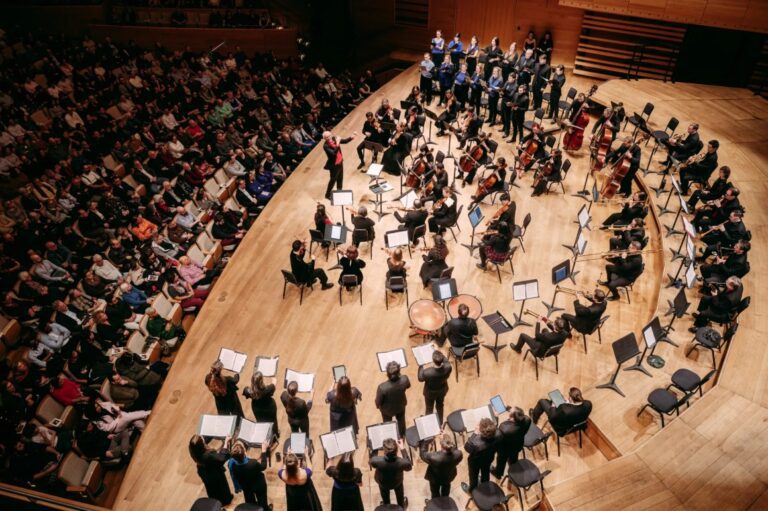
After an incisive first movement (and a somewhat hastily delivered Ave Verum Corpus by Wolfgang Amadeus Mozart as an introduction), Ensemble Caprice offered us a lyrical second movement. One can debate Beethoven’s tempo markings endlessly, but the pace here was less Andante con moto than an emphasis on the phrasing of the winds, while keeping the cellos comfortable in their rapid passages. The placement of the woodwinds at the back of the stage on raised platforms proved particularly effective, leaving the brass on the floor level. The balance was perfect, with the lower strings positioned just to the left.
Remembering the historical context introduced earlier, the horn call at the beginning of the third movement took on an entirely different meaning. Instead of merely recalling the famous motif of the first movement—often described as “fate knocking at the door”—it sounded more like a call to celebration. The third movement then becomes a preparation for the jubilant finale, carried by excited strings.
After the intermission came the Mass in C minor, the “Great Mass” by Wolfgang Amadeus Mozart, performed in its original—and therefore incomplete—version. The jewel of the evening? The two soprano soloists, Janelle Lucyk and Myriam Leblanc, who truly gave back to Mozart what belongs to Mozart. This Mass contains some of the most beautiful solo lines in his sacred repertoire, and what they sang on Friday evening was not merely a succession of notes but real musical phrases and dialogues—between themselves and the orchestra—culminating in the four-part cadence (soprano, clarinet, oboe, and bassoon) of the Et incarnatus est, a masterpiece of musical intimacy.
Tenor Emmanuel Hassler performed admirably as a replacement for Philippe Gagné, who was ill, while bass William Kraushaar was solid in his single intervention. One hopes to hear him again in a concert where he will have more opportunities to shine. As for the choir, it was excellent; the division into two choirs created a fine balance among the voices and with the orchestra. At no point was it overshadowed by the ensemble.