Additional Information
Next Saturday evening, March 7, one of the highlights of the Semaine du Neuf will be presented at the Studio-Théâtre de l’Édifice Wilder: the multidisciplinary performance Hide to Show by the Flemish Belgian ensemble Ensemble Nadar, conceived by German composer Michael Biel. The work explores hyperreality, solitude, visibility, and synchronicity in the digital age.
Hide to Show, literally “to hide in order to reveal,” is an artistic reflection that illustrates how we synchronize with other human beings while simultaneously concealing ourselves. It also evokes our behaviour on social media and our use of avatars to better hide ourselves in order to express ourselves without restraint.
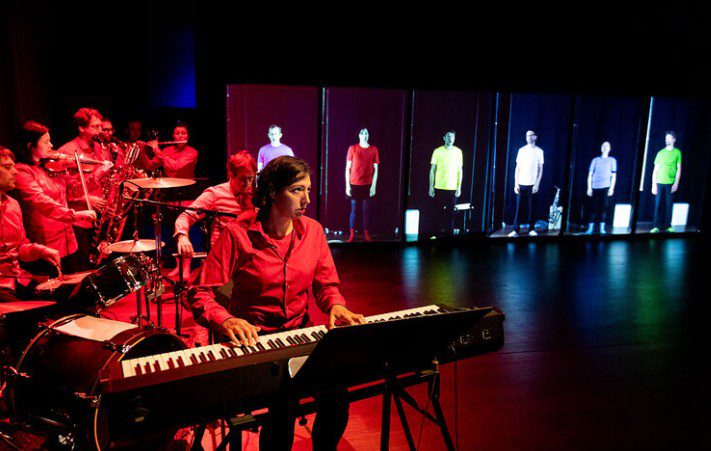
In the performance, eight musicians are filmed in real time—from backstage preparation to the moment they step onto the stage. A subtle interplay gradually takes shape, altering the audience’s perception of what is actually being performed live before them and what is not. A metaphor for our era, Hide to Show is explained here by Pieter Matthynssens, artistic director of Ensemble Nadar.
PAN M 360 : The artistic direction of the Semaine du Neuf presented your program Hide to Show as a major highlight—if not the highlight—of this year’s festival.
Pieter Matthynssens : I didn’t realize he had emphasized our program to that extent, and I’m very happy to hear it! We actually met him about two years ago in Strasbourg, I believe. He told me he had been very impressed by this work, which I would describe as a “stage composition.” We are very excited about the idea of presenting our work in Quebec. We will be performing at least three dates—we wanted to present at least three performances in Quebec (in Saguenay and Gatineau), partly for ecological footprint reasons.
PAN M 360 : This work was created by German composer Michael Beil. Can you remind us of the process behind it?
Pieter Matthynssens : The piece was conceived during the COVID lockdown. We had to postpone its performance, which ultimately turned out to be beneficial because it gave us time to study and refine the work. Its premiere eventually took place in 2021.
PAN M 360 : And Nadar is a Flemish Belgian ensemble?
Pieter Matthynssens : Absolutely. We are all Flemish and funded by the Flemish government. I’m based in Sint-Niklaas, in northern Belgium.
PAN M 360 : Let’s talk about gesture, movement, costumes, and scenography as part of the sonic material. Could you elaborate?
Pieter Matthynssens : Hide to Show is what I like to call a “stage composition” by Michael Beil. Throughout his career, he has worked extensively with live video. For this piece, he considered all aspects of the performance. He composed all the notes and sounds, but he also designed the entire video programming. Cameras are placed on stage to film and record the action in real time.
Additionally, he designed the set and costumes. The stage is divided into six compartments where the musicians perform, isolated from each other. Artists can also be separated from the audience by Venetian blinds, which double as projection screens when closed. Musicians are projected on these screens, making it impossible to tell whether the performance is live or pre-recorded. Michael Beil creates a virtuosic interplay between the performers and the video recordings, so much so that you can no longer distinguish what is really being played in front of you.
PAN M 360 : So it’s a dialogue between scenography, costume, movement, and performance. You are the ensemble’s cellist, but there’s also flute, clarinet, saxophone, percussion, violin, keyboards… and electronics?
Pieter Matthynssens : Yes, most of the time. The electronics come from a pre-produced tape. Michael Beil drew on the sound material of Hatsune Miku, the Japanese virtual singer who became famous performing as a holographic projection. Her “Leek Dance” went viral on YouTube, inspiring countless fan imitations. This dance became a starting point for Beil’s electronic work, which anime fans will recognize in subtle references. The performance also nods to the 1990s, American pop (including the Beach Boys), and the Belgian acid scene. Beil conceived this piece before the ’90s revival trend.
PAN M 360 : Why the isolation compartments on stage?
Pieter Matthynssens : In a way, it’s a very “COVID piece,” because we were all isolated. It reflects the virtual ways of rehearsing during the pandemic, which became a creative method here.
PAN M 360 : How do you see the relationship with the performers as actors? What are the interpretive challenges?
Pieter Matthynssens : We manage because we’ve worked with Michael Beil for a long time, since 2012. He had composed a 10-minute piece and thought, “This is the limit of what I can ask of a musician.” We said, “Really? We can do more!” Then he wrote a 30-minute piece, and we replied, “OK, we can reach the next level.” Finally, he said, “Now I’ll truly compose everything I can imagine with a performer,” and created a 70-minute work.
PAN M 360 : There are limits to human ability, though?
Pieter Matthynssens : The most important thing in Beil’s work is that we remain musicians. Yes, we perform gestures as actors, but these gestures are always connected to the music. We execute them in real time without feeling fake. The gestures become musical and are part of a precise vocabulary, like the musical material itself.
We achieve a very high degree of precision. Every movement is captured by cameras; mistakes appear in the recording, so we must be extremely accurate. The interpretive challenge lies in simultaneously combining musical performance with physical gesture. For example, I may play one measure, then pause, move, dance, and return to my instrument, sometimes singing in unison elsewhere.
PAN M 360 : So it’s difficult to perform all that?
Pieter Matthynssens : Yes, it may seem easy at first, but it’s complex, chromatic music, exploring microtones and shifting keys. For 70 minutes, our brains function like computers processing multiple data streams. We perform entirely from memory, without a score. After many performances, we now play flawlessly; the piece has become part of us, and muscle memory ensures an accurate interpretation.
PAN M 360 : Program notes say the piece explores hyperreality, solitude, and synchronicity with unseen humans who are observed or choose to become invisible.
Pieter Matthynssens : The core idea is exposure versus concealment. Knowing how to behave when the camera is on—or off—even though, in the end, it’s impossible. Michael Beil asks us to act as if we were at home.
PAN M 360 : Why? What is the work’s central meaning? Or is that question irrelevant?
Pieter Matthynssens : You’d have to ask the composer! Personally, I see the tension between live performance and recorded performance. Concert promoters always ask for videos of our shows. But the magic disappears when you watch only a recording. Being there, you realize the cameras have significance. The audience tries to discern the “real” live performance from the recordings. Michael Beil asks the question: to what extent can we manage the fake?