Additional Information
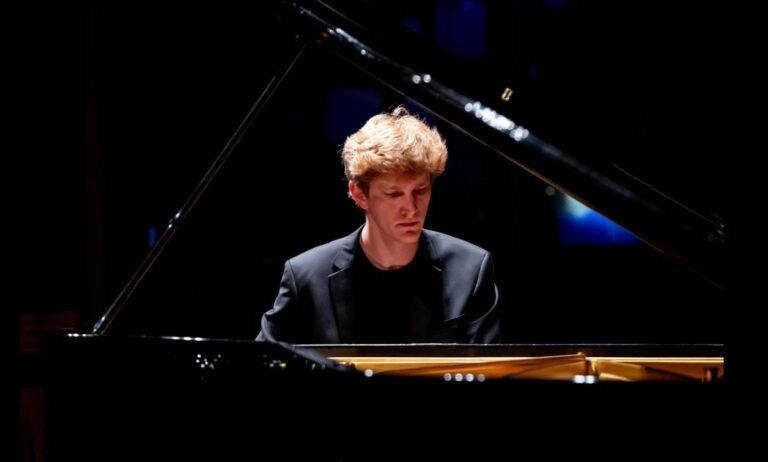
This Sunday, February 22, at 4 p.m., in the Pierre-Mercure Hall, the first Carte Blanche concert presented by Pro-Musica will feature Alberta pianist Jan Lisiecki. Preceded by a talk led by Maurice Rhéaume, the program explores two themes: first, the theme of the 2026 season, “The Great Romantics,” and second, a collection of 14 dances composed by Romantic and modern composers. This program was conceived and performed by Lisiecki himself, who joined us in Calgary to explain its intricacies.
PAN M 360: We’ve known about your career for a long time, even though you’re barely 30. As a child, you were already well-known as early as 2010! How would you summarize your long progression? Artistically and professionally?
Jan Lisiecki : I was very lucky because I started playing at a very young age.
PAN M 360: That said, we also know that it is difficult or even dangerous for a virtuoso to endure all this pressure from the gifted child.
Jan Lisiecki :I think I’d forgotten about those issues. I tried instead to stay true to myself, to keep learning from others, to receive advice, to listen. In that sense, I was very lucky because even though I started performing at a very young age, I was able to experience working with the best musicians on Earth, to share with them. And when you keep your eyes wide open, it really allows you to create something new while remaining true to yourself. That’s how I saw my own evolution.
PAN M 360: So you had to find your own fuel and feed it, didn’t you?
Jan Lisiecki : In many ways, I’ve stayed the same. I taught a very young person to discover themselves, to try to figure out who they were. I think that’s very important for any artist who has to perform at a concert. Because we’re like Olympic athletes. We have to perform when the time comes. There’s the same kind of stress, the same kind of challenge, and also the same pressure on you.
PAN M 360: Of course, the evaluation of an artist and an athlete differs profoundly.
Jan Lisiecki : Yes, absolutely, and I think one of the main differences between a classical performer and an Olympian athlete is that the classical soloist is more on their own. Of course, they have a teacher… and that’s it. You don’t have that incredible support team that a top athlete has. So, you have to rely on yourself, you have to be able to teach yourself, depend on your own resources when you travel…
PAN M 360: Competition does exist, but you are judged according to very different criteria.
Jan Lisiecki : Competitions remain an incredible tool for me; they’ve given me many concert opportunities. It was always my goal to play with an orchestra. I didn’t enter competitions primarily for the grant or the prize, but above all to play with an orchestra. In the end, I think the most interesting aspect is playing for yourself. Of course, you play for your audience, but you play first and foremost for yourself; you have to be convinced of your interpretation. If you’re doing it to please someone else, you’re going astray. I had a teacher who told me that trying to repeat what’s already been done is a caricature, just to impress the audience.
PAN M 360: You then become a crowd pleaser.
Jan Lisiecki : Exactly.
PAN M 360: As a player, where do you see your recent improvements and achievements?
Jan Lisiecki : As a pianist, I’m very happy to discover the repertoire; it’s a virtually limitless source. For example, I recently played a Prokofiev concerto for the first time. It was a bit strange for me, very different from anything I’d done before.
For me, in terms of technique, I think the last big step was when I took lessons with Professor Marc Durand, who was at the time at the Glenn Gould School of Music in Toronto. He really helped me create sounds. I was always focused on the beauty of the sound. I loved pianissimo, but projection wasn’t really my goal.
I didn’t want to play very loudly. Marc Durand then helped me to create something bigger.
PAN M 360: What are your next challenges as a player?
Jan Lisiecki : Honestly, I don’t see anything that scares me. I’ve worked with singers, with violinists, I’ve played with great conductors, symphony orchestras, chamber orchestras, small ensembles… You also have to know how to work with a singer, how to breathe with him or her, discover languages with which you are not completely comfortable.
PAN M 360: Where are you based?
Jan Lisiecki :I’m still in Calgary, but I also have a place in Poland. My 93-year-old grandmother lives there and is still in good health.
PAN M 360: A few words on each of the 14 pieces in the Montreal program? It’s an ambitious and diverse program, from Piazzolla to Martinu.
Jan Lisiecki :
Bohuslav Martinů, 3 Danses tchèques, H. 154 : Martinů is a Czech composer. Very enjoyable. This music always carries you along. You can also hear the folk elements. It’s quite angular, I’d say. Contemporary in that sense, but you can still feel the melodic line. For me, it’s a discovery.
Manuel De Falla, Danza Española N° 2, N° 1: The arrangement of this piece comes from the composer himself or was approved by him. It’s interesting because it has this incredible orchestral sound, this orchestral energy. And at the same time, it’s written for the piano. You can imagine yourself in Spain. That’s the aim of this program: a journey through the world of dance.
Karol Szymanowski, 4 Danses polonaises, M60 : In my previous program, I had a set of Szymanowski pieces that weren’t so difficult to play but very difficult to memorize—so much tonality and complicated harmonies. It didn’t always seem logical to me, but here it’s simpler. It’s a mix of dissonance and consonance, and we have this Polish dance rhythm in the middle of it all. It took me a while to find my own voice in it.
Franz Schubert, 16 Danses allemandes, D. 783 : Schubert isn’t usually associated with dance music, and perhaps that’s not his strength. In fact, these 16 dances are very short pieces and contain a lot of repetition. I was able to read them all quite easily in a day after asking myself, “Oh! What am I going to do with this musically?” Nevertheless, for me, it’s one of the best parts of the program because there’s so much energy, so much elegance, and also so much room for change because of the repetition. I can have fun in concert and spontaneously decide to do something different.
Béla Bartók, Danses folkloriques roumaines, Sz. 56 : Some people are familiar with these dances. However, the arrangements are often not very good, whereas here we have the original version. I think the key here is the transition: when you go from Schubert to Bartók, you stay in the same key, and the dance continues with the same flow. You don’t feel like you’re in a completely different world. And I think that’s why Béla Bartók works so well.
Alberto Ginastera, Danzas Argentinas, Op. 2: Ginastera is a fantastic composer for the piano, and these are three great dances. The first dance has an incredible writing style; the second is, in my opinion, one of the most beautiful pieces on this program, possessing an elegance enriched by adversity—otherwise, it would be too kitschy. And it leads into a dance of the outlaw. Very technical, very demanding… It’s simply amazing! Frédéric Chopin, Grande valse brillante, Op. 18 : Cette valse est absolument magnifiques. Qui plus est, très amusante à jouer. Puisqu’ il y a beaucoup de répétitions dans cette pièce, vous avez beaucoup de flexibilité dans la façon de l’exécuter. C’est l’un des morceaux que j’ai le plus joués.
Johannes Brahms, Valse, Op. 39 N° 3: From Chopin, we move directly to one of the two Brahms waltzes I’ve often played. When I played No. 3 in Vienna earlier this year, I was asked if it was Chopin. It relies on a delicate arrangement in this program and makes a charming interlude for what follows.
Frédéric Chopin, Valses, Op. 34, N° 1 and N° 2 & Johannes Brahms, Valse, Op. 39 N° 15:
These pieces were composed around the same time. Of course, but you don’t really think about Brahms and Chopin. Brahms is darker, more serious, while Chopin was always romantic. However, this contrast also highlights the similarities; the way these pieces are combined is important, beyond just preparing for performance. Both of Chopin’s pieces are wonderful. Chopin brought forward his own vision, his world of colors and emotions that exist only in his music.
Astor Piazzolla, Libertango: I’ve always loved tango, but also the bandoneon, which I’d love to learn to play; it would be quite a challenge. For now, this is as far as I’ve been able to go with this music. This transcription incorporates the piano and the bandoneon, the common lines of the composition and the improvisation, which makes it very technically challenging to play. Astor played it slowly and maintained a magnificent tension with his quartet (piano, bandoneon, double bass, violin). For my part, I continue to experiment with this arrangement by Nikola Kuznetsov. It’s a very dissonant, very energetic, very modern Argentine tango.
Isaac Albéniz, España, Op. 165 n° 2: Tango: Here again in this program we have a contrast between the previous piece and that of Albéniz, with less tension, a kind of elegant dance.
Manuel De Falla, Danse du feu (Ritual Fire Dance) : Once again, we have that great Spanish energy. Super!
Frédéric Chopin, Polonaise en la bémol majeur, Op. 53 : This is a work by Chopin, composed late in his life. I think the audience will appreciate it; it’s a good way to conclude.
PAN M 360: Why did you choose dance as the main theme of this program?
Jan Lisiecki : My last program was based on preludes, the one before that on nocturnes, and now here are the dances. It’s a kind of continuity and also a way to create an original program. Of course, bringing together wonderful works that people love is very good, but it’s also very good and different to conceive such a program, to create an arc, a thematic cohesion.
PAN M 360: In short?
Jan Lisiecki : I sought to achieve an interesting balance, to find a way to show not only the Beethovens, the Chopins, the Mozarts, but also to find these gems and present them to the public.