Additional Information
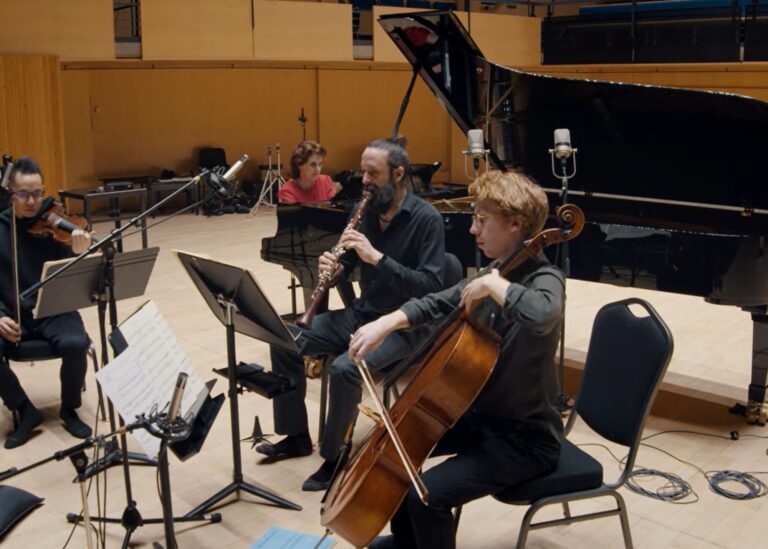
Pianist Louise Bessette is featured on the most recent ATMA Classique release: Olivier Messiaen’s Quartet for the End of Time. In this all-Canadian version, she is joined by cellist Cameron Crozman, violinist Mark Lee (of the Nova Scotia Symphony) and clarinettist Dominic Desautels (of the Hamilton Philharmonic). This resplendent recording (READ MY REVIEW HERE) is a testament to the wonderful communication between the four performers. We can say that “something happened” on the day they first played the piece together in concert. Louise Bessette tells us about this experience and the unusual circumstances that led to the formation of their ensemble.
READ THE REVIEW OF QUARTET FOR THE END OF TIME UNDER THE ATMA CLASSIQUE LABEL, WITH LOUISE BESSETTE, CAMERON CROZMAN, MARK LEE, AND DOMINIC DESAUTELS
PanM360: Hello Louise! Can you explain to us what led to the formation of your quartet for this recording? You, Cameron Crozman, Mark Lee, and Dominic Desautels?
Louise Bessette: It’s a beautiful story. In June 2024, I was invited by Simon Docking, the artistic director of the Scotia Festival of Music in Halifax. His thing is that he doesn’t invite already formed ensembles. When he conceives his programming, he invites solo artists, and he assembles the musicians according to what he thinks will form a beautiful connection. We had talked a few times and he suggested some names. Dominic, I knew him a little, I had already played with him in Toronto. I had done a concerto by Gilles Tremblay and he was in the ensemble.
Cameron, of course, I knew his name, his playing, all that, but we had never met. And then Mark Lee, he lives in Halifax, he’s Associate Concertmaster with the Halifax Orchestra. I didn’t know him at all.
Simon would say to me, “Ah Louise, I can imagine the four of you together, I’m sure you’ll get along well.” The festival took place, we played the Quartet, and it was a very powerful musical moment.
Simon calculated on his watch: it took a full minute of silence before people started applauding at the end.
PanM360: That’s rare…
Louise Bessette: No one wanted to break the spell. We came off stage, we were crying! It was really, really incredible. So, I came back to Montreal and immediately called Michel Ferland, who was still at ATMA Classique at that time. I said, “Michel, I have a project for you.” I told him about it. He said yes. So, there you go.
PanM360: He had a good intuition, this gentleman…
Louise Bessette: Ah yes. We never stop thanking him.
PanM360: We hear this strength, this transcendence, on the album. It was recorded at Domaine Forget in March 2025, some months after Halifax. What was the atmosphere like there?
Louise Bessette: It was about seven, eight months after the Halifax festival. Right away, we felt the same thing. All four of us. We were really, really immersed in the work. At Domaine Forget, we had wonderful conditions with Karl Talbot, the recording director. We worked in exceptional conditions.
PanM360: Remind us of the genesis of this work.
Louise Bessette: It was written during the Second World War, in the Stalag (a prisoner of war camp, different from the extermination camps for Jews – Editor’s note). Then, Olivier Messiaen was there, with other musicians. He used what he had: a clarinettist, a cellist, a violinist, that’s all. He said, well, okay, I’ll do something with that. And that resulted in this Quartet, in 1941.
PanM360: What is the Quartet for the End of Time about? Is it the end of times as in “apocalyptic” or is it something else?
Louise Bessette: Well, yes, of course, it’s the end of time. We know that Messiaen was very, very, very devout and religious. That’s the whole atmosphere. It takes us to the afterlife. When we listen to the last movement, for violin and piano alone, Praise to the immortality of Jesus… I mean, the music is on the verge of being impalpable.
PanM360: These are very original harmonies. Messiaen innovated both rhythmically, harmonically and melodically. He used formulas and techniques that were not common in Western music. From Indian music, among others.
Louise Bessette: Absolutely! In the sixth movement, the Dance of Fury for the Seven Trumpets, we are in unison from beginning to end, with very complex rhythms. But we have a blast playing it!
PanM360: Fool’s Dance, as my grandmother would say. But there are also lots of bird songs in there. How do you feel about these bird songs?
Louise Bessette: Ah, it’s… the whole universe of Messiaen is in this work. His complex rhythm, his chords, his bird songs, the emotion, the very, very fast movements, the extremely slow movements.
PanM360: It’s also a tremendous amount of colour work. You must master your instrument in an exceptional way.
Louise Bessette: Yes, absolutely. And also being attentive. A lot.
PanM360: It’s a bit of the pinnacle of chamber music. Musicians are in absolute listening mode. Listening to themselves and others.
Louise Bessette: Yes, and that’s the pleasure we had working together. Each one adjusted to the other.
PanM360: There is a second layer of meaning in this “end of time.” The end of time, yes, but not just a reference to Religion. A more subtle reference to rhythmic time, very Western, very square. In the Quartet, there is never any “square” time. There is never a true 4-4. There is never a 1-2-3-4, then we start again with a beat. All the phrases are extraordinarily free. There is an impression of wild freedom. But perfectly written.
Louise Bessette: Yes indeed. But I’ve played it often, so I’m starting to “get it in my fingers.”
PanM360: There is one last piece on the program, as a supplement. A Fantasy for violin and piano, from 1933. What can you tell us about it?
Louise Bessette: We were looking for a piece to complement the Quartet. There are very few works of chamber music by Messiaen. I suggested to Marc Lee one of the two pieces for violin and piano by the composer. There is the Theme and Variations from 1932 and there is the Fantasy. Marc preferred the Fantasy. I was very happy because I had never played it. It’s an early work that was published after Messiaen’s death. It’s like a score that was found. We can hear that it’s a youthful work, but at the same time, his entire universe is already there.
PanM360: It’s perhaps a bit, how to say, less assertive.
Louise Bessette: Juvenile.
PanM360: Yes, but a beautiful piece. Honestly, it’s a nice discovery.
Louise Bessette: Allow me, before finishing, to add how proud and very, very moved I am by all the work that has been done, not only with the sound team (thank you Karl Talbot), and then the video team as well, because we have beautiful videos, but also with the entire Atma Classique team.
PanM360: Yes, and the visual is very beautiful too, the one on the cover.
Louise Bessette: Ah yes, that’s fantastic. The photo was sent to us by the Messiaen Memorial in Görlitz, where Stalag VIII-A was located, in which Messiaen was held prisoner. I found this photo by chance on their website. With Atma, we wrote to them and they sent us the photo. They allowed us to use it for the album cover. So, it’s very touching. And in the booklet there is one of Messiaen young, in the 40s, precisely. It was sent to me by the Olivier Messiaen Foundation of the National Library of France. They told me “Go ahead, use it.”
The entire album, the whole product, is a beautiful tribute.