Additional Information
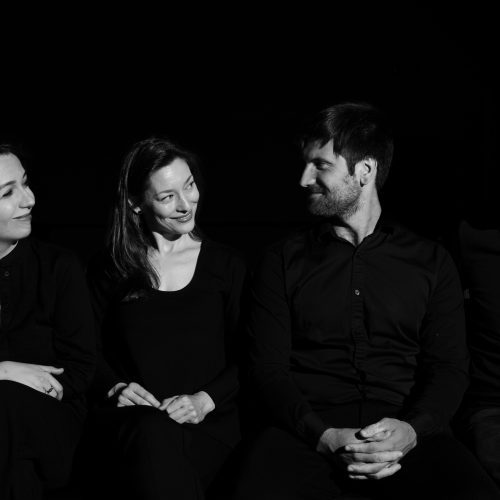
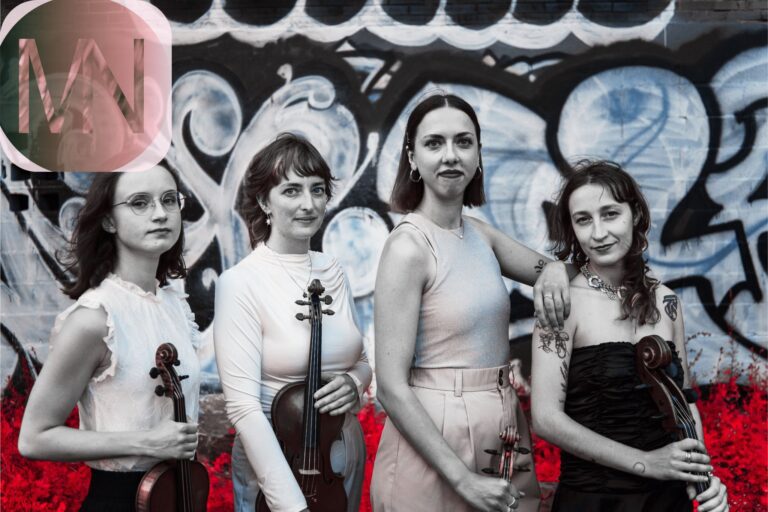
Killing two birds with one stone, that’s a bit of the result of the recent release of a new album of contemporary Quebec music, Chronos, Kaïros, and Aiôn (READ THE REVIEW HERE). It’s a very young string quartet (formed in 2024) that performs three works by as many Montreal composers, moreover on a new label created for the occasion, Mnémosyne. And since everything is somehow linked, one of the composers featured on the album’s program, Louis-Michel Tougas, is also the founder of the label in question. At the end of 2025, this is not only a beautiful gift for the next generation of creative music, but also a promising initiative as the protagonists announce many other projects in 2026. PANM360 wanted to learn more and brought together the composer and label founder Louis-Michel Tougas, as well as the violinist Meggie Lacombe, a member of the Quatuor Mémoire, to talk about all of this.
READ THE REVIEW OF THE ALBUM CHRONOS, KAIROS, AND AIÔN
PANM360: Hello to both of you. Let’s start with the Quartet. What inspired you to form a string quartet, Meggie, and what is your mission?
Meggie Lacombe: Our mission is the creation of contemporary music. In fact, Audréanne (Filion, cello) and I met at the Montreal Conservatory of Music. We were quite interested in contemporary music. Then we had the idea, during our master’s, of maybe one day having a contemporary music quartet. Then, at McGill, I met Bailey (Wantush, violin) who also specialises in contemporary music. After that, we heard about Marilou (Lepage, viola) and we decided to build this project together.
PANM360: It’s music that has been calling out to you for a long time… Why?
Meggie Lacombe: We each have our reasons, of course. As far as I’m concerned, what I really like about contemporary music is the search for different textures, different sounds. The search for music that breaks from tradition, that is quite different. So, it’s both discovering, but also, I would say, deepening my knowledge. It is also music that opens up the possibility of combining with other artistic mediums.
PANM360: Contemporary music is a very broad label. Do you plan to cover all genres, Avant-garde/experimental, Minimalism, Neo-romanticism, etc.?
Meggie Lacombe: For the moment, I think we’re aiming rather broadly. And maybe eventually, who knows, we’ll really discover a style that we really and exclusively want to go for. We would also like to do more experimental concert projects, with scenic elements. We particularly enjoy working with composers from Montreal. That’s an important focus.
PANM360: And it’s a hyper-rich environment, with a diverse and quite numerous next generation. Collectif9, No Hay Banda, Ensemble Éclat, Paramirabo…
Meggie Lacombe: Yes, we know each other well. I feel that we also support each other well among ourselves. No Hay Banda invited us on January 19 to do a double bill with them. Audréanne often plays with them. I think she’s going to play with Paramirabo too. That said, I would say that our difference is that we are a string quartet.
PANM360: There are two major contemporary string quartets located in Montreal, the Bozzini and the Molinari…
Meggie Lacombe: From a personal point of view, when I was young, it was my dream to have a quartet like the Molinari. The Molinari’s violist, Frédéric Lambert, was my teacher at McGill. He was Marilou’s teacher too. So, it happened that we had questions and then we asked them for advice. They have been a great support for us. Then, the Bozzini contacted us to participate in Québec Musque Parallèle 2025 with them.
PANM360: Let’s talk about the album. What led you to choose these works, including one by Louis-Michel?
Meggie Lacombe: The project started with Olivier Saint-Pierre, who wanted to record his piece. There was no talk of the album or recording other pieces yet. After that, the idea came to record Louis-Michel’s piece and Florence’s piece that we were already learning. The idea of the label was part of the projects we had. Finally, we combined everything. I didn’t expect it to happen so quickly, which is pretty awesome.
PANM360: Olivier St-Pierre’s piece is substantial, about 35 minutes. The theme is Time, according to the three concepts in ancient Greece. Tell me about Chronos, Kairos, and Aiôn.
Meggie Lacombe: It was a challenge. Olivier explores the relationship with time, with Chronos the linear time, Kairos the opportune time, like “the right moment,” and Aiôn the cyclical time. We have to play the piece with four metronomes, one for each of us, because we are at different tempos throughout the piece! At certain times, even though we have different tempos, we end up playing together. I think there are four places in the room where that happens. Then we shift again. Then, within the piece itself, there are parts where it is extremely calculated, which we can associate more with Chronos, and parts where we start to improvise a bit harmonically. They are like kinds of improvisation boxes. And there, we associate it with opportunity, Kairos. For Aiôn, the cycle, I see it in the canons that come back and are very carefully timed out.
I would say that one of the great challenges of the piece is that even though we have four different tempos, we still have to manage to play together and create atmospheres together. Then it’s a piece that was physically very demanding as well, because there was no stop. You have to play very slowly. I felt like I was falling into a bit of a meditative trance. I think of the Louanges in Messiaen’s Quartet for the End of Time. It’s almost painful for the body because it’s so slow. There was a bit of that, but it also brings us into a space that I find really interesting as an interpreter.
PANM360: It’s very interesting these insights you bring to the piece. It greatly enhances the listening experience and adds depth to my review of the album. Louis-Michel, you offered a Quartet (No. 2) for this album. What can you tell us about it?
Louis-Michel Tougas: In the piece, I tried to develop elements that I had started in my first Quartet, which was written for the Bozzini Quartet, notably the question of polyrhythm. It’s one of the aspects that made my piece join Olivier’s, the polytemporal treatment, if you will, the stratification of several temporalities. Then in the piece for Bozzini, I had also used independent metronomes, then it was a bit of a challenge to take up this idea of rhythmic stratification again, but without the technological aspect. It’s actually an idea from the late Middle Ages with Ars subtilia, correlation canons, having a motif that appears at a certain speed, then having the same motif in a related pattern that appears at a distinct speed, connected by a specific ratio.
It’s also somewhat of an idea that Olivier took for his quartet, to link the harmonic aspect and then the rhythmic aspect, that is, to have pitch intervals formulated by ratios that are also used in the rhythm. It’s the kind of technique we share in our ways of working. That has been an important aspect, so the kind of constant presentation of stretched, contracted patterns, then always simultaneously, somewhat like we find in some Renaissance or late Middle Ages music, but obviously with a different aesthetic.
That’s one aspect. Another aspect was, let’s say, having an accumulation of different materials. We start the work with one or two types of motifs, themes, if you will, that are in interaction, then at each section, one or two are added and culminate. The accumulation eventually creates this kind of maze of motifs that interact, then are exchanged between the members of the quartet. At certain moments in the piece, the motifs are presented individually, then at other times, they combine and create composite motifs, if you will, among the instrumentalists.
PANM360: In this quartet, what did you find the most difficult to master, Meggie?
Meggie Lacombe: I would say the rhythm. The tempo relationships between the sections, too. There is something very mathematical and it requires great precision. If we miss one of the transitions, we’ll be a bit lost for the rest of the piece. It was also about getting the rhythms just right, which can seem almost random, but are actually very, very calculated.
PANM360: Releasing this album on a brand new label, like two simultaneous births, was that planned from the beginning? It’s still courageous…
Louis-Michel Tougas: It was an incredibly lucky moment, I think. I had been thinking about this for a long time, not necessarily to start a record label or a company, but to have access to high-quality recordings of works that composers produce, particularly in Montreal. One of the issues we’ve been discussing with colleagues for years is that we compose works for six months, eight months, a year, then the work is played once, in a room that is not necessarily ideal, with all sorts of technical issues, etc. That’s the end of the work’s life in too many cases, unfortunately.
The idea of recording just came from that observation. The work cannot be redone many times, because they are expensive projects, they take a lot of time, they involve a lot of people, especially ensemble pieces. At least, if we can have a reference recording of those works, it ensures their longevity.
Through conversations with the composers around me, with the ensembles as well, we said to ourselves, well, it would be nice if we set up some kind of platform where people could propose their works, then we could record that, then give them a life after the creation. Ideally, of course, the works would be replayed, but at least, there would be this possibility of memory. Then it would also be an opportunity for composers, ensembles, to present this work internationally, on the Internet, to have some form of visibility.
When Olivier Saint-Pierre approached me, he said, I would like to record my piece. It would be nice to have a reference recording where it’s not just two mics at the front of the stage, at the creation concert. I did some work, not quite like a pop production job, but still a bit inspired by that. I have a background as a jazz and pop drummer, and also as a recording student at McGill.
I had a bit of production experience beyond just recording a concert like a documentary. That’s something that interested me, bringing that approach to contemporary and classical music, producing this album somewhat like a pop album, meaning we edited, there are sections, there are cuts, there’s mixing, there are eight mics on the string quartet, there are all sorts of subtle treatments. It doesn’t sound like a pop album, obviously.
When you listen to the album, you think it’s a realistic recording. We are definitely in a realistic aesthetic, but there is still that work that has been done to give, let’s say, the best possible version of the piece or one of the best possible versions.
PANM360: For the Mnémosyne label, is it the same mission as the Quatuor Mémoire? The Montreal/Quebec repertoire?
Louis-Michel Tougas: I wouldn’t say that we’re going to limit ourselves to 100% Quebec repertoire. For the moment, let’s say, these are the opportunities that are presenting themselves. There are ensembles I’m talking to who also want to record international pieces.
PANM360: What’s coming up for Mnemosyne?
Louis-Michel Tougas: I don’t know to what extent I can give names, because not everything is signed in the contracts. But I can tell you that there are several young contemporary music ensembles in Montreal that have shown interest in releasing albums. Also, several female composers. So, in 2026, there should be several releases, probably before the summer, depending on whether the conditions allow it. But we hope so.
PANM360: And for the Quatuor Mémoire, Meggie?
Meggie Lacombe: For winter and spring, we have three concerts coming up. On January 19, we have our double bill with No Hay Banda. We’re going to perform a piece by Hannah A. Barnes and Lily Koslow. We’re going to explore something a bit more theatrical with two singers.
On February 20, we’re playing another work by Olivier St-Pierre. It’s a concerto for quartet and orchestra. It’s going to be with the Ensemble Éclat. It’s organised by the SMCQ.
Finally, on April 17, we have a concert at the Chapelle du Bon-Pasteur (located at the Canadian Centre for Architecture until repairs to the original building are completed). It will be a piece by Francis Battah.
PANM360: Thank you both for being present, and especially for creating new opportunities for local classical music. Good luck.