Additional Information
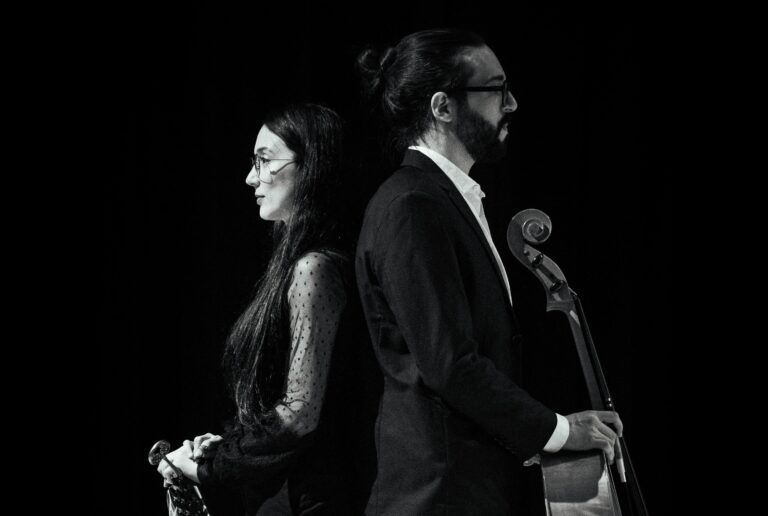
On Tuesday, November 11, the Arab World Festival presents Convergence, a duo performance created by two seasoned instrumentalists: Chaima Gaddour on qanun and Samih Souissi on cello. Both originally from Tunisia, one lives in Montreal and the other in France. They will present a unique and exciting fusion of musical cultures at the Salle Claude Léveillée in Place des Arts. Michel Labrecque interviewed them to learn more.
PANM360: Before we talk about this concert, which will premiere in Montreal, tell me about your personal and musical background, so that we can get to know you better.
Chaima: I’m a newcomer to Quebec, having arrived two and a half years ago. Before that, I lived in Tunisia, my country of origin, and then in Dubai. I started playing music at the age of five, with the qanun, and I graduated in Arabic music. I also studied classical dance at the conservatory for many years and earned a master’s degree in administration and cultural policy. I also taught music at the conservatory and university in Tunisia. I’m very happy to be living in Montreal now.
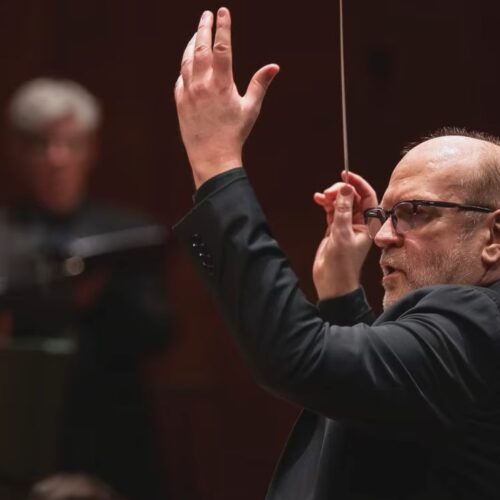
Samih: I was also born in Tunisia, and I started learning music at the age of eight. Now, I’ve lived in France for half my life. I began with the violin, but fairly quickly switched to the cello. I graduated from the conservatory. Professionally, I started a career as a computer engineer, but for the last ten years, music has been the heart of my life. I conduct choirs and also musicals, while continuing to play the cello. And I try to give the cello a sound that incorporates my Arab and Middle Eastern roots. This requires a completely different technique.
PANM360: Before going any further, let’s talk about the qanun, an instrument less well-known in our region. If I’m not mistaken, it’s a stringed instrument created by the Ottomans.
Chaima: The qanun is nicknamed “the king of instruments” in the Eastern world. It is a horizontal harp, so to speak, an instrument with an enormous capacity for harmonic and musical richness.
PANM360: How did this project, Convergence, come about, the first version of which we will see at FMA?
Chaima: We met while touring with a large orchestra, the Boudchart Orchestra, and we tried duets during breaks or after concerts. Or on days without concerts. And we clicked.
Samih: It’s not every day you see a duo like ours: a traditional Arabic plucked string instrument and a cello. I’ve already done concerts with qanun players, but Chaima has a really special musical openness that leads me to explore new worlds.
Chaima: Actually, we’re both very musically curious. We’re interested in music of all genres. We also explore Latin and Asian music.
Samih: Beyond simply juxtaposing repertoires, we try to create stylistic fusions. For example, combining Latin American music with North African and Andalusian music. Or combining Schubert with Mohammad Abdel Wahad, an Egyptian singer and composer. And it all has to flow naturally.
PANM360: Do you also compose?
Chaima: No, not exactly. But to blend these musical styles, you have to rearrange them, sometimes add lines or counterpoint, so in a sense, there’s a compositional process involved. Not to mention the improvisation that’s present in our pieces. There’s also a whole musicological research process to connect all these musical sources.
PANM360: How would you describe the spirit of Convergence, which already intrigues me greatly?
Chaima: It’s a kind of journey in which the Orient travels: it goes to Ireland, to Europe, to Latin America and to Asia. It mixes with all these musical styles.
Samih: This is an opportunity for us to express our multiple identities. We both reject any single identity label. This show is a first, but we hope to repeat it many times around the world. We want to spark a dialogue between different cultures that will make others’ cultures less intimidating. Canada is an excellent place to begin this process.
PANM360: Thank you for this interview! I’d like to add that we’ll also be able to hear you accompanying Fairouz Oudjida for the Legendary Andalusia concert at the Fifth Hall of Place des Arts on November 7th. You also conduct the RCM Orchestra, which stands for Cultural Richness of Montreal.
Chaima: Thank you to the Arab World Festival for giving us these opportunities.