Italians playing Bach’s “dry,” “scholarly,” and “outdated” music, very few 18th-century Latins would have imagined it. Germans themselves would mostly have seen it as a waste of time. Because, you know, Bach was far from being the musical superstar he is today. Time has done its work, fortunately, and what seemed antithetical is now celebrated as a shared heritage in which kinship ties are found.
There is nothing new in knowing that Bach, from the beginning of his career, showed a lot of curiosity and interest in the musical style coming from the peninsula further south. We know he had fun transcribing and arranging scores by Vivaldi and the Marcello brothers (among others). The “Concerto for Four Violins” by the Red Priest (Vivaldi) is actually one of the best examples of this attraction, Bach having transformed it into an exciting Concerto for… four harpsichords.
If at the time the “sharing” was rather one-sided, as the centuries passed, the German Cantor became the musical god we know and today even Italian hedonists recognise his incomparable genius. So, why not place the two worlds side by side (once again, we will say, since this kind of juxtaposition is not new)?
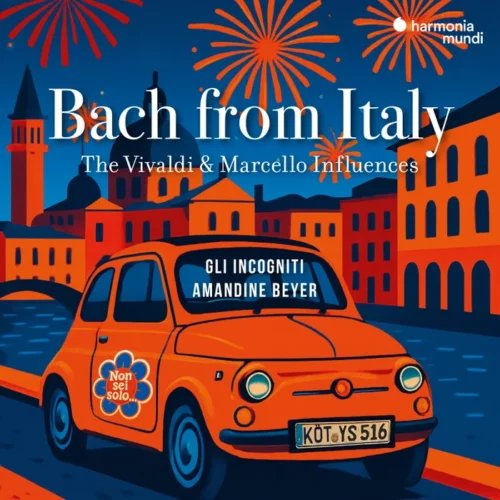
That’s what Amandine Beyer and her ensemble Gli Incogniti do excellently in a program that goes back and forth between Bach and Vivaldi and Marcello. The program includes well-known titles, strung together in a spirit of commentary on the influences the Italians had on the German master. The direct ascendancy is rarely explicitly presented (with the exception of the Concerto for Four Violins/Harpsichords mentioned earlier). Why not, for example, juxtapose Marcello’s Oboe Concerto with Bach’s keyboard version? But that might have been too much of a “rehash,” since we’re already doing the same exercise with the four violins.
The result is that the thematic or melodic links are often tenuous. Where Beyer beautifully recovers is in the interpretive style infused into Bach’s works (the Brandenburg Concertos 3, 4, and 5 and the “Concerto for Two Violins BWV 1043,” among others), in which we feel here the strong bow strokes, there a certain lyrical portamento, elsewhere the singing character of the solos, in short, Italianism in the German’s scores.
Whether you perceive these details, which are quite subtle most of the time, or not, the program of this double album has the distinct advantage of being impeccable in terms of appeal but above all, yes above all, of being delivered with a quite delightful sparkle, and a charm that is matched only by the rigour of the technique.
One cannot remain indifferent in the face of so much beauty that is both radiant and spirited.