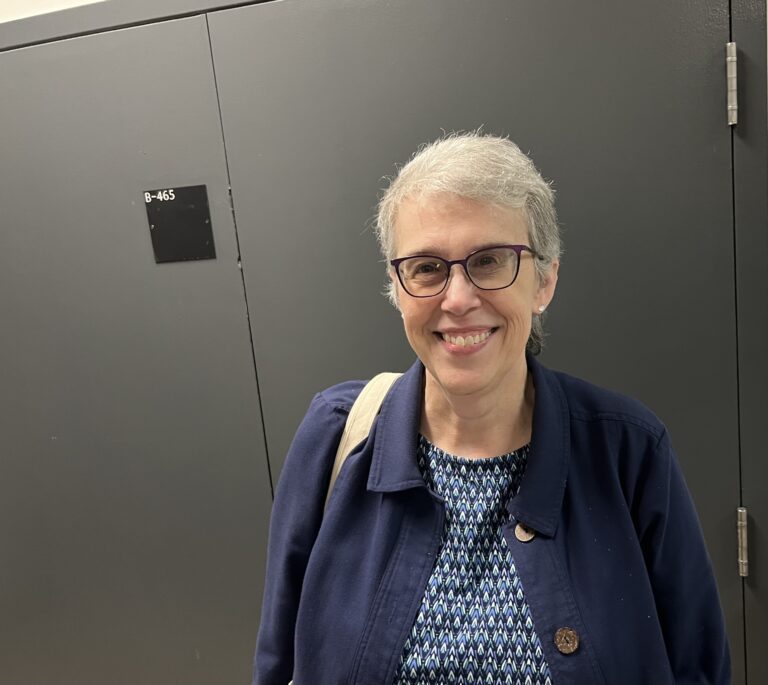
From October 16th to 18th, the Faculty of Music at the Université de Montréal held a conference entitled Music, Diplomacy, Propaganda. Curious by nature and a journalist by profession, our collaborator Michel Labrecque attended. Here, he presents a discussion with Danielle Fosler-Lussier, a musicologist specializing in American musical propaganda during the Cold War.
Chatting with Danielle Fosler-Lussier for thirty minutes just makes you want to dig deeper. This musicologist is a bottomless well of knowledge on the links between music, diplomacy, and propaganda in the United States.
In 1970, in the midst of the Vietnam War and the Cold War, the US State Department sent the rock band Blood Sweat & Tears to tour behind the Iron Curtain. The band played in Poland, Romania, and Yugoslavia (now disbanded in Croatia, Slovenia, etc.).
It was a strange bet: the members of the group were rather anti-war and very critical of the Republican government of Richard Nixon. Nixon hated this kind of group, but the idea was to demonstrate that the United States was a much freer country than its communist adversaries.
Young people in communist countries were thrilled by these concerts. In Romania, the police intervened, and it ended in imprisonment.
“Blood Sweat and Tears suffered greatly from this tour,” Danielle Fosler-Lussier tells us. “American progressives criticized them for collaborating with the government.” In return, the American right didn’t like them either.
The United States used a lot of diplomacy and musical propaganda during the Cold War, between 1945 and 1991. This involves many paradoxes. Jazz musicians like Louis Armstrong and Duke Ellington were sent to several African and European countries to promote American values, while they themselves were victims of rampant segregation in their own countries.
Fosler-Lussier explains that jazz musicians formed a large contingent, but there were also folk and classical musicians. Sometimes, these musicians were very critical of the United States. “At the same time, many musicians understood the totalitarian reality of certain countries and came back more pro-American,” the musicologist learned while writing her book Music in America’s Cold War Diplomacy (University of California Press, 2015).
“The US began these propaganda operations during World War II. It started in Latin America, where Nazi Germany and Fascist Italy were conducting very intense propaganda,” says Fosler-Lussier.
After the war, musical propaganda intensified against the USSR and its satellite countries, particularly through radio stations like Voice of America, which the Trump administration has just dismantled. Did this propaganda diplomacy have a real impact? “If you ask diplomats, they say yes. Through a musical performance, music brings people together and can start a conversation on other topics,” explains Danielle Fosler-Lussier.
Starting in the 1970s, these initiatives slowed down. But since music is one of the United States’ great cultural forces, this propaganda diplomacy continued beyond government efforts. There were exchange programs, particularly in rap and hip-hop, under the Barack Obama and Joe Biden administrations.
Anthony Blinken, Secretary of State under Joe Biden, is a special case: a rock guitarist himself, he inaugurated the Global Music Diplomacy Initiative in 2023 by singing a song by Maddy Waters. In 2024, he also played Rockin’ in the Free World, by Canadian Neil Young, in a Kyiv bar during the Ukrainian war. An idea that got people talking, but did not meet with unanimous approval.
What emerges from Danielle Fosler-Lussier’s work is a nuanced portrait. Certainly, the United States was making these musical efforts to promote its interests and worldview, but this “propaganda” was diverse and contained critical elements, something that would not have been possible on the Nazi or Soviet side. Or today, one might extrapolate, on the Russian or Chinese side.
For the musicologist, making a difference in propaganda and diplomacy is not easy. “During this conference, we are trying to do this work, but it is really not easy. For some, the word “propaganda” is evil, for others, it means moving ideas, it is more positive.”
And what remains of these musical efforts today, under the Trump administration? Danielle Fosler-Lussier remains cautious, since speaking out as an academic has become much more complicated than it used to be. “As far as I know, nothing is happening, the Voice of America radio station no longer exists, and the US State Department seems to have moved away from the idea of cultural exchange with the rest of the world.”
Danielle Fosler-Lussier has also written a book on Béla Bartok and the Cold War and Music on the Move, about how music crosses borders through the ages, available free from the University of Michigan Press.