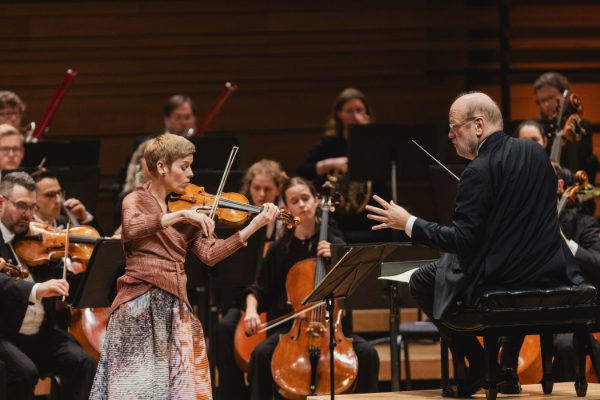
The Montreal Symphony Orchestra welcomed two powerful musical personalities for its October 8 concert. Bernard Labadie, a distinguished specialist in the Baroque and Classical repertoire, and German violinist Isabelle Faust joined forces on stage to present a program showcasing the Viennese classical spirit. And what better way to express this Viennese spirit than with two of the most emblematic composers of this period, both in terms of their energy and stylistic influence, than Joseph Haydn and Ludwig van Beethoven.
The former easily ranks among the most important and influential composers of the 18th century, notably because of his long life – he died at the age of 77 – and his jovial personality. Everything in Haydn’s music is extremely imaginative and lively, even in the most dramatic passages. Several surprises await the listener at the turn of a musical phrase. The latter also left a lasting mark on the world of music with his passion and by being the gateway to Romanticism in the history of music.
To open, the OSM musicians presented Symphony No. 103, subtitled “Timpani Roll,” so named because of the composer’s characteristic presence and entrance. After a thunderous roll, the first movement opens with an Adagio quoting the Gregorian hymn Dies Irae. This thematic material is faithfully reproduced by the composer, who modifies it slightly by inserting dissonant chords and syrupy melodic lines in the strings. The second movement, oscillating between ceremonial and ironic march, exemplifies Haydn’s humorous side. The third movement features sublime exchanges between strings and woodwinds in a light fanfare effect. The symphony’s Finale displays a variety of colors in different materials that evolve toward a climactic ending.
It is particularly in this movement that we can appreciate the characteristics of Haydn’s language, such as the sudden changes in dynamics that run through the movement. Dynamics and affects that Labadie masters with ease and clarity and where he gives the orchestra space to express itself.
Although Beethoven’s name is strongly associated with the Romantic period, the music of the impetuous Bonn musician is expressed in the style of Viennese Classicism. Known for his strong temperament and emotional fervor, which he transposed into music, Beethoven adopts here in his only violin concerto a more optimistic discourse with a light character, but retaining an intensity of line. Endowed with “clarity, audacious depth, and brilliant technique” (San Francisco Classical Voice), Isabelle Faust embraces the contours of the orchestral sound and offers controlled and sonorous dramatic flights. At first hearing the first movement, we were struck by these qualities of the musician, but also by the very technical approach of her interpretation where the expressiveness of the lines, although perfectly executed and proud, seemed cold. It was in the second and third movements—both linked together—that the expression and quality of Faust’s playing captivated us. The lyricism and gentleness of the Larghetto evoked a noble and majestic character, while the final Rondo, with its multiple thematic ideas and interplay of orchestral textures, brought the evening to a luminous close. Aside from the quality of the performance, the other engaging spectacle unfolding before our eyes was the communication, complicity, and pleasure that emanated from the interaction between Faust and Labadie during this performance. Always in contact, responding to intentions, directions, and phrase inflections with a message, the duo brought these works to life. They thus created a space of expression where intimacy and listening pleasures were combined.
Photo Credits : Gabriel Fournier