Additional Information
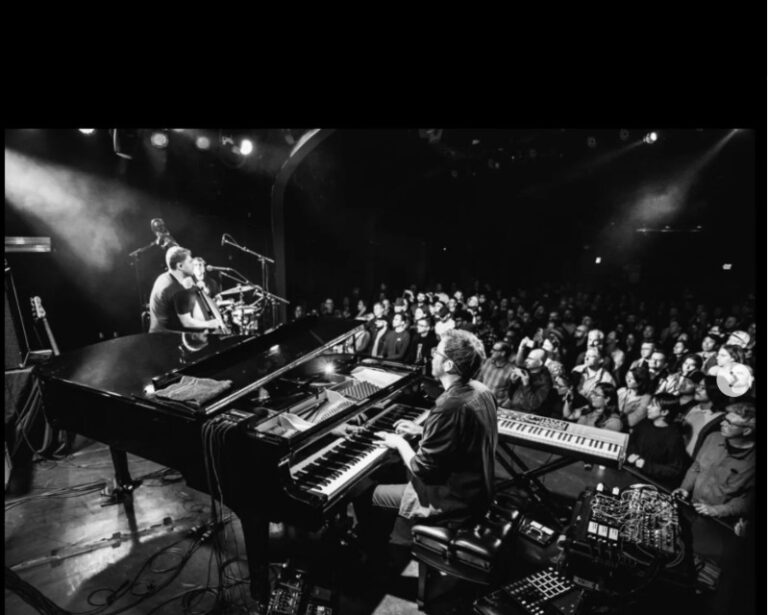
Nick Blacka, playing alongside pianist Chris Illingworth and drummer John Scott, is the bassist for the British trio GoGo Penguin. Since 2012, the Manchester trio has released seven studio albums, two EPs, three live recordings, and was nominated for the Mercury Prize shortlist in 2014.
We’re not really talking about an emerging band on the ice floe of jazz in the grip of climate change, much less a rallying cry for Sidney Crosby’s team!
Over the previous decade, GoGo Penguin had been identified among the leading trios of this new aesthetic, certainly associated with jazz, but also with math rock, prog and cutting-edge electro.
These acoustic trios (or almost) have in common the primacy of collective work, and a more tenuous approach to individual expression. A trend, certainly.
Last June, the album Necessary Fictions was released, and we can well imagine that its material will be the main course of the group’s Quebec and Canadian tour, of which the Palais Montcalm will be an important stop on Thursday, October 16.
And that’s why PAN M 360 was put in touch with Nick Blacka for the following interview:
PAN M 360: Let’s start with your new album, Necessary Fictions. What has been accomplished if we take a chronology of your recording development?
Nick Blacka: V2.0, our second album, was nominated for the Mercury Prize. That’s when we started paying more attention to what we were doing. And then we signed to Blue Note, where we released the albums Man Made Object, A Humdrum Star and GoGo Penguin (of the same name). Two more albums followed on XXIM Records, including our latest album. It’s been a long journey… even though life is short!
PAN M 360: Yes, life goes by very quickly, but it’s a very good purchase to record 9 albums, 9 collections of new songs, and it continues.
Nick Blacka: Like life, isn’t it? You look at a photo of yourself years after it was taken, and you realize you’ve aged. We always say that each of our albums is a snapshot, a Polaroid of who you were at a specific time. So the idea of a new album is to stay true to ourselves, honest and open about who we’ve become.
PAN M 360: There is indeed a danger of finding yourself a prisoner of your image and marking time, as is so often the case in music.
Nick Blacka: Right, so we don’t worry too much about what the outside world thinks of us. We still have to take risks. We want to explore new territories.
PAN M 360: And what are these new territories, in the case that concerns us?
Nick Blacka: We’ve always used a bit of electronics and synthesizers, but I think there’s more of that on the new album. However, for a long time now, using these machines has made us think differently about composition.
PAN M 360: Can we be more specific about some examples? Our readership is also interested in knowing the parameters of your compositions.
Nick Blacka: A good example would be a track on the new album, What We Are and What We’re Meant to Be. The electronic influence is very clear: the very heavy bass comes from a synthesizer. Then we play the acoustic instruments over it, but it’s very close to dance music. Only a few tracks on this album carry these kinds of ideas, I’m also thinking of Naga Ghost.
PAN M 360: The electro influence therefore led you to play it in addition to evoking it acoustically.
Nick Blacka: In the past, we often talked about dance music forms, which we expressed with our acoustic instruments. Now, we sometimes try to use synthesizers, even though bass and drums remain at the heart of what we do.
PAN M 360: Many music lovers who enjoy improvisational music and new hybridizations of jazz and other styles know Gogo Penguin and appreciate your music. Your success is also attributable to the trend you emerged from: small, cohesive jazz ensembles, very rhythmically solid, and less inclined to solos.
Nick Blacka: As you say. But there are times when we improvise, of course, and especially live, things change. There are of course bass, piano, or drum solos, but that’s when it serves the music, rather than every piece.
PAN M 360: And, just before the emergence of your generation, there had been precedents.
Nick Blacka: When I was a teenager, I was influenced by bands like Portishead (trip-hop) or Ronnie Size Reprazent (drum’n’bass). These bands, among others, took samples of double bass or drums, it was really inspiring. And we always come back to it. Personally, I studied jazz at school, I did my jazz degree, I learned about all these different styles, and I became very excited about playing bebop and standards. But there was a point where it was cool to do something else and we stayed true to our interest in new fusions.
PAN M 360: We can still talk about a trend: in the 2010s, we saw several groups of this kind emerge in the UK – Get the Blessing, Neil Cowley Trio, The Comet Is Coming, Sons of Kemet, etc. Now we can see it elsewhere in Europe and also in North America. What’s next?
Nick Blacka: I think the way we play and write music is just in tune with the musical culture of our time. We come from that melting pot. In Manchester, our city, there are so many different styles of music and the local scene is so vibrant, there’s bound to be some crossovers happening. Because it’s so hard to fund it, a DIY attitude has developed. So we’re always putting things together.
The two things that always stand out about Manchester are football and music. For a city not as big as London, Manchester has contributed a lot musically. Maybe because it rains a lot… I don’t know. Everyone wants to make music here!
PAN M 360: One thing is certain, teamwork trumps all when it comes to you!
Nick Blacka: It’s more than just teamwork, it’s also the joy of being in a band. Everyone has their strength, everyone contributes, it’s not done alone. That’s the beauty of it all. Each of us could have solo careers, but we prefer to stay within this band. It’s great, this feeling of musicians working together. That’s what we feel, anyway.
PAN M 360: Whatever form it may take!
Nick Blacka: Yes, we’ve gotten to the point where we don’t worry about whether it’s jazz or something else. We make music, we try to write songs, and we want it to resonate emotionally. That’s our focus.
PAN M 360: How does it work on a daily basis?
Nick Blacka: The music is mostly written by Chris and me, who live in Manchester. We do a lot of development work together. John is in London, and he comes to work with us for intensive work sessions. So we spend a lot of our lives together, we evolve together. These shared lives are definitely reflected in our music.
Yes, yes. If you ask anyone in the world, the two things they’ll say about Manchester are music or football. Those are the two things. For a city that’s not as big as London, the history and heritage of the city and what it’s contributed in terms of music is considerable. Maybe because it rains a lot… I don’t know. Everyone wants to make music here!
PAN M 360: And how can all this stand the test of time?
Nick Blacka: We’re older, we’re in the middle of our lives, but we’re still wondering what’s next. We’re still looking to move forward with authenticity and the desire to communicate something personal, without the challenge of changing everything.