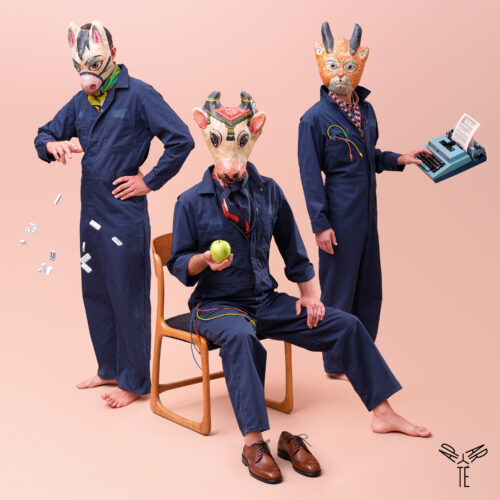
It’s a surprising and unexpected juxtaposition, albeit a logical one in the final analysis, that the Thélème ensemble offers us. All we get is life is a meeting of the music of John Dowland and John Cage, five centuries apart. The thread that links these two major composers? The desire to create a close relationship between the performer and the composition (or even the composer himself).
The Dowland pieces chosen here were intended to be read and performed by performers gathered in a circle, exchanging their portions for an overall communion on the order of intimacy. And then the texts themselves, woven from the thousands of possibilities offered by love relationships or considerations of death, suggest a necessary egalitarian communion, for we are all affected by them, at one time or another.
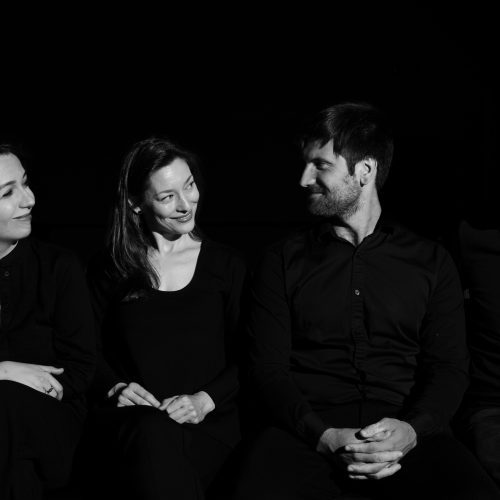
For two voices (tenor-baritone) and lute, Dowland’s jewels are magnified by a concentration and devotion to the fundamental feeling of the subjects and harmonic lines by Thélème, an exceptional Swiss ensemble devoted to early music.
Cage’s pieces come from his Song Books corpus, for solo voice and more or less precise instrumentation. Cage also leaves open the possibility of using ‘the popular hi-fi manner’ to create original effects. Here, in some cases, the famous autotune is used (Cage never envisioned it), abused by pop artists, both the best and, above all, the worst. Proof that a technical gadget overused by an anything-but-creative industry can become a valuable artistic vehicle in the hands of true craftspeople. And that’s what this album is all about. Take a listen to Solo for Voice No. 91 (Song Books), which sounds like something out of an improbable Daft Punk experimental album, stripped of its rhythmic base.
Technological considerations aside, there is the intrinsic value of Cage’s compositions, one of the most original modern artists in recent history. Like the author and poet Francis Ponge, who stripped literary writing to the bone in a quest for the primordial signifier, the word that could replace all the others rendered useless by modern verbiage, Cage too strips musical and sonic space, renders the voice, texts and his own compositional directives as minimal as possible in order to achieve, firstly, an essential expressive purity and, secondly, to allow the performers to participate as fully as he did in the creation of a unique relational experience between the music, its actors and its listeners. ‘’And so: Instead of being a solitary architect organising sounds according to a form destined to never vary, the composer becomes the instigator of an event to which he invites his fellow creatures‘’.
For example, Cage indicates on a score certain notes matched to intervals of time within which they can be played for a duration freely decided by the performer. Thélème takes advantage of this autonomy to create very intimate panoramas whose economy of sound and harmonic texture are reminiscent of their partners 500 years older.
Although he takes up an enormous amount of space in the media comms accompanying the album, Pop star Sting is present for just one track, a highly original revisit of Shape of My Heart. Far from being a linear reworking, pastiched with ‘Renaissance’ effects, the famous song (a melodic and poetic masterpiece) takes on an old-fashioned feel, yes, in the harmonies, but also moves away from it to get closer to Cage and completes its rewriting with some astonishing 80s synthesiser effects. As the final track on the album, this meeting becomes a kind of summary of the programme’s overall aesthetic. Sting’s presence is given with is voice, still beautiful despite being 73. It has to be said that he has always had the intelligence to take care of his instrument and never ‘’push’’ it beyond its natural limits.
The total result is strikingly beautiful, either full and complete, or strange and unfathomable. All we get is life is one of the most inventive albums you’ll hear in a long time.