Country : Ireland / UK Label : Hyperion Genres and styles : Romantic Year : 2023

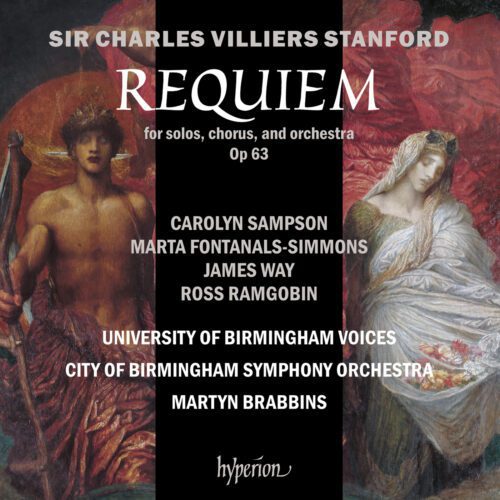
Stanford – Requiem

· by Frédéric Cardin

This Requiem op. 63 by Sir Charles Villiers Stanford (1852-1924) is a rarity on record. There was a pioneering recording on the Marco Polo label (later reissued by Naxos) more than 25 years ago, with Irish forces. A good version, but now largely surpassed by this one, from the very British Birmingham, where, incidentally, the Requiem was first performed in 1897.

Martyn Brabbins and his very fine local forces (the University of Birmingham Voices and the City of Birmingham Symphony Orchestra) have a close affinity with this kind of music, solidly romantic, Brahmsian with a French tendency in certain colour schemes. The orchestra sparkles under Brabbins’ baton and the choir shines. The soloists (Carolyn Sampson, soprano; Marta Fontanals-Simmons, mezzo-soprano; James Way, tenor; Ross Ramgobin, baritone) have character and a fine grasp of the desired discourse, made up of an assertive lyricism but imbued with an undeniable spiritual restraint.

This is important, because the essence of this Catholic mass set to music by the Protestant Stanford is all there: in this amalgam of grandeur and sobriety. The grandeur certainly comes from the Catholic ritual itself (which tends towards excess) and from other requiems composed previously (Mozart, Verdi, Brahms), as well as from Stanford’s lyrical fibre (he wrote no less than 9 operas). The sobriety comes from Stanford’s Protestantism, but also from his experience in writing Anglican hymns. The result is a work written for imposing forces, both vocal and instrumental, but which are used sparingly, with very few ostentatious outbursts, no terrifying explosion of sound like Verdi’s, and plenty of light, a soft, beneficent light. 

Stanford’s writing concentrates on clear themes and melodic lines. He very rarely resorts to massive tutti, and when they do arrive, it is at the end of sustained crescendos that gradually prepare the listener. The Tuba mirum, the Quam olim abrahae promisisti (an energetic fugue) and the Sanctus are the best examples, with the latter radiating seraphim and warmth. Here, a finely balanced opulence rather than a muscular outburst.

Elsewhere, and for the vast majority of the work’s 75 minutes or so, we are treated to tender, measured passages, where the strings gently quiver beneath angelic choirs, leading us into contemplative, celestial considerations. This Requiem never wallows in threatening darkness. It chooses hope and redemption. It emphasises Renewal rather than Damnation. 

Without having the same instrumental poetry, the Stanford Requiem undeniably has certain similarities with Fauré’s Requiem. It should also appeal to lovers of the latter. Propelled by the quality of the performance and the generous, full sound recording, with no loss of detail, this is a wonderful discovery for those who weren’t familiar with it and an absolutely definitive version of this masterpiece.

Latest 360 Content

Opér’actuel becomes a biennial festival: we discuss it with the artistic director Marie-Annick Béliveau

Opér’actuel becomes a biennial festival: we discuss it with the artistic director Marie-Annick Béliveau

Paul Marleyn; Stéphane Lemelin – Tenderness and Tragedy

Paul Marleyn; Stéphane Lemelin – Tenderness and Tragedy

TransQueb – Maelstrom

TransQueb – Maelstrom

Elinor Frey ; Accademia de’ dissonanti – CPE Bach : Cello Concertos

Elinor Frey ; Accademia de’ dissonanti – CPE Bach : Cello Concertos

FME 2026: haha Laughing, An Avant-Garde, Sluggy Surprise

FME 2026: haha Laughing, An Avant-Garde, Sluggy Surprise

haha Laughing All the Way to the Bank

haha Laughing All the Way to the Bank

The Four Seasons of Quebec: Interview with François Dompierre

The Four Seasons of Quebec: Interview with François Dompierre

Colin Stetson : Exploring and reinventing trad landscapes with Brìghde Chaimbeul

Colin Stetson : Exploring and reinventing trad landscapes with Brìghde Chaimbeul

Brìghde Chaimbeul and Colin Stetson – All the light in the world

Brìghde Chaimbeul and Colin Stetson – All the light in the world

FME 2026 I An Ether Afternoon with Worry

FME 2026 I An Ether Afternoon with Worry

FME 2026 I The Sadies and the Horse They Rode In On

FME 2026 I The Sadies and the Horse They Rode In On

FME 2026 I Moiré is Slowcore for Feeble Minds

FME 2026 I Moiré is Slowcore for Feeble Minds

FME 2026 I Double Truck, Double Violence

FME 2026 I Double Truck, Double Violence

FME 2026 I Mek’Dr’Dr Brings Shovels and Whimsical Post-Punk to FME

FME 2026 I Mek’Dr’Dr Brings Shovels and Whimsical Post-Punk to FME

FME 2026 I Hologramme Turns Petit Théâtre Into a Sweaty Discotheque

FME 2026 I Hologramme Turns Petit Théâtre Into a Sweaty Discotheque

FME 2026 I Lou-Adriane Cassidy Turns Main Stage Into Her Own Disco-Funk Coronation

FME 2026 I Lou-Adriane Cassidy Turns Main Stage Into Her Own Disco-Funk Coronation

FME 2026 I Thee Soreheads Are Basement Brain Surgeons

FME 2026 I Thee Soreheads Are Basement Brain Surgeons

FME 2026 I Muhoza Brings Unadulterated Joy

FME 2026 I Muhoza Brings Unadulterated Joy

FME 2026 I BALACLAVA: GOOD EFFECT ON TARGET

FME 2026 I BALACLAVA: GOOD EFFECT ON TARGET

FME 2026 I Corridor, A Psychedelic Indie Rock Ouroboros

FME 2026 I Corridor, A Psychedelic Indie Rock Ouroboros

FME 2026 I Iguana Death Cult Converts the Non-Believers

FME 2026 I Iguana Death Cult Converts the Non-Believers

FME 2026 I Max Baby is an Indie Sleeze Elf

FME 2026 I Max Baby is an Indie Sleeze Elf

FME 2026 | RIZOMAGIC from Bogotá: Tropical Futurism and Cosmic Tuning

FME 2026 | RIZOMAGIC from Bogotá: Tropical Futurism and Cosmic Tuning

FME 2026 I Birds of Prrrey’s Grungey Siren Call

FME 2026 I Birds of Prrrey’s Grungey Siren Call

Subscribe to our newsletter

Inscription
Infolettre

"*" indicates required fields

Type of Suscribers