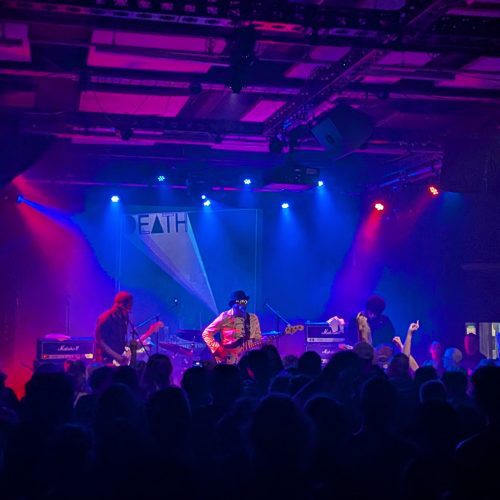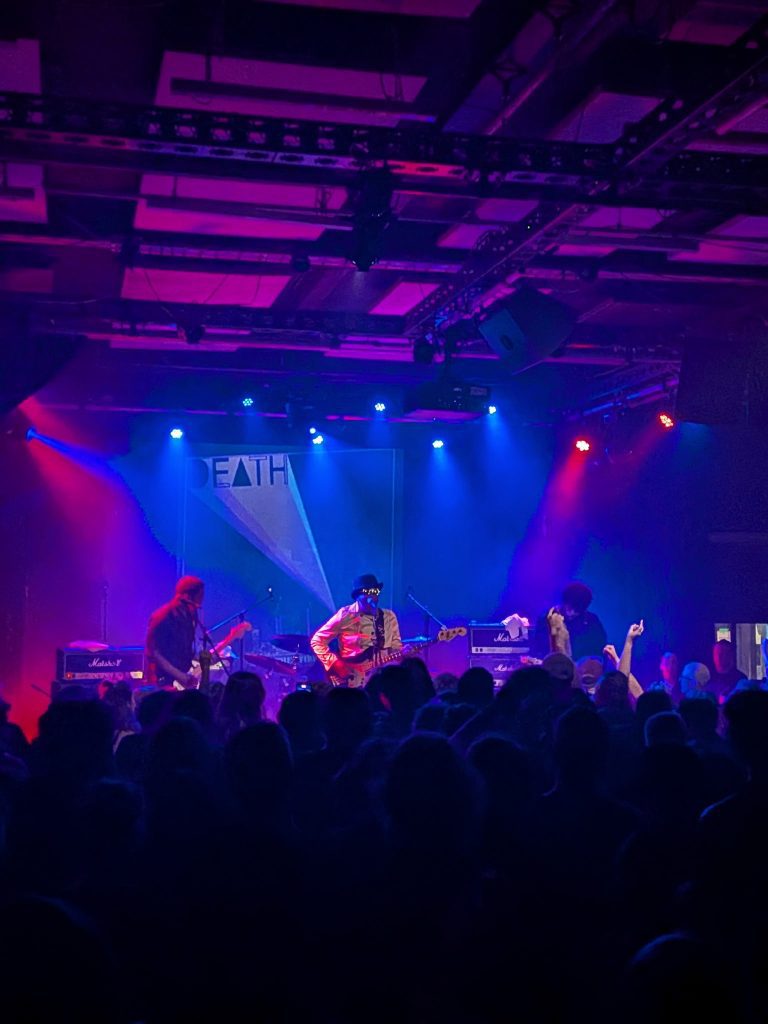
Seeing Bobby Hackney Sr. and the legendary band Death post up on the small Ausgang Plaza Stage brought to mind a tired phrase: Big fish in a small pond. Formed in 1971 and disbanded in ‘77, this three-piece proto-punk act has since enjoyed a resurgence some half a century later, and seeing them in the flesh proved that Death is in no need of resuscitation.
Now’s as good a time as any to admit that I wasn’t well-versed in the ways of Death prior to seeing them live, which made it especially confusing when they opened the set with a smooth, funked-up excerpt from the band’s initial form, “RockFire Funk Express.” They eased through a few bars, transporting me to a simpler time of clean coke, cowprint vests, and copious cigarettes smoked inside.
But it all comes to a screeching halt as Bobby jumps on the mic for a brief history lesson, explaining the band’s origins as a funk outfit, then reintroducing themselves as, and I quote, “DEEEEEEEEEEATH!” before exploding into their all-time hit, “Keep On Knocking.”
Death has always been a family affair, originally composed of brothers Bobby, Dannis, and David Hackney. Today, Bobby continues to hold it down dauntlessly on vocals and bass, his voice a little rougher around the edges, but no less energetic, compelling, or free-flying than on the recordings from ‘75. Likewise, Dannis is still blasting away upstage on the kit, and while I didn’t get a good look at him throughout the set, rest assured that the entire venue felt and heard him loud and clear. Taking up the family mantle on dual (and sometimes duelling) guitars are Bobby’s sons Julian and Urian, whose fearsome prowess and boundless energy, flanking their father, helped add new exigency to Death’s classic catalogue.
Much has been said and debated about Death’s influence, both sharing and receiving as they came up in a time of rock and revolution. While you can certainly hear the oft-made comparisons to Alice Cooper, MC5, Iggy & The Stooges, The Stones, and more, there’s also something different about this group. As someone who experienced them in retrospect, informed by the context of decades of music that they pioneered and arguably helped to shape, it’s impossible to ignore their presence and influence throughout huge swaths of the punk rock tapestry ever since.
Never mind the metamusical discussions, though. At the end of the day, Death lives, and they have more than enough entropy and riotous rage to stand squarely apart from any comparison.