Avant-Garde / expérimental / contemporain / musique contemporaine

Shared listening room with Quasar – saxophone quartet and Trio Zukan

by Frédéric Cardin

A quartet on one side, a trio on the other. Four Montreal-based saxophones (Quasar) there, an accordion, percussion and a txistu from Basque country (Trio Zukan) on opposite. Sorry? A what? A txistu, a traditional Basque flute, played vertically like a recorder. In short, all these people gathered on Thursday evening, September 18, 2025, at the Orange Space of the Wilder in Montreal, in the Quartier des spectacles. Chambre d’écoute (Listening Room), the title of the concert but also of the first piece in the program order, offered five compositions by four composers, three of whom unified the two ensembles. If the title piece, by Chantale Laplante, was interesting, ambient-wise, it was the two works by the Quebecer Émilie Girard-Charest that most impressed your humble chronicler.

Firmly rooted in a well-educated contemporary soundscape, Girard-Charest’s music possesses a quality that too few of her equivalents claim: an attention to stimulating and captivating narrative construction. Atonal, experimental, fragmented, the young artist’s pen is nevertheless attached, at least that’s what I perceived, to the construction and expression of a story. Which one? That’s up to you, but what is certain is that music lovers are taken somewhere, and this is thanks to a generally easily understandable architecture, both for seasoned ears and for the simply curious/bold, without expertise.

In the two scores proposed by the composer, Artefaktuak and Quantum Statistical Zero-Knowledge, it was the first one that made the best impression on me. Written specifically for the Zukan trio, Artefaktuak is made up of two sections with simple and effective textural contrasts, followed by a short and lively conclusion. The first of the sections is built with pointillist sounds that are accentuated by the gestures of the artists on stage. The physical gesture leading to the sound is just as important here as the sound itself. The second part uses rubbed sounds, more sustained over time, like a bow on the vibraphone, for example. Each of the sections is deployed in a dynamic and energetic crescendo leading to its end.

Quantum Statistical Zero-Knowledge is written for the unified quartet and trio, in a tripartite structure of intense-calm-intense where the two outer movements are particularly dense, even saturated to the point of noise, while the central movement provides a desirable dose of soothing. Quantum mechanics, this scientific branch that accounts for the mechanisms existing in the infinitely small, sub-atomic levels, reveals astonishing realities, such as entanglement or the simultaneity of contrary states. If Quantum Statistical Zero-Knowledge does not offer a particularly destabilising incarnation of musical possibilities, it is nevertheless a piece that knows how to maintain the interest of listeners, even the most profane. In itself, it is already a success, especially in the field of very complex music.

The Concerto grosso by Miguel Matamoro is full of colours, just like the compositions of the same type from the Baroque era, while Jalkin by Ramon Lazkano, with quite predictable sound dots and strokes, seemed to me to be the most conformist work of the lot.
Baroque

Montréal Baroque 2025 | 4 seasons: welcome to the 21st century and the climate crisis, Mr. Vivaldi

by Frédéric Cardin

From Vivaldi’s Four Seasons, it seems that all manner of expressive concepts and contemporary symbolism can be drawn. It is indeed the mark of a living masterpiece that so many artists draw on it for multiple meanings, constipated purists be damned.

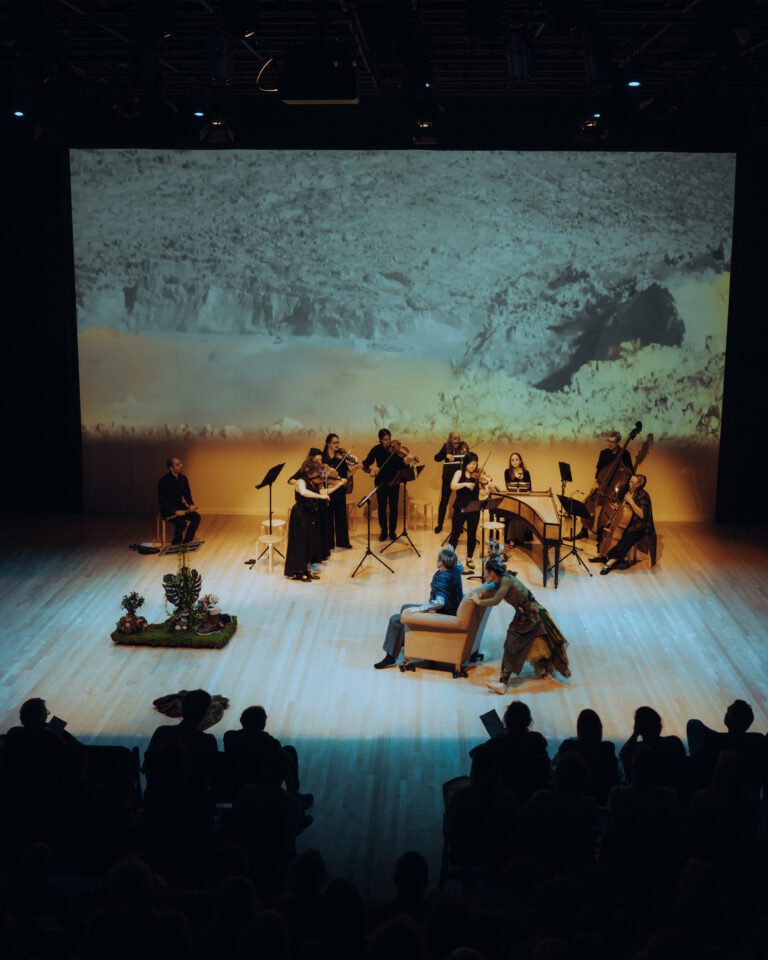
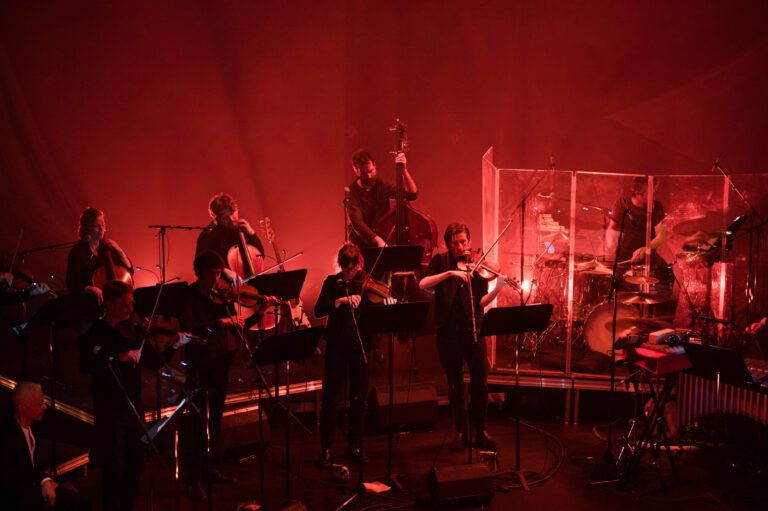
The final concert of the Festival Montréal Baroque 2025 presented a Climatic Crisis-linked modern version of the famous Four Seasons. On stage, in addition to the Pallade Musica ensemble, were characters evoking Nature and the humans who foul it. Between each of the seasons, a composition by Mathias Maute recalled the themes of the Four Seasons, but reworked to underline the current disruption of nature. The four solo recorder scores, often of formidable virtuosity, were impeccably rendered by Vincent Lauzer.

The choreography/staging had the good idea of not abusing the presence of the characters. Indeed, the problem I sometimes see with “collages” of choreography to existing classical music is the lack of ideas to accompany the music all concert-long. Here, the appearances were occasional, though numerous, leaving enough pauses to return to the music alone. The character of Mother Nature was continually present, but often in the background or hidden, like an observer. In short, the balance was right.

As for the music, Pallade Musica’s rough, even violent playing is to be underlined, as they built Seasons characterized by a rare emotional and physical intensity, often deviating from the principle of “beautiful sound” to get to the heart of their incendiary vision. On some notes, accuracy was sometimes lost, and this should not be overlooked completely, but transcending this fact, we were treated to a 21st-century post-punk vision, and an approach that, in truth, is not at all out of keeping with the current climate crisis.

Of course, this kind of attitude can be highly displeasing to self-proclaimed professors of good taste, such as those in a well-known Montreal daily. That’s to be expected. A recent review of the journalist in question drew a comparison with the same Four Seasons presented the same day by the Montreal Chamber Music Festival at the Maison symphonique, with the brilliant Kerson Leong as soloist (link to the article at bottom of the page). There’s no need to put the two versions back to back: their nature is totally different.

Leong is sovereign as soloist throughout (at Pallade Musica, a different soloist was featured in each season). He is one of the most dazzling violinists of his generation. He and his ensemble have indeed built a luminous and perfectly balanced edifice, tonally ideal and technically flawless. Pure, inspiring seasons.

But the underlying argument of this well-known critic is that this is the only way to conceive this masterpiece. Once again, I underline the mediocrity of his argument, as I did previously on another subject (READ THE COMMENT Diversity and inclusion are not punching-bags).

A masterpiece that couldn’t stimulate a variety of interpretations, and precisely the most extreme ones, would be condemned to gather dust. Everyone is free to appreciate or not, of course, but the insinuation that one way is justified and the other not is ridiculous.

Ultimately, these Four Seasons of Climate Crisis offer an original and distinctive commentary on the Vivaldi monument, trading “plastic perfection” for a provocative and memorable symbolic embodiment.

Link to the article mentioned above :

https://www.ledevoir.com/culture/musique/894091/critique-concert-deux-fois-quatre-saisons-cloture-festivals

Chamber Pop / Contemporary

Semaine du Neuf | A lot of chamber groove from collectif9 and Architek Percussions

by Frédéric Cardin

Five contemporary works, as many composers. The common thread? In addition to the words woven by author Kaie Kellough – groove. Indeed, this element so rarely associated with creative music was the central element of the evening of March 15 at the Espace Orange du Wilder in Montreal’s Quartier des Spectacles. As part of the Semaine du Neuf organized by Le Vivier, a show entitled Quelque part, mon jardin / My Backyard, Somewhere was presented, bringing together the creative universes of two of the most original and dynamic ensembles on the Montreal/Canadian scene: collectif9 and its nine strings, and Architek Percussions and its four genial tappers and pickers… To find out much more about the origins of this concept, read the interview conducted by colleague Alain Brunet HERE

Gracieuseté Semaine du Neuf – Le Vivier crédit photo : Philippe latour par Frederic Cardin

The interpretative strategy adopted by the artists is quite original: the five works are cut into various parts, and then mixed together to form a continuous framework lasting around an hour and fifteen minutes. A bit like taking five models of Lego blocks and reassembling them into a single new, entirely coherent construction. 

The evening’s sonic thread was criss-crossed by contrasts between the glitch/syncopated aesthetics of Nicole Lizée, post-minimalist/dissonant of Luna Pearl Woolf, chamber pop of Eliot Britton, almost muzak of Brett Higgins and neo-impressionist/rock of Derek Charke. Kellough’s lyrics sometimes chanted or declaimed by the artist himself, have a spoken word style and are very urban, sometimes pre-recorded and altered, marking the blow and offering a very street colour to the whole concert. 

Quelque part, mon jardin / My Backyard, Somewhere is a contemporary proposition whose topicality is rooted in the blurring it creates between the scholarly contemporary creation and multi-trend pop worlds. Above all, it is an attempt to include the swaying pulse of Black music rather than the metronomically regulated pulse of Minimalism, another stylistic school based on rhythmic affirmation. You may have to pass for lovers of harmonic modernity, or especially the avant-garde, as this is almost totally consonant territory. 

The end result is resolutely contemporary, yet very accessible, even for an audience unfamiliar with creative music. Perhaps even a little too “polished” for some, if a few of the comments I’ve heard are anything to go by?

Be that as it may, and as far as I’m concerned, Quelque part, mon jardin / My Backyard, Somewhere is one of the very good projects by collectif9 and Architek.

Luna Pearl Woolf: But I Digress… (2018) – 19 min

Bret Higgins: among, within, beneath, atop (2018) – 8 min

Derek Charke: the world is itself a cargo carried (2018) – 15 min

Eliot Britton: Backyard Blocks (2018) – 17 min

Nicole Lizée: Folk Noir/Canadiana (2018) – 14 min

expérimental / contemporain / musique contemporaine

Semaine du Neuf | VIVIERMIX // QUASAR + NEM + FIOLÛTRÖNIQ

by Varun Swarup

Hier soir, on nous a servi trois cours de musique numérique, chacun présenté par l’un des ensembles distingués dirigés par Le Vivier. Au cœur de cet événement, deux œuvres mixtes de l’invité d’honneur Pierre Jodlowski et une pièce de Cléo Palacio-Quintin résonnaient dans un mélange éclectique de sons et de récits transdisciplinaires.

Le premier cours a débuté avec « ALÉAS », de la compositrice et interprète elle-même, Cléo Palacio-Quintin à la flûte et son collègue Bernard Falaise à la guitare électrique. Ensemble, ils ont sonorisé en temps réel une projection visuelle ostensiblement d’eau qui coule, dans une invitation à redécouvrir le monde qui nous entoure à travers un prisme déformant de son et de poésie de Thierry Dimanche. Vous pouvez lire notre entretien avec Cléo ici.

André Leroux, l’un des saxophonistes du prestigieux quatuor Quasar, a été à l’honneur lors de la deuxième représentation, dans son interprétation de “Le dernier songe de Samuel Beckett”. Leroux a fait preuve d’une maîtrise considérable dans cette performance qui impliquait des lignes atonales araignées et de nombreuses techniques étendues. Avec son pied, il contrôlait une pédale qui déclencherait une piste d’accompagnement, des paysages sonores banals et effrayants dans cet hommage au dramaturge estimé.

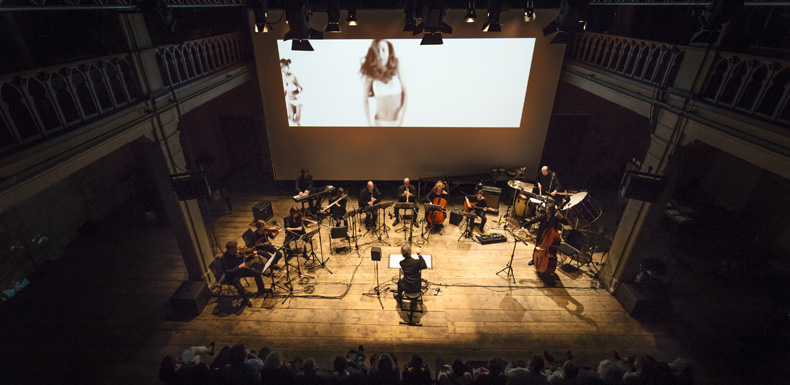
Pour moi, le point culminant de la soirée a été la représentation de l’œuvre de Jodlowski, “Respire”, interprétée par le Nouvel Ensemble Moderne. Il s’agit d’une œuvre qui semble explorer le mécanisme même par lequel nous nous maintenons en vie, notre respiration. Des corps humains sans visage se contorsionnent et bougent en synchronisation avec les sons hypnotiques de l’orchestre, parfois fous, mais parfois beaux dans cette danse entre son et silence. On peut certainement entendre l’influence du minimalisme à la Steve Reich, prononcée par les accords sublimes occasionnels du clavier. Un ouvrage vraiment envoûtant et qui fait réfléchir.

expérimental / contemporain

Semaine du Neuf: Quasar – Exercices d’étrangeté III Mycorrhizia

by Rédaction PAN M 360

Through the extraordinary work of Sandeep Bhagwati, Quasar explores the relationship between nature, technology and contemporary music.

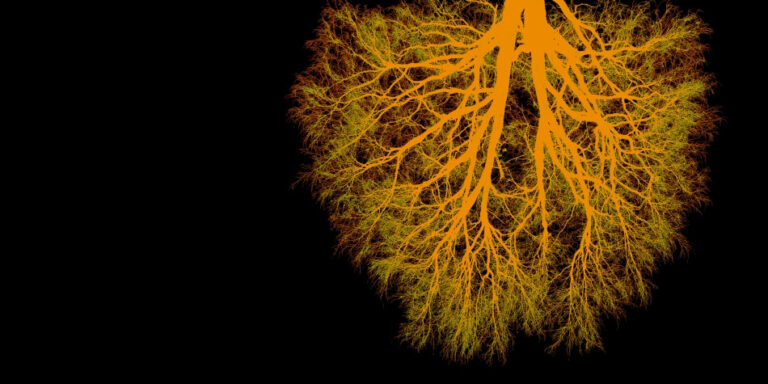
As part of the Société de musique contemporaine du Québec’s Hommage à Sandeep Bhagwati series, Quasar presents Exercices d’Étrangeté III Mycorrhizia. For the duration of the concert, the audience is transported into the singular universe of the internationally-renowned composer, who blends nature with new technologies in a work inspired by communication between trees. On stage, a luminous device representing the root network will react to the sounds produced by the saxophones, for a unique sensory experience.

À travers l’œuvre hors du commun de Sandeep Bhagwati, Quasar explore la relation entre la nature, la technologie et la musique actuelle.

À l’occasion de la série Hommage à Sandeep Bhagwati de la Société de musique contemporaine du Québec, Quasar présente Exercices d’Étrangeté III Mycorrhizia. Le temps d’un concert, le public est transporté dans l’univers singulier du compositeur de renommée internationale, qui marie la nature aux nouvelles technologies avec une œuvre inspirée de la communication entre les arbres. Sur scène, un dispositif lumineux représentant le réseau racinaire réagira aux sons produits par les saxophones, pour une expérience sensorielle unique.


TO BUY YOUR TICKETS, CLICK HERE!

This content comes from Le Vivier and is adapted by PAN M 360.

expérimental / contemporain

Semaine du Neuf: Ghostland

by Rédaction PAN M 360

Immersive and spellbinding, this creation by Pierre Jodlowski plunges us into a space with undefined boundaries.

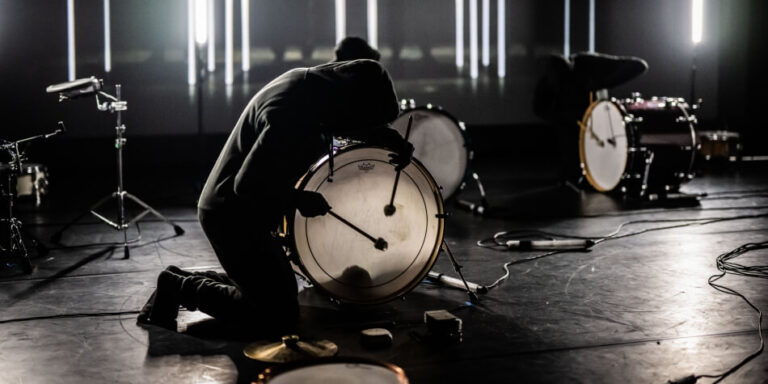
The project is based on the concept of the ghost. It is conceived for four percussionists, who concentrate their playing on four drums and virtual instruments, and a puppeteer with an interactive light, sound and video device.

The ghost is considered in its multiple symbolic dimensions. The stage is no longer simply a performance space, but becomes an ambiguous and infinite space, essentially destined to witness the emergence of a kind of sonic and visual ritual that itself becomes an object to be perceived.

The elaborate score highlights the qualities for which the Percussions de Strasbourg are renowned. The various parts of Ghostland are structured in a dramaturgy that moves from shadow to light.

Immersive et envoûtante, cette création de Pierre Jodlowski nous plonge dans un espace aux frontières indéfinies.

Ce projet repose sur le concept de fantôme. Il est conçu pour quatre percussionnistes qui concentrent leur jeu sur quatre batteries et des instruments virtuels, une marionnettiste avec un dispositif interactif de lumières, sons et vidéos.

Le fantôme est envisagé dans ses multiples dimensions symboliques. La scène n’est plus seulement un espace de représentation mais elle devient un lieu ambigu et un espace infini, essentiellement destiné à voir éclore une sorte de rituel sonore et visuel devenant lui-même un objet à percevoir.

La partition très élaborée met en valeur les qualités qui font la notoriété des Percussions de Strasbourg. Les différentes parties de Ghostland se structurent dans une dramaturgie allant de l’ombre à la lumière.


TO BUY YOUR TICKET, CLICK HERE!

This content comes from Le Vivier and is adapted by PAN M 360.

Experimental / Contemporary

Concert Vivier interuniversitaire à l’Espace Orange

by Rédaction PAN M 360

Lors de la 7e édition du concert annuel du Vivier InterUniversitaire (ViU) seront présentées des œuvres insolites et novatrices pour instrumentale, mixte et électroacoustique. Elles sont toutes composées et interprétées par quelques membres brillants de la génération émergente en composition et en interprétation de l’Université de Montréal, de McGill, de Concordia et du Conservatoire de musique de Montréal.

The 7th annual Vivier InterUniversitaire (ViU) concert will present unusual and innovative works for instrumental, mixed and electroacoustic music. They are all composed and performed by some of the brightest members of the emerging generation of composers and performers from the Université de Montréal, McGill, Concordia and the Conservatoire de musique de Montréal.


POUR ACHETER VOTRE BILLET, C’EST ICI!

Ce contenu provient de Le Vivier et est adapté par PAN M 360.

Création

Événement exploratoire : Autour d’Alla ZagayKevych à l’Espace Orange

by Rédaction PAN M 360

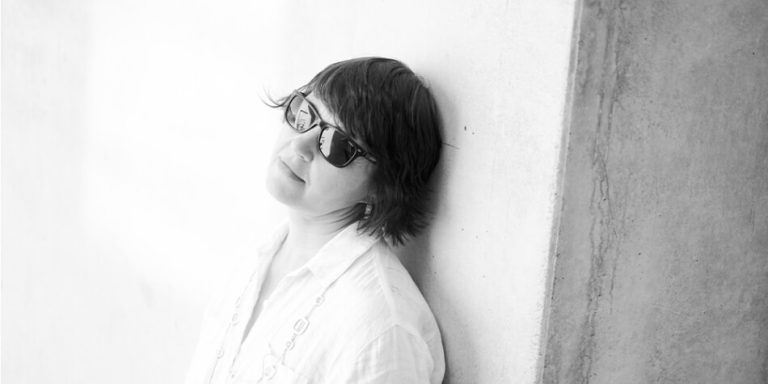
Dans le cadre de la résidence de la compositrice ukrainienne Alla Zagaykevych au Vivier. Présentation et première lecture d’une toute nouvelle œuvre écrite pour le NEM, avec la participation d’Alla Zagaykevych, sous la direction musicale de Lorraine Vaillancourt.

As part of Ukrainian composer Alla Zagaykevych’s residency at Le Vivier. Presentation and first reading of a brand new work written for the NEM, with the participation of Alla Zagaykevych, under the musical direction of Lorraine Vaillancourt.

RÉSÉRVATION PAR COURRIEL À L’ADRESSE SUIVANTE : info@lenem.ca

Ce contenu provient de Le Vivier et est adapté par PAN M 360.

classique

Québec Musique Parallèles : Quatuor Bozzini avec Kyriades et Moor

by Rédaction PAN M 360

Ne manquez pas le passage de Québec Musiques Parallèles à Montréal pour une soirée de musiques éclatées en compagnie du Quatuor Bozzini et du duo Moor-Kyriakides, guitare électronique et électronique! Une rencontre inédite entre des artistes d’ici et d’ailleurs. 

Le Quatuor Bozzini offre en création cassettes, 16 mouvements pour quatuor et électronique inspirés par des rêves faits pendant les premiers mois de confinement, encodés dans la musique jouée par le quatuor et dans les textures sonores qui l’entourent. Dans Rebetika, Andy Moor et Yannis Kyriakides explorent et exploitent le terrain riche et mystérieux du rebétiko, musique populaire née dans les années 1910 en Grèce. Les chansons célèbrent le mode de vie « rébet », mélange de bonté de cœur et de rouerie.

Don’t miss the Montreal visit of Québec Musiques Parallèles for a dazzling evening of music (at Le Vivier) with the Quatuor Bozzini string quartet and the electric guitar and electronics duo Moor-Kyriakides! A unique encounter between artists from here and abroad.

Bozzini Quatuor premieres cassettes, 16 movements for quartet and electronics inspired by dreams had during the first months of lockdown, encoded in the music played by the quartet and in the sound textures that surround it. In Rebetika, Andy Moor and Yannis Kyriakides explore and make use of the rich and mysterious terrain of rebetiko, a popular music born in the 1910s in Greece. The songs celebrate the “rebet” way of life, a mixture of good-heartedness and cunning.

POUR ACHETER VOTRE BILLET, C’EST ICI!

Ce contenu provient du Vivier et est adapté par PAN M 360.

Electroacoustic

Jean-François Laporte et Isak Goldschneider présentent NACHT

by Rédaction PAN M 360

Dans une évocation du temps et de l’histoire, Isak Goldschneider au piano et Jean-François Laporte à la Table de Babel vous transporteront tantôt dans des espaces liminaux inspirés d’un palais babylonien, tantôt sur les traces de la mémoire. Palais de Mari, dernière pièce pour piano seul de Morton Feldman, et Nacht, création de Pierre-Luc Senécal, seront caressées par les univers visuels des artistes Elysha Poirier, Tiffany Moore et Xavier Madore.

Dès les premières notes, la pièce de Feldman nous ouvre lentement la porte sur l’univers mystérieux inspiré du palais de Mari, à l’époque du roi Zimri-Lim. Œuvre introspective d’une infinie douceur, Palais de Mari se déploie comme un chatoiement délicat, où les motifs sont répétés de façon apparemment identique, mais presque toujours variés par de légères modifications de rythme ou de hauteur du son. Fasciné par les musiques ambient et drone, Senécal nous plonge dans une matière sonore profonde et sombre, afin de nous faire sentir comme un arrêt du temps. …

In an evocation of time and history, Isak Goldschneider at the piano and Jean-François Laporte at the Table of Babel will transport you from liminal spaces inspired by a Babylonian palace  to the traces of the memory. Palais de Mari, Morton Feldman’s last piece for solo piano, and Nacht, a creation by Pierre-Luc Senécal, will be gently enveloped by the visual worlds of artists Elysha Poirier, Tiffany Moore, and Xavier Madore.

From the very first notes, Feldman’s piece slowly opens the door to the mysterious world inspired by the Palace of Mari during the time of King Zimri-Lim. An introspective work of infinite gentleness, Palais de Mari unfolds like a delicate shimmer, where motifs are repeated in a seemingly identical manner, varied by slight changes in rhythm or pitch. Fascinated by ambient and drone music, Pierre-Luc Senécal plunges us into a deep and dark pool of sonic material, creating the sensation of frozen time. Enriched through artistic collaboration with Jean-François …

POUR ACHETER VOTRE BILLET, C’EST ICI!

Ce contenu provient du Vivier et est adapté par PAN M 360.

Classical

Montréal-Hanovre : Quatuor Bozzini et ur.werk à l’Édifice Wilder

by Rédaction PAN M 360

Deux quatuors montréalais à la réputation solidement établie – Quasar quatuor de saxophones et le Quatuor Bozzini – engagent un dialogue innovant avec deux brillants ambassadeurs de la musique nouvelle allemande, Flex ensemble et ur.werk.

Dans ce second concert de la série Montréal-Hanovre, le Quatuor Bozzini et l’ensemble ur.werk convient le public à un échange alchimique entre compositeurs et interprètes canadiens et allemands.
Au programme, plusieurs commandes dont celles d’Ofer Pelz et de Jean Lesage, auxquelles s’ajoutent des œuvres de Michael Oesterle – dont on célèbrera la parution d’un nouvel album – ainsi que Gordon Williamson, Snežana Nešić et Johannes Schöllhorn, pour ne nommer que ceux-là.

Programme

PARTIE 1 | UR.WERK
Ofer Pelz: Acufene , 2021 – 2022 – création
Snezana Nešić: The Patterns of Light and Darkness , 2011 – 2021
Annette Schlunz: Journal n°6
Johannes Schöllhorn: Oréade , 2009
Jean Lesage: Marcia Funebre , 2022 – création
PARTIE 2 | BOZZINI
Michael Oesterle: Three Pieces for String Quartet , 2016
Gordon Williamson: fragile reconstructions , 2017
Benjamin Scheuer: Schleifen , 2017
Participants
PARTIE 1 | UR.WERK
UR.WERK
ANNE BISCHOF (flûte)
MARTIN ABENDROTH (clarinette, clarinette bass)
YULIIA VAN (violon)
MARTHA BIJLSMA (violoncelle)
ASHLEY HRIBAR (piano)
SNEZANA NEŠIĆ (accordéon, direction artistique)
SAŠA DAVIDOVIĆ (chef)
PARTIE 2 | BOZZINI
ALISSA CHEUNG (violon)
CLEMENS MERKEL (violon)
STÉPHANIE BOZZINI (alto)
ISABELLE BOZZINI (violoncelle)

Two well-established Montreal quartets – Quasar Saxophone Quartet and Quatuor Bozzini – engage in an innovative dialogue with two brilliant ambassadors of German new music, Flex ensemble and ur.werk.

In this second concert of the Montreal-Hanover series, the Quatuor Bozzini and the ur.werk ensemble invite the public to an alchemical exchange between Canadian and German composers and performers. The program includes several commissions by Ofer Pelz and Jean Lesage, as well as works by Michael Oesterle – whose new album we will celebrate – as well as Gordon Williamson, Snežana Nešić and Johannes Schöllhorn, to name a few.

Program
PART 1 | UR.WERK
Ofer Pelz: Acufene , 2021 – 2022 – premiere
Snezana Nešić: The Patterns of Light and Darkness , 2011 – 2021
Annette Schlunz: Journal n°6
Johannes Schöllhorn: Oréade , 2009
Jean Lesage: Marcia Funebre , 2022 – premiere
PART 2 | BOZZINI
Michael Oesterle: Three Pieces for String Quartet , 2016
Gordon Williamson: fragile reconstructions , 2017
Benjamin Scheuer: Schleifen , 2017

Participants
PART 1 | UR.WERK
UR.WERK
ANNE BISCHOF (flute)
MARTIN ABENDROTH (clarinet, clarinet bass)
YULIIA VAN (violin)
MARTHA BIJLSMA (cello)
ASHLEY HRIBAR (piano)
SNEZANA NEŠIĆ (accordion, artistic direction)
SAŠA DAVIDOVIĆ (conductor)
PART 2 | BOZZINI
ALISSA CHEUNG (violin)
CLEMENS MERKEL (violin)
STÉPHANIE BOZZINI (viola)
ISABELLE BOZZINI (cello)

POUR ACHETER VOTRE BILLET, C’EST ICI!

Ce contenu provient du Vivier et est adapté par PAN M 360.

Classical

Montréal-Hanovre : Quasar et Flex Ensemble à l’Édifice Wilder

by Rédaction PAN M 360

Deux quatuors montréalais à la réputation solidement établie – Quasar quatuor de saxophones et le Quatuor Bozzini – engagent un dialogue innovant avec deux brillants ambassadeurs de la musique nouvelle allemande, Flex Ensemble et ur.werk.

Programme

PARTIE 1 | QUASAR
Tjarbe Björkson: Friction Sounds , 2020
Snezana Nešić: Quatre graffitis pour le début du temps , 2022 – création
Gordon Williamson: Breathing Room , 2021
Georges Aperghis: Crosswind , 1997


PARTIE 2 | FLEX ENSEMBLE
Márton Illés: Vier Aquarelle , 2022 – création
Michael Oesterle: Baba O’Riley , 2022 – création
Gérard Pesson: Mes béatitudes , 1995
Andrew Staniland: Spinning Wheels of Death and Paradox , 2022 – création


Participants
PARTIE 1 | QUASAR
QUASAR
MARIE-CHANTAL LECLAIR (saxophone soprano)
MATHIEU LECLAIR (saxophone alto)
ANDRÉ LEROUX (saxophone ténor)
JEAN-MARC BOUCHARD (saxophone barytyon)
PARTIE 2 | FLEX ENSEMBLE
FLEX ENSEMBLE
KANA SUGIMURA (violon)
ANNA SZULC (alto)
MARTHA BIJLSMA (violoncelle)
JOHANNES NIES (piano)

Two well-established Montreal quartets – Quasar Saxophone Quartet and Quatuor Bozzini – engage in an innovative dialogue with two brilliant ambassadors of German new music, Flex Ensemble and ur.werk.

Approaching near musical perfection through clarity, energy and brilliance of texture, Quasar and Flex ensemble will premiere Canadian and German works. Quasar will also team up with Anna Szulc (Flex) for Crosswind by George Aperghis, the man who reinvented musical theatre. For their part, Flex presents the striking work Mes Béatitudes by the great French composer Gérard Pesson.

Program

PART 1 | QUASAR
Tjarbe Björkson: Friction Sounds , 2020
Snezana Nešić: Quatre graffitis pour le début du temps , 2022 – premiere
Gordon Williamson: breathing room , 2021
Georges Aperghis: Crosswind , 1997
PART 2 | FLEX ENSEMBLE
Márton Illés: Vier Aquarelle , 2022 – premiere
Michael Oesterle: Baba O’Riley , 2022 – premiere
Gérard Pesson: Mes béatitudes , 1995
Andrew Staniland: Spinning Wheels of Death and Paradox , 2022 – premiere


Participants
PART 1 | QUASAR
QUASAR
MARIE-CHANTAL LECLAIR (soprano saxophone)
MATHIEU LECLAIR (alto saxophone)
ANDRÉ LEROUX (tenor saxophone)
JEAN-MARC BOUCHARD (baritone saxophone)
PART 2 | FLEX ENSEMBLE
FLEX ENSEMBLE
KANA SUGIMURA (violin)
ANNA SZULC (viola)
MARTHA BIJLSMA (cello)
JOHANNES NIES (piano)

POUR ACHETER VOTRE BILLET, C’EST ICI!

Ce contenu provient du Vivier et est adapté par PAN M 360.

Subscribe to our newsletter