Interpol is a band I had, despite a few drunken nostalgia playlist nights screaming “Stella was a Diver and she was Always Down”—forgotten about, lost to the endless stream of new bands and new songs. The group’s debut, Turn On The Bright Lights was a seminal album for me, even though I didn’t discover it many years after its release in 2002. A friend’s brother, who also opened my musical ears to groups like Beastie Boys, Massive Attack, Gorillaz, and The Fall, had an Antics (the band’s second album) poster hanging in his wall. I always wondered what “Antics” was and for a brief spell, thought the band was called Antics. “No, they’re called Interpol,” the older brother said over a quickend lunch, tossing me a CD. It was Turn On The Bright Lights and I devoured it. The haunting baritone of Paul Banks, baffling in his enunciation, fueled my 13-year-old teenage angst. It was indie rock, dark and gothic—a sound that for a few of my years on this Earth, was the coolest sound one I had ever heard. The older brother called it “post-punk,” and it was most likely the first time I had ever heard of the genre. I found Antics online, a pirated a Chinese bootleg on Frostwire (dating myself I know)—I’m not sure why I didn’t just ask the brother to borrow it? Embrassment or stupidty—and ripped it on my Sony bean MP3.
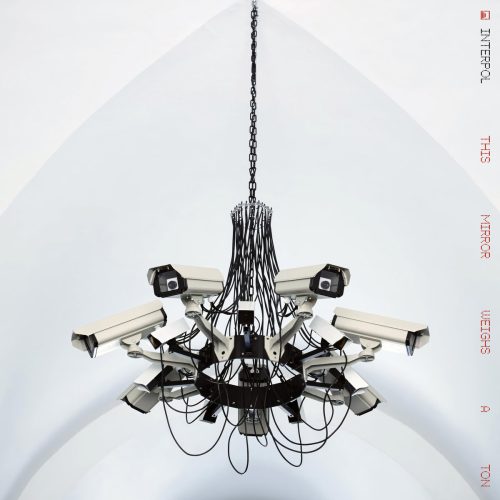
I think I lost touch with the band sometime in the 2010s. They had more albums, but the love affair died. So it goes, I guess. Now, we are in 2026, and Interpol have released their eighth album, This Mirror Weighs A Ton, and I’m pleasantly surprised. Banks is still as baffling as all hell, holding onto certain words longer than they need to, to perhaps build the tension and have his listeners crave that oh-so-cathartic release.
The opening title track, starts more electronic than I anticipated, a bit lo-fi Eno-esque, while a slurring lead guitar trips up and down. Banks sings in a hushed register, while some wispy female vocals arrive. Very Massive Attack, that is until Banks sings “This Mirror Weighs A Ton,” taking form as a wizard, singing about the Arcane qualities of the radio. It’s a strange opener and brings a diluted version of the frenetic Interpol I expected. “See Out Loud,” is very anthemic, buzzing synths and that classic, gritty neo-noir guitar-leading punk Inteprol we all know. Thematically, at least in the first couple of listens, it’s a darkly poetic album, very Banks. But it’s more atmospherical than straight guitar rock, the lead guitar lines from Daniel Kessler ringing and bouncing off the rafters.
This Mirror Weighs A Ton does have some duds, or at least, to me, songs that don’t really hold water. “Iron City” feels like an outtake from The National, someone I’m pretty sure Banks holds in high regard. Both “Darling Thoughts” and “Ever The Actor” have identity crises, beginning as buzzing indie burners and then dropping out of existence about halfway through. All the intensity Banks and Co. build kind of fizzles out in place for this, again subdued post-everything
But “So Rides The Reindeer” sticks the abstract landing; actually, it’s very Antics-coded, a lumbering and beautifully drunken composition. “Enemy” also brings back the hazy and smoky piano rock vibe (female vocals back) that Interpol has dabbled in before. Is Banks singing about his enemy’s demise, or his very own? I’ve never really tried to synthesize what his lyrics are truly about—it’s always been more of a vibe for me.
Most of the hooks on this album are all there—Interpol has always been adept at writing those. Still, I’m not sure if any of these tracks will follow me for years, like the group’s first two, but it occurs to me that This Mirror Weighs A Ton will be some listener’s first introduction to Interpol, and that gives me a warm feeling inside. Perhaps someone else’s brother will open the door to another young kid’s musical world. Who knows.