Additional Information
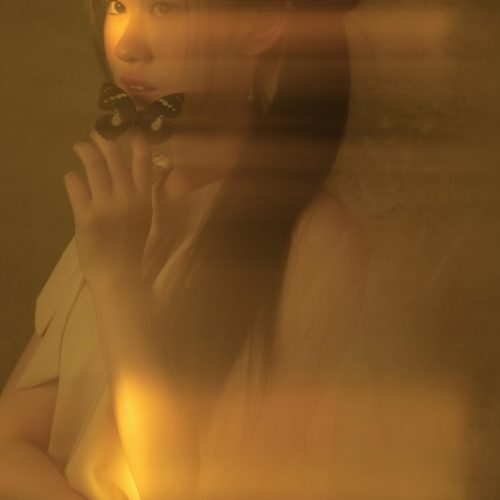
In Jiyoung Wi’s recorded works, her field recordings reveal “fictional truths” so powerful that they distort our perception of space. Tonight, this fiction will momentarily occupy a very real space at S.A.T., and beyond the simple physical conditions of the event, it is impossible to predict what will happen. While her latest album, “Accept All Cookies”, offers a thoughtful documentation of human behavior, Jiyoung Wi’s live performances reveal her own humanity in a striking narrative of the present moment. The heart revealed through static noise.
Freed from almost any conceptual framework, her improvised approach is rooted in the immediacy of the stage, the audience, and the violin in her hands. This is a show not to be missed, as it will never be performed the same way again.
After listening to “Accept All Cookies” several times, I contacted Jiyoung Wi, who kindly answered my questions, offering insight into her creative process, her relationship with improvisation, and the ideas behind her latest work.
PAN M 360: What is your main instrument? Tell us how you learned to play it and how you practice today.
Jiyoung Wi: I mainly use the electric violin as my primary instrument for my concerts. My only formal training consisted of studying a few Suzuki method textbooks for two years as part of an after-school program when I was ten years old. In that sense, I consider myself technically, even intentionally, untrained. At one point, I bought a violin and left it aside for years, until I finally gave my first concert in 2023. At first, I had trouble reconnecting the instrument with muscles I hadn’t used in so long. I rented a small rehearsal room and immersed myself in exploring all the different sounds I could produce with the bow. Today, I try to discover sounds not only from the bow, but also from all the elements that make up the violin itself. I don’t practice in the traditional way of a violinist, but when I discover a kind of “sudden technique” during a concert, I remember it and keep it in mind as a preset, then try it again at the next concert. The result is always slightly different, because it’s improvisation.
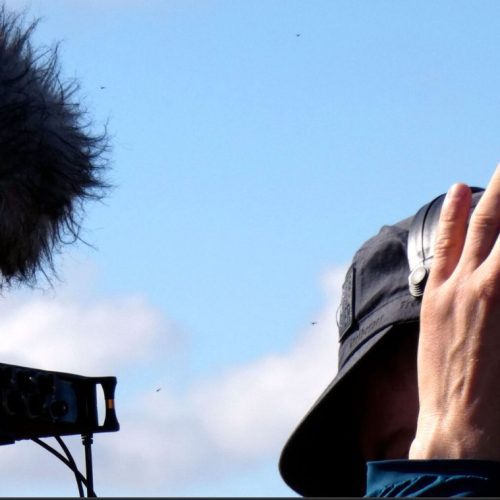
PAN M 360: In your article on Record Turnover, there is a photo of you with a field recorder in an amusement park. What other tangible or intangible/imaginary spaces do you include in your work?
Jiyoung Wi: Like the term “diegesis” in film theory, space can be anywhere as long as it contains clues that evoke your auditory memory. For example, the recording of the amusement park was incorporated into a chapter of my book and album Sound Fiction 4’44”, where the character calls his grandmother to check on her. I juxtaposed the noisy sounds of the amusement park with the superficial conversation because I wanted to reveal the character’s unconscious guilt. You could say that this represents the main protagonist’s auditory memory.
PAN M 360: Your album oscillates between staged conversations and spontaneous conversations. What does “truth” mean in your concept of Sound Fiction, and how do you reconcile authenticity and construction?
Jiyoung Wi: In the context of fiction, as I juxtaposed text and sound and tried to reveal something through the narrative, any notion of existing truth would be closer to a fictional truth. From a constructive point of view, I enjoy the process of fictionalizing fragments of reality during my field recordings. For example, I might secretly record a phone conversation on the street and use it as a clue to imagine another layer of fictional possibilities.
PAN M 360. In your methodology of recontextualizing field recordings and anonymous dialogues, what narrative “symptoms” emerged in this album that surprised you during the process?
Jiyoung Wi: That’s an interesting question. In Sound Fiction 4’44”, seven speakers express themselves in seven different languages, and at a certain point in the editing process, I began to perceive all their voices as my own. I felt as if I were living several lives simultaneously. It was as if all the notes were resonating at the same time, which is fundamentally impossible.
PAN M 360: When you perform live, do you treat sound fragments and dialogues differently than you do in the studio, or does improvisation play a more important role on stage?
PAN M 360: Is there anyone or anything you would like to thank for supporting or influencing this project and performance?
Jiyoung Wi: All the tracks on Sound Fiction 4’44” last 4 minutes and 44 seconds. In many Asian cultures, the number 4 symbolizes death. So, when I was designing this project, I couldn’t help thinking about John Cage. I thought about adding 11 seconds to Cage’s 4 minutes and 33 seconds. Also, when I imagined the death closest to me, I felt I had to write a book for my grandmother in Korea. The last time I saw her, she was suffering from dementia and kept repeating the same phrase: “Be happy.” She made me think about something important that repeats itself in 4 minutes and 44 seconds, or in the very form of life itself.
Jiyoung Wi isn’t afraid to confront the realities of life and death, and this is clearly reflected in his music. This is perhaps one of the first openly acknowledged noise performances in this space, and I can’t wait to hear what would normally be heard in a DIY venue with what is now being presented through such an impressive sound system.