Additional Information
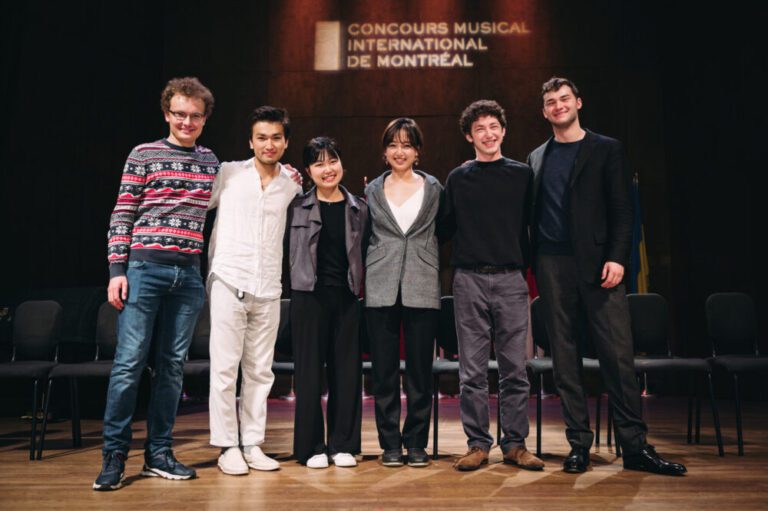
Le Concours musical international de Montréal (CMIM) , which is dedicating its 2023 edition to the violin, is in full swing and will reach its final outcome on Thursday evening at the Maison symphonique. Six finalists, 4 men and 2 women, in their early twenties and coming from Ukraine, the United States, Israel, South Korea and Kazakhstan. On the sidelines of this final, which will take place today and Friday, we had the opportunity to speak with the finalists after their dress rehearsal with the OSM and Rafael Payare, a few hours before their competition. To begin, here is Dmytro Udovychenko (Ukraine) who will play Shostakovich’s Concerto No. 1, Nathan Meltzer (United States) who will perform Berg’s Concerto No. 1 “In Memory of an Angel” and Michael Shaham (Israel) who will conclude the evening with Sibelius’ Concerto No. 2 in D minor.
PAN M 360: What is your state of mind right now, a few hours before your final event?
Dmytro Udovychenko : I feel very thrilled and will try my best today with this wonderful orchestra.
Nathan Meltzer : Right now, I’m kind of riding the high of experiencing this piece with an orchestra for the first time and basking out about how really great it feels and sounds. Everything went really smoothly. I’m really glad that I didn’t have any major memory slips [laugh]. You have to kind of memorize the entire orchestra part because it’s so interconnected. So, I’m pretty relieved that it didn’t blow up in my face. I’m trying to stay in the moment, and I’m just looking forward to playing the piece again tonight.
Michael Shaham : I have actually been in this situation before, in the finals, having to play Sibelius’s concerto. And I think if I had to do one thing differently from that time is to have a mindset that I already won. Because no matter the price, I’m not going to think about what placement I will get or the other competitors, which are fantastic, which is also a reason not to think about that. I’m just going to play and have fun with the orchestra playing my favorite music, which is very important. I will try to say something to the audience and the jury members to make it memorable.
PAN M 360 : Of all the concertos available in the repertoire, why did you choose this one and why? What are the challenges of this piece?
Dmytro Udovychenko : Shostakovich Concerto No. 1 is my favorite concerto and one of the favorite pieces of music in general, so it’s always a great honor and challenge at the same time for me to be able to play it.
Nathan Meltzer : Berg’s Concerto No. 1 “In Memory of an Angel is a pretty rarely done work. I think it’s an amazing piece, but I’d really never seen it on a rep list for a competition. So it really just struck me as a really rare opportunity to delve into a piece that is not the normal rotation of concertos for orchestras. The difficulty is partially the obscurity of it. It’s the technical, challenges and musical ideas that are quite far removed from classical violin technique like what you learn in your lesson. So it requires a lot of imagination and a lot of understanding of the scope of the piece. But it’s just a brilliant piece of writing and very clever. The whole Second Viennese School serialist idea just leads to this really interesting sound. In a strange way, it is a very earnest kind of piece when compared to composers like Shostakovitch, and Bartók, where there’s this kind of crassness and sarcasm. I was really shocked to learn that there really is very little that in this piece. It’s a very earnest and very soulful piece despite having this sound world that is really alarming.
Michael Shaham : I chose Sibelius’ Concerto No. 2 in D minor because it was part of my childhood: when I heard my father, who is a violinist, perform it for the first time with an orchestra. It means a lot to me and it is one of my favorite concertos since I was a child. I think the difficulty with this concerto is that it’s not very soloist-oriented. I think it’s more of a symphony than a concerto, in a way. I’m really part of the orchestra, and we’re creating something huge together, like a big mountain. And it’s not very ego-driven, which I really like.
PAN M 360 : What does it mean to you to be at CMIM and how is this competition different from others you have participated in?
Dmytro Udovychenko : Every competition is a different story for me and, of course, at the end of this one I already have a huge amount of very strong impressions! It’s an amazing journey and I’m so grateful to the competition team and to everyone who is involved in this great celebration of music!
Nathan Meltzer : It’s an amazing honor to be at the final stage here, and I’m very glad to be able to play this piece. I’m really glad to be able to put all this work into learning and enveloping this kind of sound world. I’m just really excited that there’s going to be, like, a sense of closure to it, to play and experience the piece. Every competition is a little different and has their kind of emphasis. What I was so interested in for CMIM, was the fact that they highly recommended that the competitors bring their own pianist and that the rep list was so open-ended and that I was able to do some really interesting pieces. Because I brought my own pianist, I was able to really think of it more as an opportunity to put together a couple of interesting recital programs. I felt very musically fulfilled in this competition and I’m really glad that I was able to learn and work on and perform all these pieces. And also the Hall! This is amazing!
Michael Shaham : I’m not very experienced with competition, to be honest. But my impression is that this is probably the most professional competition there can be. I’m very impressed by the organization here. The atmosphere is great. It’s exactly what I expected and hoped it would be. I’ve been following, maybe with delay, but I’ve been following the recent editions of the violin competitions here, and it’s just so great to be here in the finals and join all of those colleagues of mine and violinists that I look up to.
The profiles of the remaining three finalists will be online this Thursday.
You can stream the final in real time here.