PAN M 360 at Nuits d’Afrique 2024 – Athenea, A Woman of Many Roots
by Sandra Gasana
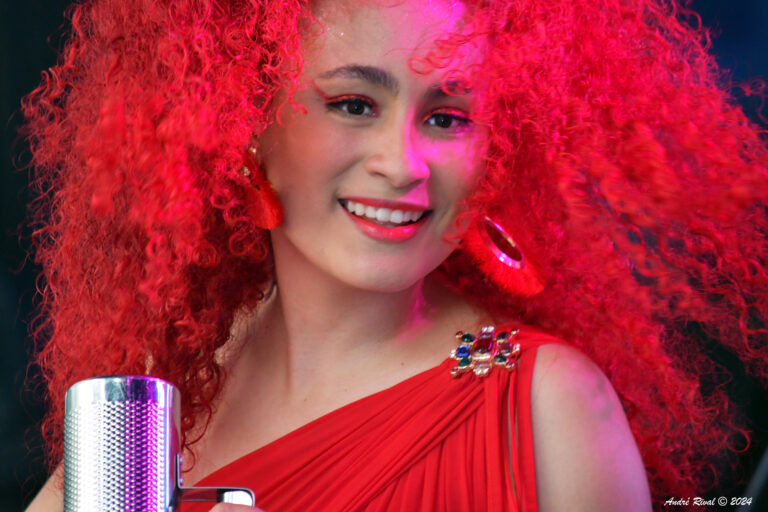
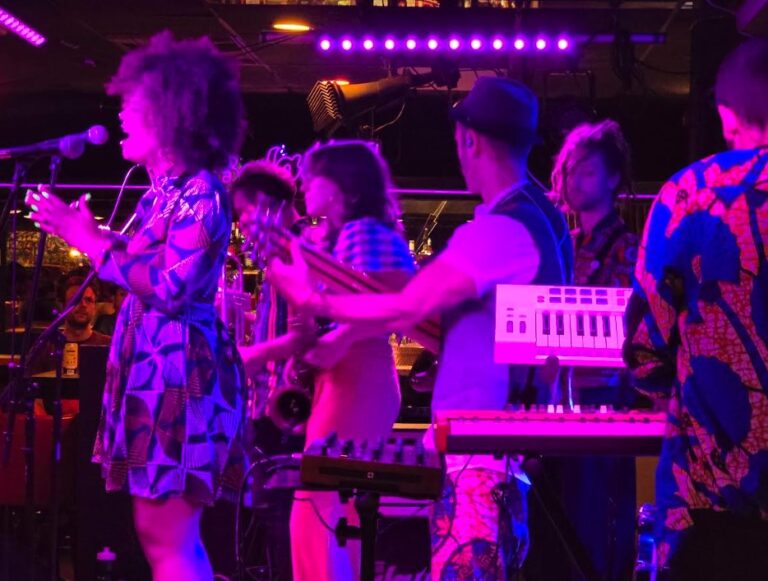
“I was born in Cuba, but I’m actually a quarter Ethiopian, a quarter Haitian, a quarter Chilean and a quarter Spanish,” she tells us in the middle of her show. Indeed, the Lady in Red from head to toe (I’m not exaggerating, even her hair was red) charmed us during her outdoor performance at the Festival Nuits d’Afrique.
Arriving with an array of musicians on stage, including her husband Ricardo on keyboards, the band’s musical director, and an excellent pianist, she blew us away from the moment she took to the stage. She is accompanied by a percussionist, a drummer, a saxophonist, two trumpeters and a guitarist. She decided to open with a cover of Gloria Estefan’s Mi Tierra, but followed this up with one of her own compositions. And it’s here that we discover her talents as a percussionist and dancer, as well as playing the maracas.
“The next one is a composition of mine, Amarga Gloria, and it’s about the contradiction that exists with immigration. We think all our problems will be solved, but we’re going to run into other problems here.”
She alternates between salsa and cumbia, and sometimes changes rhythm in the same song, which adds richness and depth to the track. She has a great stage presence, taking up space and revealing herself completely, interacting with her audience. And there’s no denying her talent for staging dramatic finales! But hey, you had to play the game!
She surprised us with her cover of Papaoutai, which she interpreted very well and allowed us to discover that she sings in French. My favorite was her Spanish rendition of the Jacksons’ Blame It On The Boogie, which I really enjoyed. She finished with a few classics from the salsa repertoire, before getting us all up and dancing, and allowing each of her musicians to do their solo.
PAN M 360 at Nuits d’Afrique 2024 – Omar Mbaye: Take-off for Dakar!
by Sandra Gasana
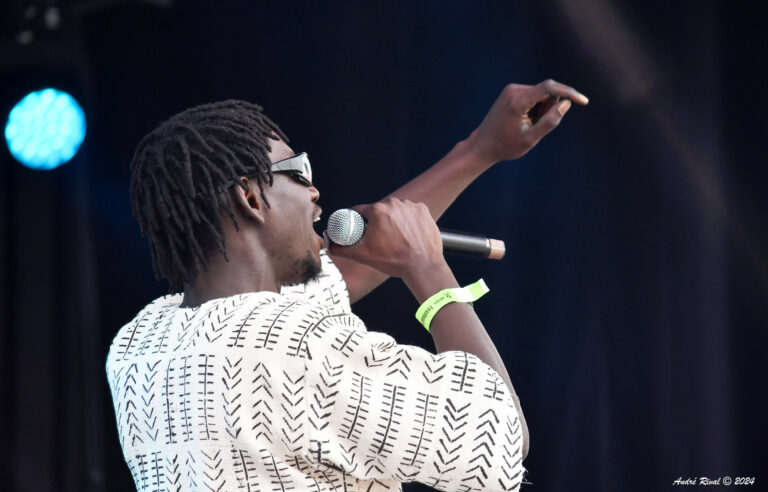
“You’re ready to take off for Dakar!!!” These are the opening words of Omar Mbaye, who arrives on stage wearing white pants and a patterned African shirt. With his guitar, he is accompanied by two backing singers, including one called Amina, a keyboardist, a drummer, a bassist and a percussionist who acts as host at times. No sooner had he taken to the stage than he asked us to sing along.
The Loto Québec stage wasn’t very busy at the start of the show by the Senegalese newcomer to Montreal, but that wasn’t the case at the end. Although a little shy at the start of the concert, festival-goers loosened up as the show went on.
“This song is about protecting and educating children. I’m an ambassador for this cause,” he announces at the outset.
He puts his guitar aside for his second track, which he dedicates to all the mothers of the world. The song is gentle, and you can already hear the beginnings of a light Mbalax. He takes the opportunity to get us dancing, asking us to follow his steps.
It’s on the third track that he reveals his penchant for reggae and dancehall, which is sure to get the audience moving. The percussionist manages to set the mood, and uses a stick to tap his djembe, accentuating the sound and giving it a Senegalese feel.
The weather was perfect for the second day of the Nuits d’Afrique outdoor festival, and a few Senegalese could be seen cheering on their compatriot. A number of benches and chairs were available for some of the older festival-goers who wanted to enjoy the show without having to stand the whole time.
My favorite track is the one he sings with Amina, the backing singer, who sings her parts in English. Perhaps a translation of the lyrics by Omar Mbaye, who sings in Wolof? In any case, he chooses to end the show with a return to Mbalax, the musical style we talked about at length with Def Mama Def during my interview with them. By the end of the show, we had landed in Dakar, thanks to Omar Mbaye.
PAN M 360 at Nuits d’Afrique – Afrovibes Opens the Ball
by Michel Labrecque
On this Tuesday afternoon, very hot but cloudy, the public space of the Nuits d’Afrique Festival was still in the making. The African village was finishing filling its displays, a Brazilian woman was giving dance lessons to a very small, but very attentive, audience.
On the Esplanade Tranquille, around a hundred people were seated, in the ambient humidity. It’s not easy to be the first group to launch the free music programming of the Festival Nuits d’Afrique.
This thankless task was that of Afrovibes, the voodoo-afrobeat ensemble from Montreal, led by percussionist Emmanuel Delly. Eight musicians, one singer, in front of a largely deserted audience, at the start. Ungrateful, I told you.
But it started to groove very quickly; the group is tightly woven. A trio of percussionists, facing a battery of three guitars, a keyboardist and a flawless bassist. And the singer who wraps it all up in a sensitive way. Everything was pretty tight.
I didn’t expect anything from this group. It was a cover assignment, in other words PANM360 asked me to go. I was pleasantly surprised. Not that Afrovibes is reinventing music, but he delivers a solid and super danceable performance. The three guitarists, one black, one white and one white, are hyper complementary between the solos and the riffs. The mix between Haitian and African influences is richly integrated, with a touch of America.
I enjoyed listening.
Little by little, people came to dance. An audience of all ages and colors, fascinating for a journalist to observe.
Afrovibes would have deserved a better niche. But someone has to start the festivities. The group will tour a lot in Quebec this summer. To monitor.
In closing, I ask a quick question: why is this type of group, from Quebec, so rarely present in the variety shows on our TV?
PAN M 360 at Nuits d’Afrique – Pahua : A Latina Tornado
by Michel Labrecque
Pahua, real name Paulina Sotomayor, is a Mexican DJ, producer and songwriter. She plays folktronica, this new genre that mixes traditional sounds and electronic music.
Her concert began late, which made me miss a large part of the recital by the Brazilian Luis Salgado, at Balattou, which was otherwise very good, in a very different register.
As soon as she arrives on stage, Pahua envelops the audience with her disarming smile, her enthusiasm to be among us. She is surrounded by computers, but also by percussion and two musicians, an electric guitarist and a percussionist, both wearing enormous white glasses.
Palhua composes, sings and is also a percussionist. Which gives a more percussive version in concert than that of his first album, Habita, released at the end of 2023. Groove quickly took hold and a majority of the audience started dancing. A mixture of cumbia and other Latin American rhythms stirred up Le Ministère.
The electronic arrangements, mixed with traditional recorded instruments, notably accordion, flutes and trumpet, add musical material to the rhythm. There are also more meditative, more folk moments.
Paulina Sotomayor also knows how to sing and clearly enjoys it. In addition, behind the stage, a video constantly shows images of both the urbanity and the nature of Mexico and Latin America.
Because, if Pahua is Mexican and proud of it, we sense in her a desire to embrace all Latin American cultures. She will also, in a future project, be interested in Brazilian baile-funk, she told us in an interview.
On her album Habita, she multiplied collaborations with musicians from across the continent, from Costa Rica to Chile. It is part of a larger ecosystem of folktronica, which would benefit from being better known here.
Pahua is undoubtedly a Mexican artist to follow. And Le Ministère public seemed to enjoy it to the fullest.
PAN M 360 at Nuits d’Afrique 2024: Rumba de Bodas, Italian coffee roasting
by Alain Brunet
From Italy, Bologna to be precise, Rumba de Bodas illustrates the groove culture of Europe’s thirtysomethings.
It’s no longer exclusively a question of funk, soul or R&B adapted to the flavors of the month, but of a more global integration, with Afrobeat, highlife, reggae, dancehall, ska, Afro-Latin, reggaeton and even a few housy flirts on the menu… Italian-style, needless to say.
We’re talking about this Italian group invited to Balattou on Sunday. Rumba de Bodas joyfully proclaimed their inclination for “exuberance and freedom” and the “cabaret style that has endured on the roads of Europe since 2008”.
And here they are for the first time at Nuits d’Afrique in MTL. A fine visit, to be sure.
Competent instrumentalists on keyboards, guitar, bass, drums, saxophone and trumpet, a cohesive and motivated band, all headed by Rachel, an explosive singer, inhabited by groove.
Rumba de Bodas certainly encourages movement, at least nodding and shaking the shoulders, but it also suggests active listening. It’s fair to say that the quality of the arrangements and the on-stage performance attract our attention for all the right reasons. These artists have their own style, and it’s sure to catch on! A must-have for your hard drive.
PAN M 360 at Nuits d’Afrique 202 | All United by The Kora
by Michel Labrecque
The kora is one of the most fantastic African inventions. This 21-string harp, made of calabash (a large, very hard squash) and cowhide, invented at the end of the 17th century, allowed West African griots to create complex music with very rich harmonic possibilities.
My first auditory contact with this instrument occurred in the summer of 1979 (that doesn’t make me any younger…) in a post-hippie bar in Olympia, in the United States, during a community radio meeting. The Mandingo Griot Society record was playing and everyone at our table stopped talking; some started dancing. “What is this instrument, it’s so beautiful,” someone cried. We had to do our research later. There was no internet or cell phones.
From the mid-1980s, the African wave swept across the West, bringing us multiple koras in its wake.
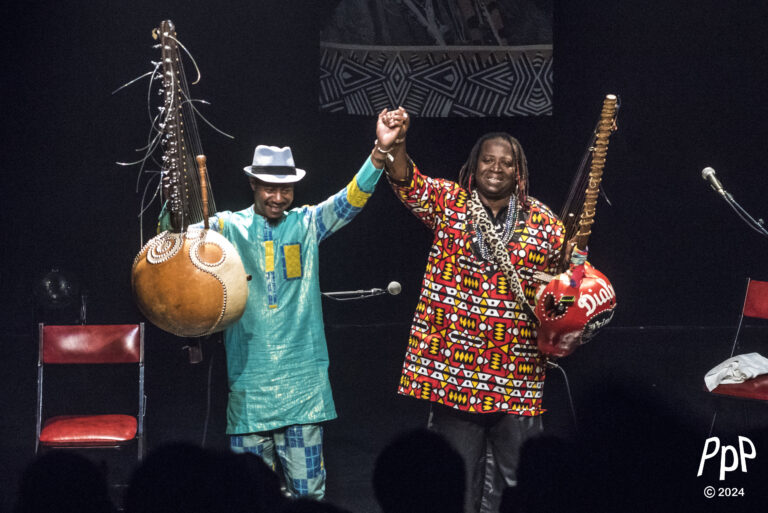
The Night of the Kora has become a staple of the Nuits d’Afrique festival. To embody it in 2024, who better than Prince Diabaté, nicknamed the “Jimi Hendrix of the kora”. Originally from Guinea Conakry, from a lineage of griots, these traditional Mandingo singing journalists, Prince Diabaté is an innovator of the kora, having sometimes merged with modernity, the WahWah pedal, rap and symphonic music. The prince of alternative Kara.
However, at Gésu, this July 14, Prince Diabaté presented himself in a more intimate format, solo, with his all-red kora, with his name engraved on it. Is it for lack of resources or for concern for authenticity? Regardless, the result delighted the rather large audience.
Prince Diabaté completely merges with his instrument. He manages to extract unknown, unpublished notes, sometimes in cascades, sometimes gently. He also sings in a pleasant voice, or declaims words of traditional songs or compositions. He also sometimes hits the body of his instrument with force, to create rhythmic surprises.
For me, there is something strangely timeless about this performance. I can not explain it. This sound, based on centuries-old traditions, is surprisingly current.
Opening act, Malian-turned-Montrealer Diely Mori Tounkara. “We’re going to have fun tonight,” he said from the outset. Diely is less flamboyant than Prince Diabaté, but his more meditative playing, using a lot of reverb, is not without interest, quite the contrary. This distinguished artist of Montreal diversity gave us an excellent time. To cap off the evening, the two musicians played together, alternating improvising one after the other.
The audience, predominantly white but with a significant African component, was won over. There were no more races, languages, differences. Everyone was united by the kora.
PAN M 360 at Nuits d’Afrique 2024 | Queen Omega, From the Top of Her Throne
by Sandra Gasana
Willy B Rose was the host for the long-awaited show by the Queen of Reggae, here to accompany Entourloop, with whom she’s been collaborating for several years now.Much to my surprise, we kicked off with Queen Omega, the majority of the audience having come to see the French group who has many fans in Montreal.
The Trinidadian reggae icon was accompanied for the occasion by The Royal Souls, made up of Ons Barnat on keyboards, Thomas Broussard on guitar, Thierry “Titi” Lechauve on bass and David Dub Akom on drums.
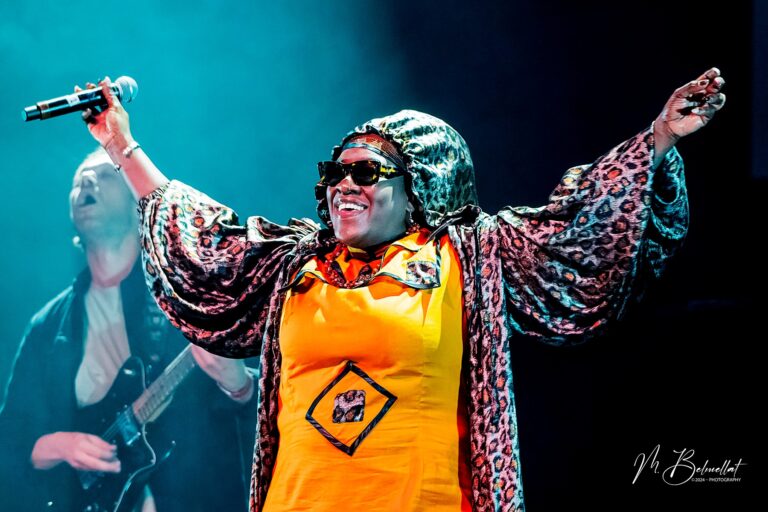
First, the musicians set the stage for Royalty, whose voice can already be heard in the distance. And what better way to kick things off than with Fittest, from her most recent album Freedom Legacy, one of her signature tracks. With her long orange dress and legendary signature turban, she takes to the stage like a queen. She segues seamlessly into Make a Sacrifice, during which there was a minor technical hitch with the microphone, followed by Judgement, with audience participation on the chorus. She jumps around the stage, does military steps at times, in short, this Queen is in good physical shape.
“It’s good to be here in Montreal,” she says, not speaking the language of Molière despite her many stays in France. On Dirty Minds, she talks about corruption, which she wants to eradicate, before continuing with Bite the Dust. “I feel your energy, thank you very much. It’s time for renewal,” she announces. She does a magnificent cover of Amazing Grace, which she has renamed Jahmazing Grace, adding her own little touch, mixing reggae and dancehall. At times, we felt like we were in a church in the USA. She jumped in the air, danced with the guitarist, sometimes in a trance, singing Glory and ending with a Hallelujah.
She takes a leap back in time when she sings Ganja Baby, from her 2004 album Away from Babylon. “Kudos to the Canadian government for legalizing ganja here. Weed isn’t a drug, it’s a plant, but you shouldn’t abuse it,” she reminds the audience, who seem to appreciate her lyrics. She’s completely on fire during the track Elevate, but my favorite moment of the evening is undoubtedly when she shares a new sound like Head Above the Water, with its subsequent message of encouragement. “Even when things seem insurmountable, tell yourself it will pass! Don’t give up!” she said to appreciative applause.
“Do you remember I Can’t Breathe? Do you remember Black Lives Matter?” she asks the crowd before playing Elimination. She does a few dance steps, even does the robot at one point, in addition to dancing and jumping around the stage. One thing’s for sure, this queen has an undeniable stage presence and is tireless. She couldn’t leave without paying tribute to women, which she does in Black Woman. “Encourage women, love them, worship them!” she declares. And addressing women directly: “Women, keep your crown on your head and keep your head up! I love you.”
She saved the best for last, including the global hit that made her world-famous, the track No Love, followed by Local, on which she claims to be an international singer and ambassador of Reggae. This gave the crowd a chance to let off steam and get ready for L’Entourloop.
I was left wanting more. An hour’s performance wasn’t enough for the spectators who came to see Queen Omega. Let’s hope she comes back for a full show very soon.
I had time to see a few minutes of Entourloop before leaving Mtelus. I didn’t know the band or the concept at all, but what I understood was that they’re a DJ duo of a certain age, who mix reggae sounds as well as dancehall, dub, ragga, downtempo and hip-hop, accompanied by a trumpet player and two MCs who liven up the evening by singing and rapping mainly in English. The room was mainly made up of French people, and on the screen behind them were animations of all kinds. When I left, people were having a blast.
PAN M 360 at Nuits d’Afrique | Youba Adjrad, Algeria’s Great Pop Voice
by Alain Brunet
If fans of raï, chaâbi, Arabo-Andalusian or even salsa, tarab and Amazigh culture (indigenous to the Maghreb) knew about the immense voice of Algerian singer Youba Adjrad, Fairmount would have been shaken. Such power singers are few and far between.
Youba Adjrad was born in Algeria in 1991, took his first steps in music at the age of 14, studied music at the age of 17, and was inspired by his chaâbi-singing father to enroll in a classical music school in 2009. On Algerian radio, Youba improvises a few Algerian chaâbi classics and even a song of his own. In 2012, at the age of 21, he took part in the national Alhan Wa Chabab (Algerian Super Star) competition, then reached the final of Arabe Idol (season 4). Some consider him to be one of the best Arab voices of the current period. The thirty-something certainly comes from pop and reality TV, but he frees himself from it and distinguishes himself from it.
Believe me, this is no show-off. I was there for the first set on Friday night and wow, what a voice! The groove is purely Maghrebian but also Afro-Latin, the result of Youba Adjrad’s encounter with percussionist Youcef Grim. Montreal musicians Bertil Schulrabe, Carlo Berri, Rafik Abdeladim and Ryan Kaouene are also mentioned as having taken part in the project.
The few dozen people on hand were very happy to be there, despite the low attendance for an artist of this calibre. Next time, we predict, it will be very different.
PAN M 360 at Nuits d’Afrique 2024 – Def Mama Def, Two Sisters in Art
by Sandra Gasana
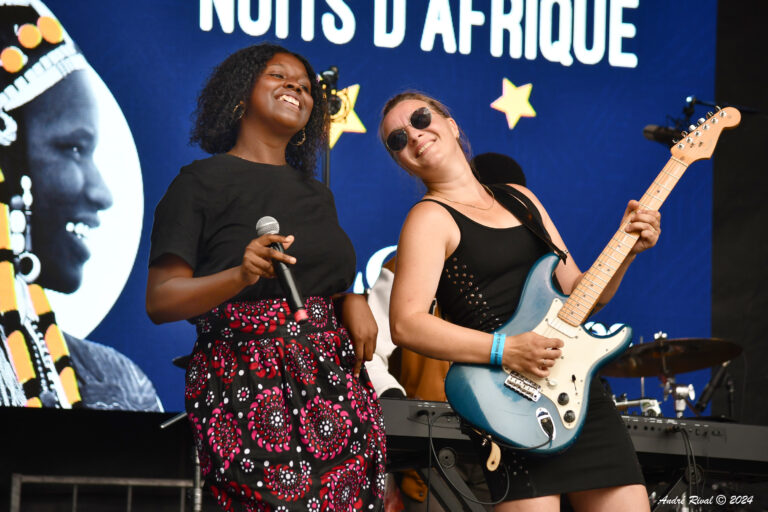
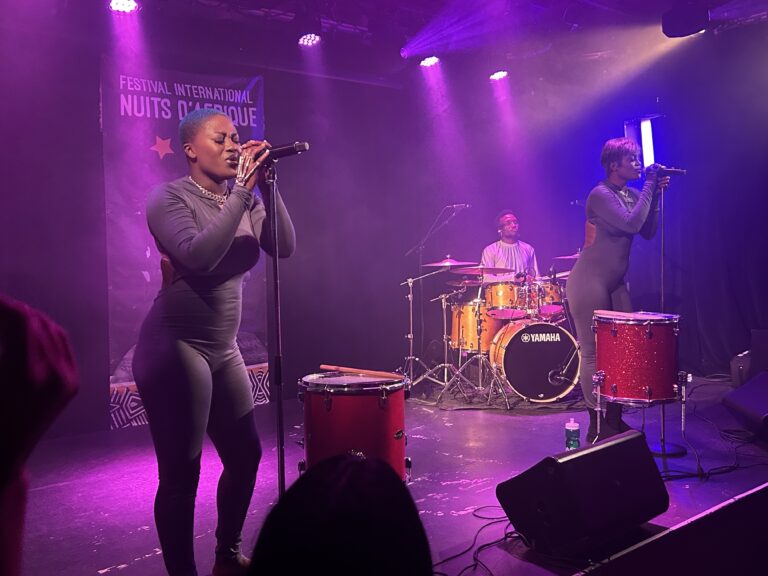
That’s what came out of the show put on by Defa and Mamy Victory, aka Def Mama Def, last night at Le Ministère, during the 38th edition of the Festival Nuits d’Afrique. The explosive Senegalese female duo of the moment is much more than a duo, they’re sisters in art. Dressed in skin-tight hooded jumpsuits, wearing smoked glasses, they arrive on stage accompanied by Simsa on drums and Mr No One on turntables. Between rap and singing, the two artists complement each other and engage in a musical dialogue on stage. “We almost didn’t sleep last night, we were so excited,” confides Mamy Victory, her hair dyed blue for the occasion. As well as singing and rapping, they dance perfectly well, play percussion, all with an electrifying energy. “The next song is for lovers,” they tell us, before teaching us the lembel, one of Senegal’s many dances.
In front of a still shy audience, they managed to raise the temperature in the room on the track Jigeen, which means woman in Wolof. On several occasions, they address the crowd in their native tongue, much to the delight of the Senegalese in the room. “This time, we’re going to the north of Senegal”, warns Defa, as she performs dance steps from her homeland and gets the audience singing along. The two artists tease each other a lot, especially when they tackle the delicate question of ethnicity. “Y’a pas que les Toucouleurs, y’a aussi les Sérères”, Mamy Victory defends herself.
Another highlight of the evening is the song Oh Maliko, on which tradition and modernity are fused. The second half of the concert opens with percussion, as they reveal their talents with this instrument. The two women return to the stage equipped with sticks, and it’s immediately clear that the level of intensity is about to rise. The complicity of the two women is evident throughout the performance. Through glances, smiles and improvised choreography, you can tell they’re enjoying playing together, like yin and yang, waltzing between softness and hardness. Softness in Defa’s honeyed voice when she pushes the note, and hardness at times during Mamy Victory’s torrid raps.
Another electrifying moment is undoubtedly the song Dieuredieuf, released in 2022, which means thank you in Wolof. “We’re going to sing for the whole of Africa”, they announced, in a discotheque-like atmosphere. We were even treated to a little cardio session during which they got our arms moving, before returning to percussion accompanied by their DJ, who also got in on the act. My favorite track was Kalanakh, from the Oh Maliko EP, which they described as “an alarm bell announcing their next album” during my interview with them. Indeed, 2025 will be the year of Djar Djar, the duo’s debut album. Before closing their show, they paid tribute to all the artists who had gone before them, including Positive Black Soul (PBS) and Orchestre Baobab, to name but a few. The only disappointment is that the Senegalese community didn’t turn out in large numbers to welcome the two sisters in art, but let’s just say that this is their first concert in the city, and certainly not their last. Until then, let’s hope the word of mouth will do its job.
PANM360 at Nuits d’Afrique | Alberto Salgado Turns Balattou Into a Percussive Laboratory
by Michel Labrecque
The Brazilian songwriter told me in an interview: “I make MPB, Brazilian percussive music,” making a play on words with the real meaning of MPB (Brazilian popular music). We were able to see, Thursday evening at Balattou, that he was speaking the truth.
The guitarist and singer from Brasilia offered us a two-part concert, largely consisting of pieces from his records Além do Quintal and Cabaça de Agua, as well as the upcoming album Tutorial de Ebo. The temperature quickly rose in the club dedicated to world music.
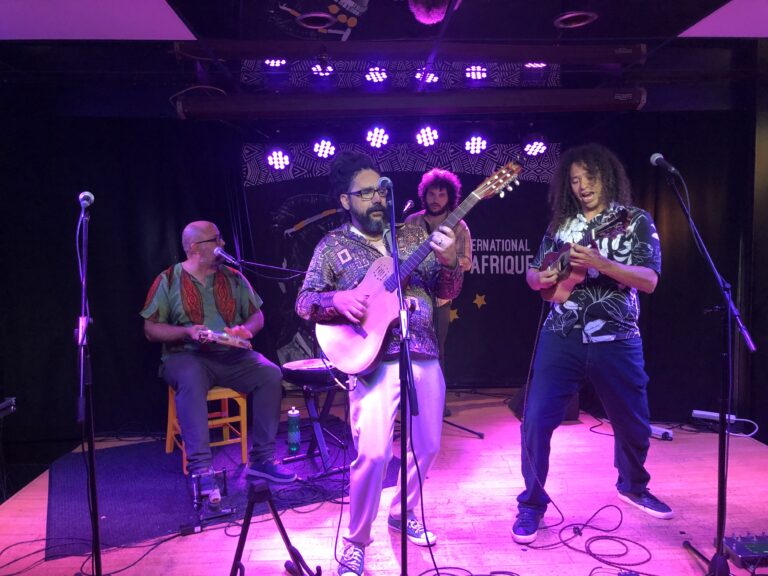
Alberto Salgado is surrounded by a small musical group: Marcelo Marinho on cavaquinho, Valerio Xavier on pandeiro (small drum) and other various percussions, and an occasional triangle player (yes!). This contrasts with the multitude of instruments, including electronic, that we hear on these studio recordings. On the other hand, the guides are overflowing with communicative energy. Enough to supply Place Ville-Marie with electricity!
Marcelo Marinho is the John McLaughlin of cavaquinho, this tiny guitar with high notes. He multiplies his solo flights, dropping notes by tens per second. It is he who provides the melodic foundation of the group, with the voice and guitar of Alberto Salgado.
Salgado’s guitar is very percussive, which brings us back to this idea of music very focused on rhythm. There are forró, samba, Afro-Brazilian rhythms, often very subtle. It is an essential force in Brazilian music, beyond Bossa Nova and the forms better known here. This is what made Balattou transform into a percussive laboratory. In addition to the musicians, the entire audience was stamping their feet or tapping on the table or their thighs. Those who weren’t tapping got up to dance.
Alberto Salgado and his musicians speak very limited English, which has deprived them of sharing with us their worlds beyond music. But that did not prevent the public from feeling communion and the desire to share.
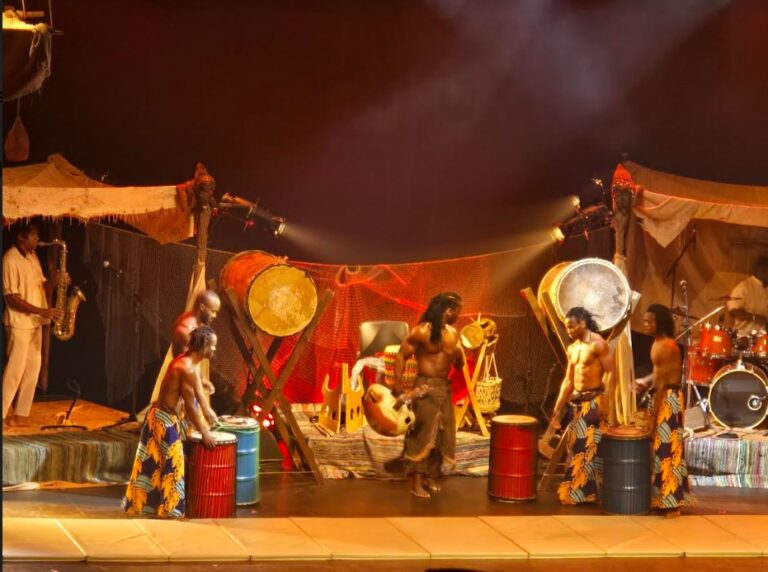
The first “big” show of the Nuits d’Afrique 2024, Afrique en Cirque unfolded on Wednesday at Montreal’s Olympia to a full house. There was a big appetite for this Afro-Quebec circus, this time centered on Guinean culture, typical of West Africa.
“I’ve worked for just about every circus in Quebec on the international scene, and I felt there was something missing: African acrobatics. So I wanted to put on a show about my native Guinea,” explains Yamoussa Bangoura, founder of the troupe. A multi-instrumentalist and acrobat, the leader of Kalabanté has delved into the traditional legacy of Guinea, his homeland, to create a series of musical-circus tableaux, spanning some 90 minutes.
Dynamic, impressive, thrilling, entertaining, humorous, festive, martial, athletic, virtuoso. These are just some of the epithets to describe these acrobatic and choreographic maneuvers of high acrobatics. Four men and two women, some of them amazing contortionists, adapt circus arts to African traditions. They reproduce everyday, traditional practices such as fishing, the market and village feasts, not to mention a few nods to Western life, such as this hilarious number by muscular males à la Village People.
Three musicians accompany them (bass, drums, saxophone, effects pedals, etc.), not to mention the ringmaster, who is in fact the main musician (kora, djembé singing and other percussion instruments) as well as being an acrobat and Kalabanté’s artistic director. Based in Montreal for over two decades, Yamoussa Bangoura is well acquainted with some of the world’s most innovative circus practices, far beyond Cirque du Soleil. A seasoned percussionist, he has instilled the practice of percussion in his fellow acrobats, who regularly contribute to pounding large drums whose horizontals are somewhat reminiscent of Japanese kodo.
The musical direction is hybrid, between traditional Mandingo music and modern Western music (funk, a touch of jazz, etc.). Not rocket science if you know these styles, but solidly executed. The most lasting memory of this evening is that the rich culture of West Africa has legitimately appropriated the universal circus.
Nuits d’Afrique 2024 – Kirá Was On Fire At Balattou
by Sandra Gasana
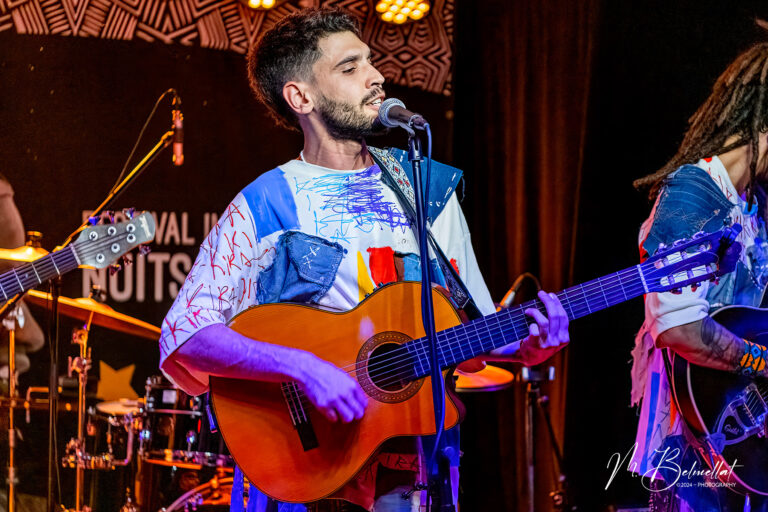
Accompanied by his drummer, percussionist, bassist and guitarist, Kirá kicked off the 38th edition of the Festival Nuits d’Afrique with his guitar. A packed house awaited Manu Chao’s son at Club Balattou last night, his first visit in the city. “Are there any Brazilians in the room?” he asks.
“I’m happy to share this with you,” he says in English. Unlike many concerts given by Brazilian artists, this one had a diverse, multi-generational audience. He alternates between his two latest albums, Semente de Peixe and Olho Açude, one more introspective and the other outward-looking.
The audience started dancing very early in the concert, and the longer the show went on, the harder it was to stay seated. The backing vocals were provided by the percussionist and guitarist, while the bassist kept a low profile. Sometimes, in the same song, we had a complete change of rhythm, sometimes mixing reggae with baião or maracatu. We were treated to some breathtaking guitar solos before listening to the track Mar Mangão. “Here, we go to the sea, to the east coast of Brazil,” he explains before the track.
It’s during the 2nd half of the show that he reveals his stage presence, particularly when he puts aside his guitar to dance. The Balattou stage was clearly too small for Kirá’s dancing. “We exist thanks to you, so thank you for making us exist, for making us play, for singing, for being alive with us,” he confided between songs. There was a good sense of synergy between the musicians, and Kirá often interacted with them during the show.
“We’re going straight to Bahia,” he says in Portuguese, before leaving his guitar aside and going wild on stage. He gets the audience jumping, doing dance moves, asking them to get down on the floor and jump up again, which they do with great pleasure. He thanks the crowd in French, Spanish and Portuguese, switching languages from song to song. He takes time to thank all the musicians, the sound technician and the Nuits d’Afrique festival, to the applause of the audience. “This is the last song, we need your maximum energy,” he asks before playing his latest hit Bota Pra Rodar. “This song is crazy in Brazil,” he tells us, before continuing with a couple of more rocking numbers. I wouldn’t be surprised to see him back in Montreal very soon, and this time in a larger stage where he can move more freely.