chanson française / disco punk

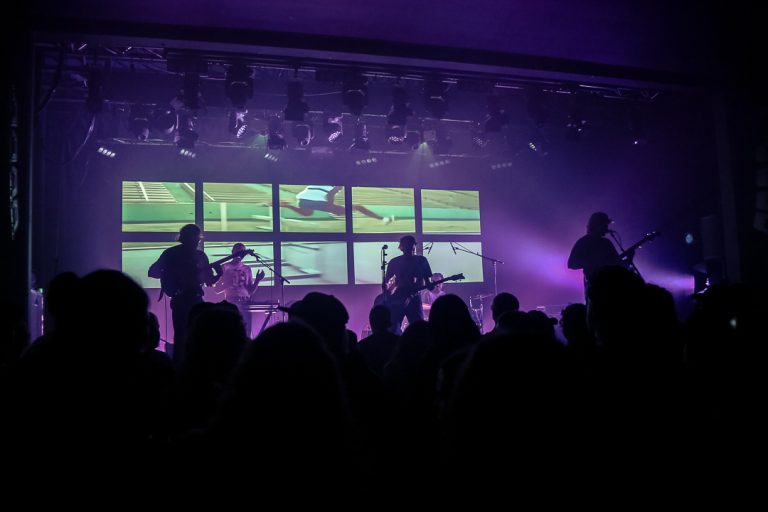
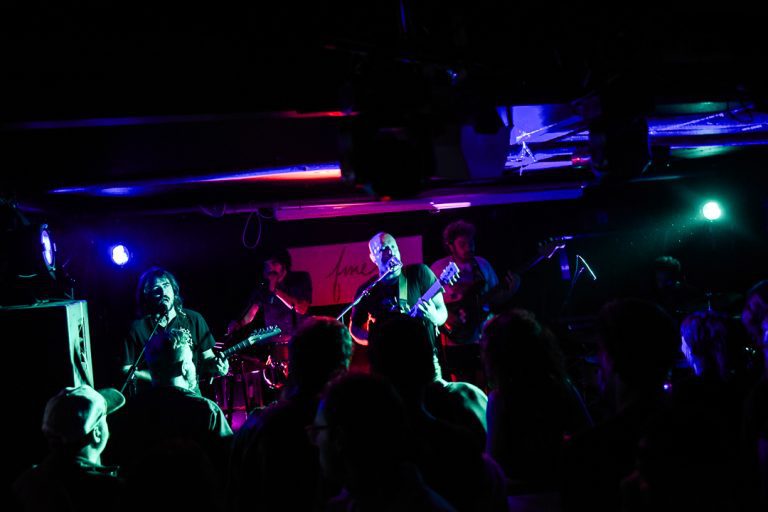
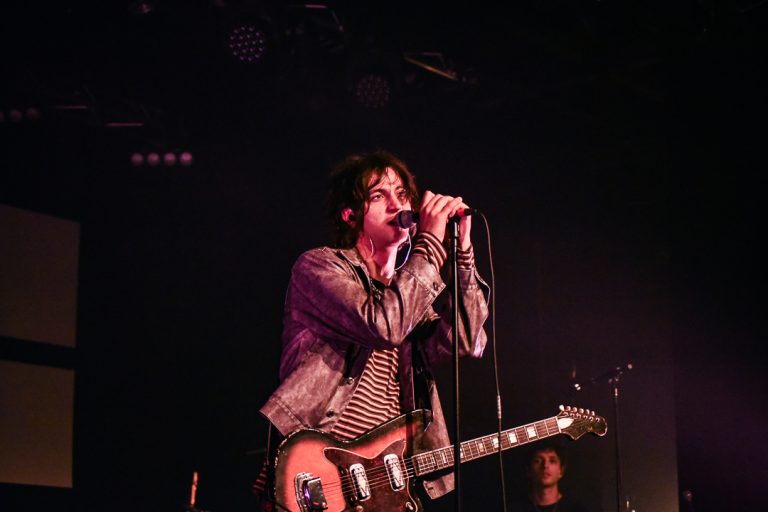
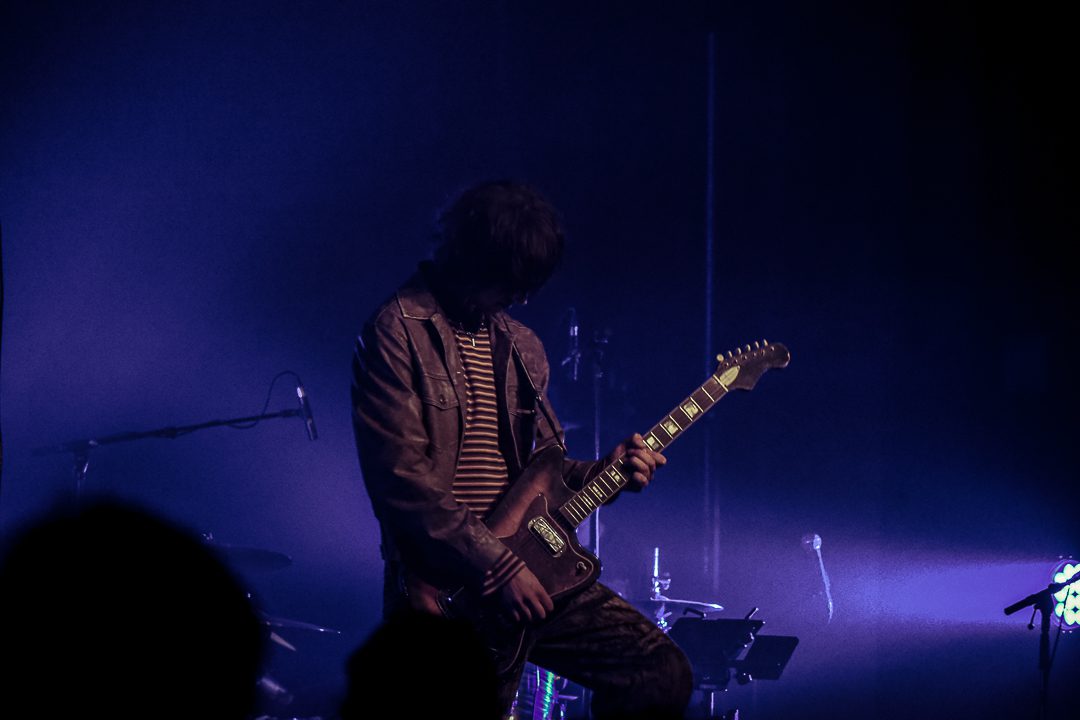
Taverne Tour | Man and Beast: Bernardino Femminieli

by Loic Minty

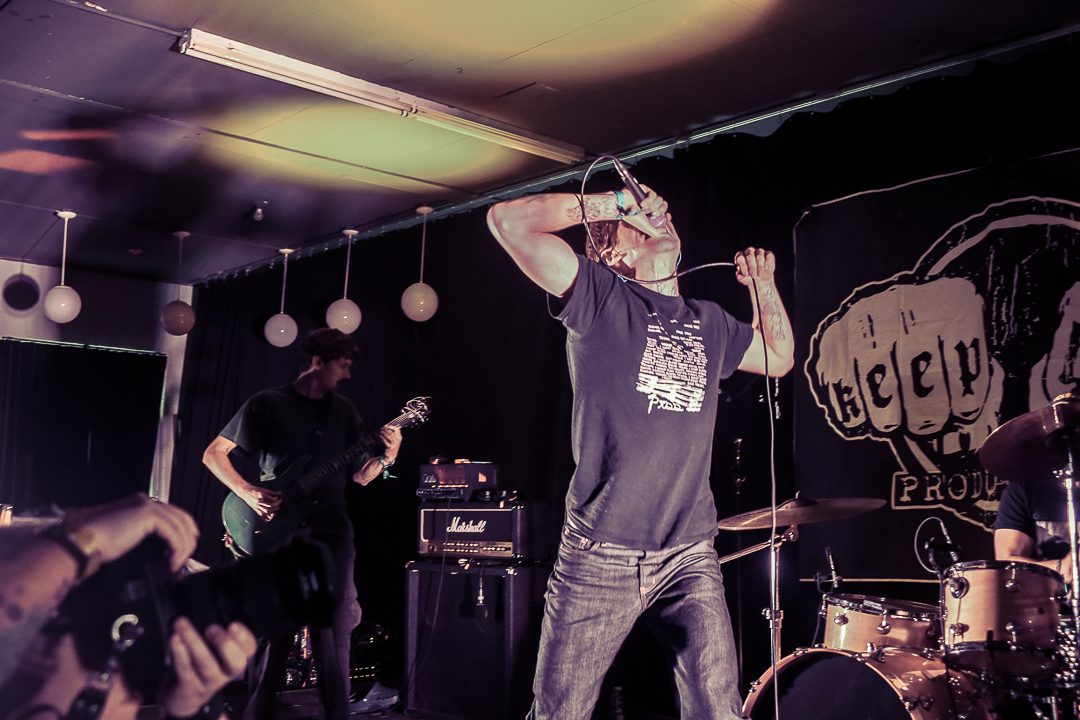
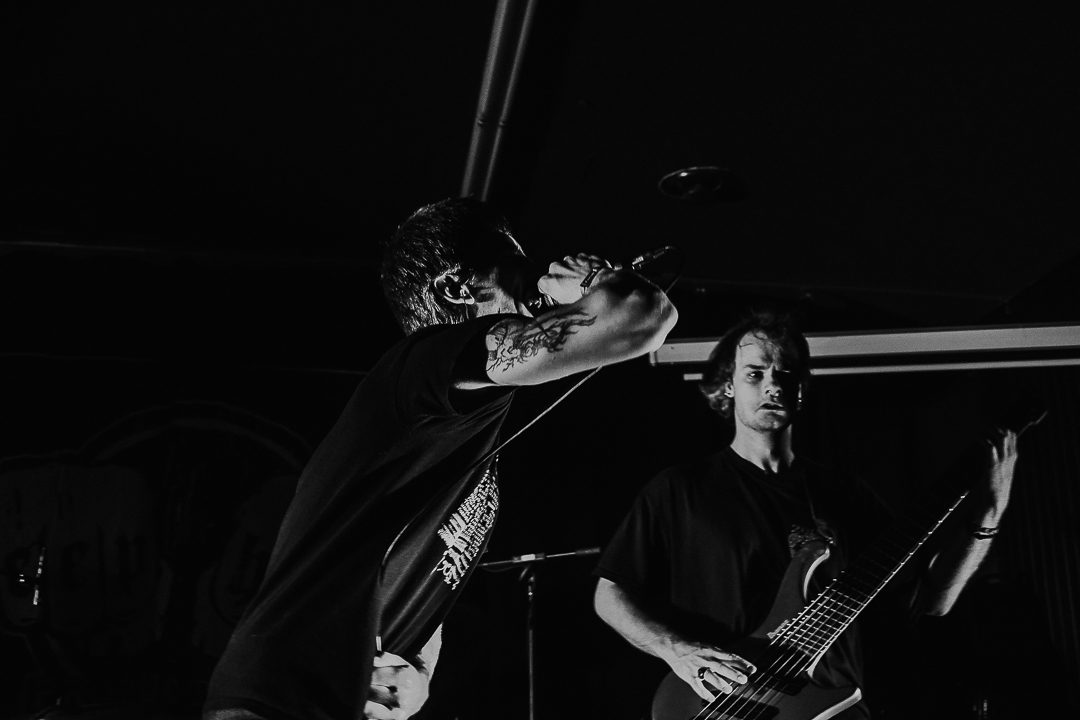
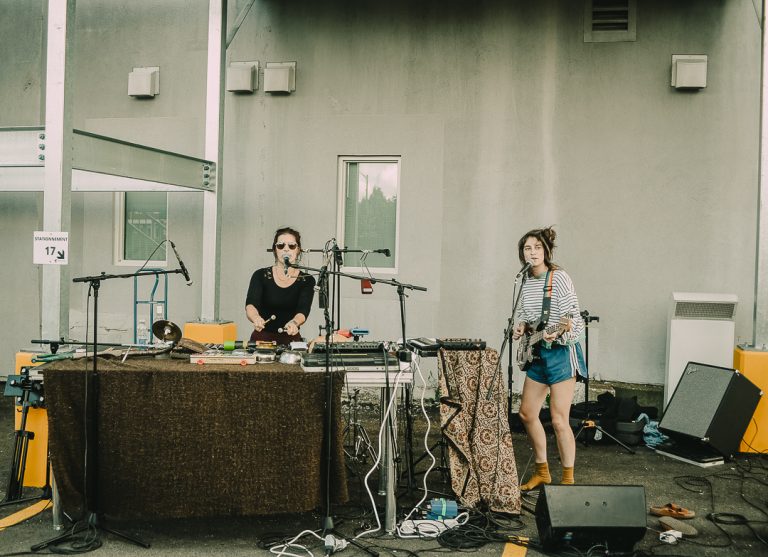
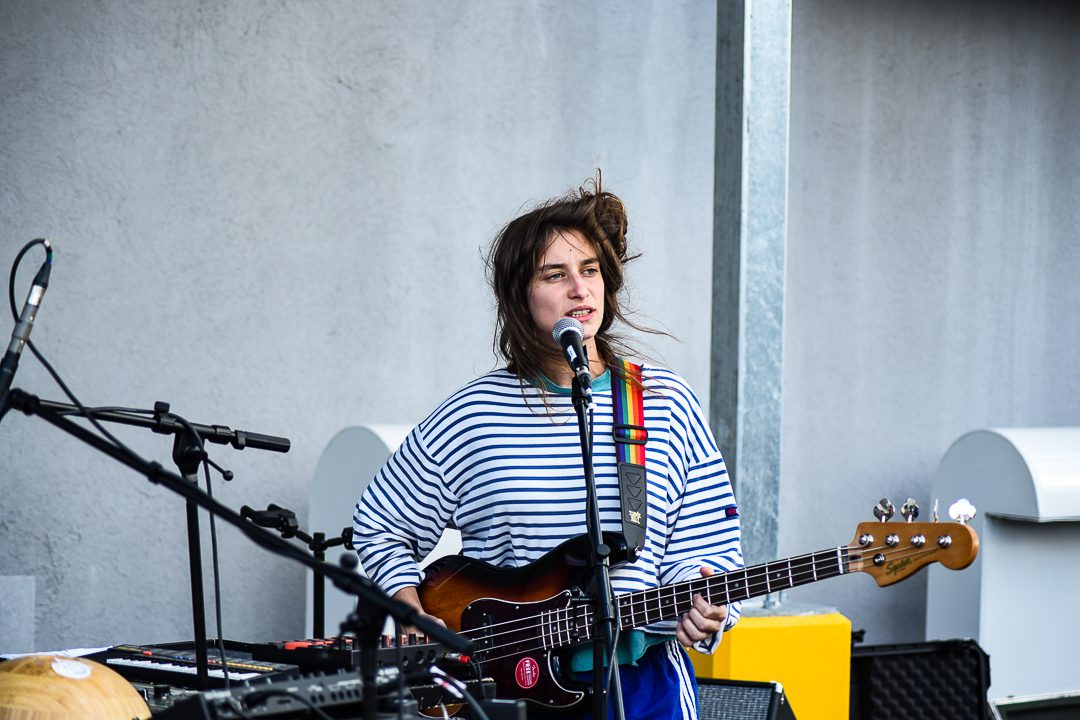
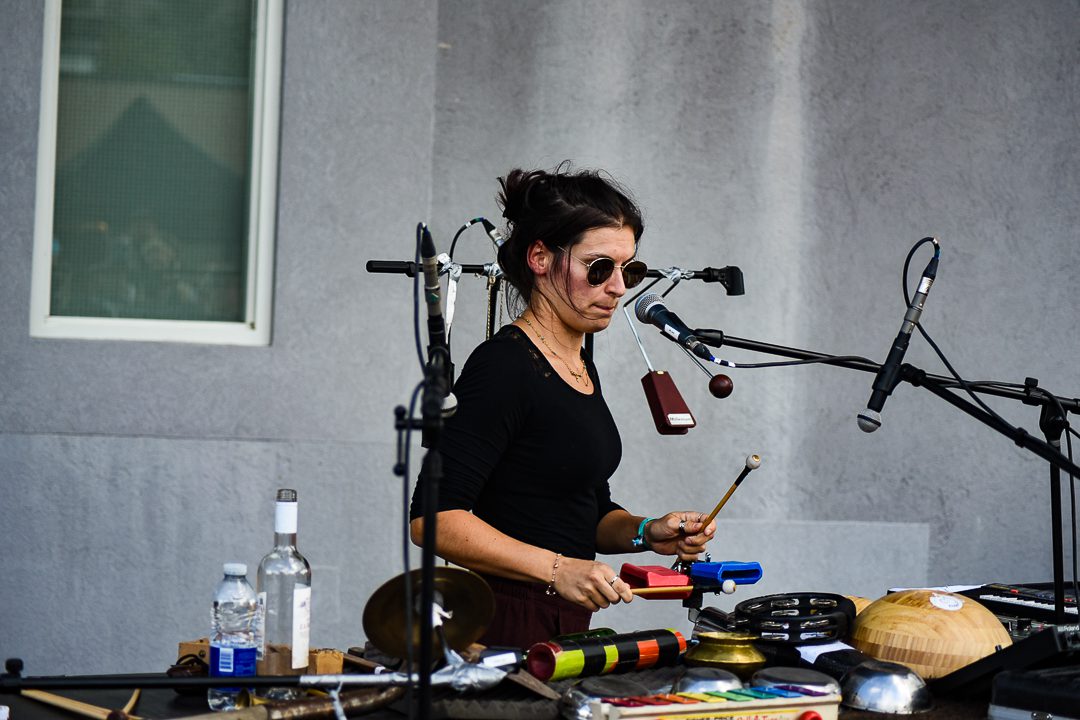
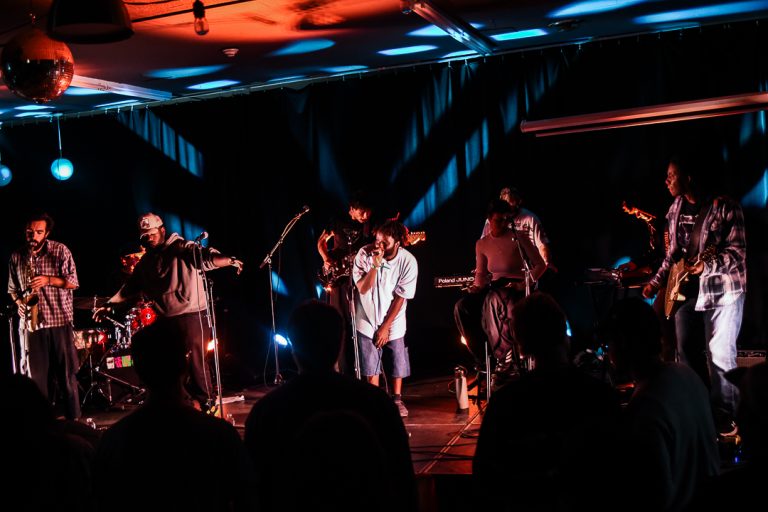
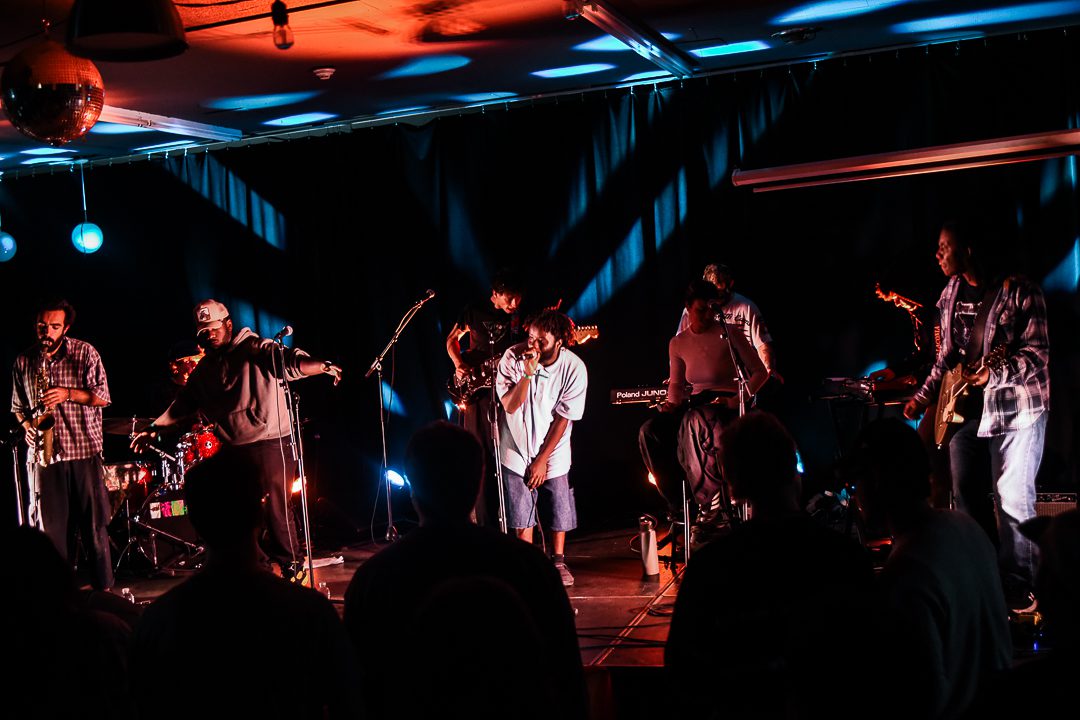
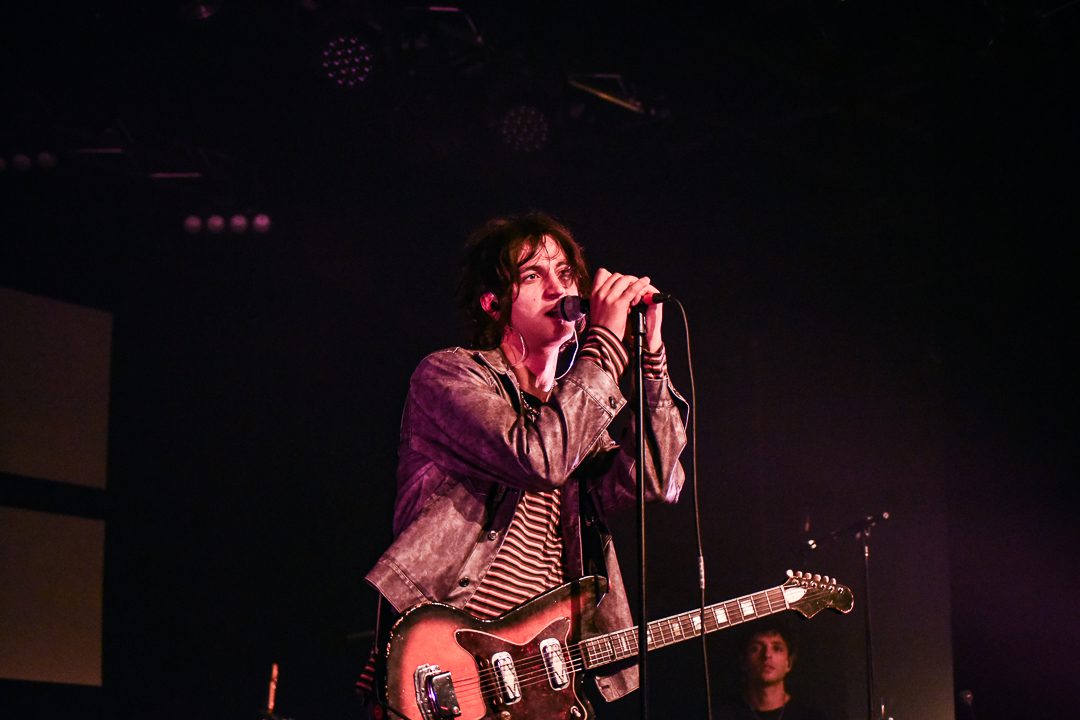
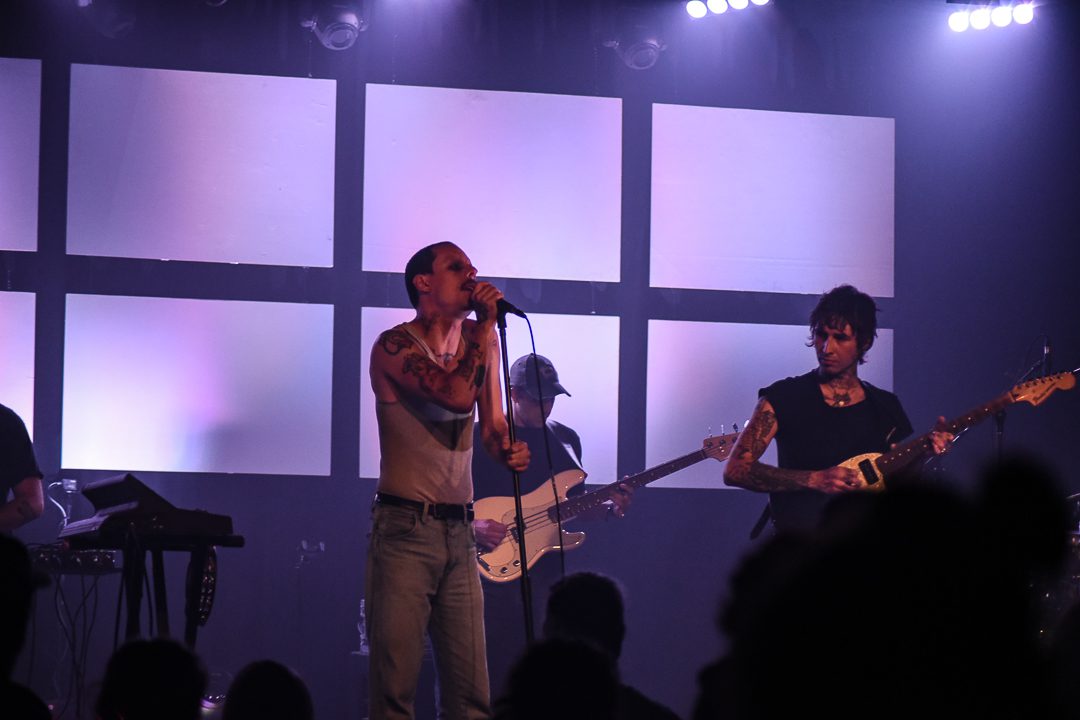
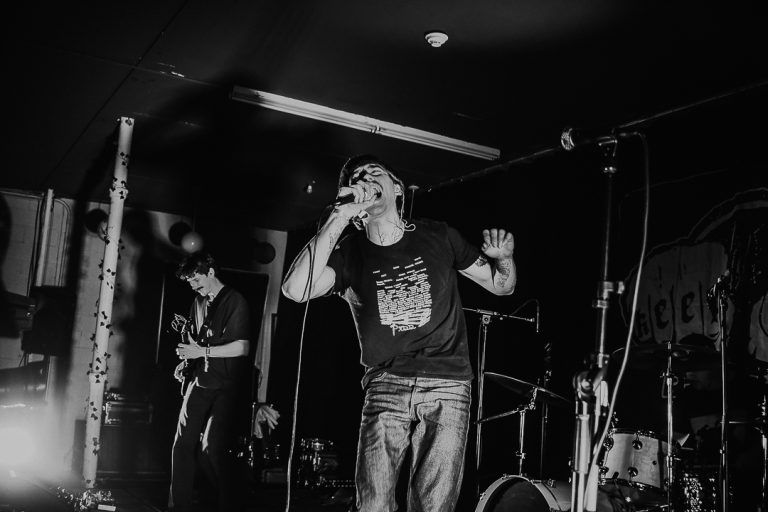
Sunglasses on, eyes fixed on the back of the room. “This one’s about my lawyer and my wife.” Microphone pressed against the long hairs of his mustache, he begins to mutter like Gainsbourg after a few vermouths.

Maybe I’m deaf after doing the whole Tavern Tour without earplugs, but I can’t hear a word he’s saying except for a few bits about anal sex and fascism. The connection between the two remains a mystery. There’s no need to understand all the lyrics; his more Italian side—lively and physical—tells the story for them.

Bernardino Femminieli a.k.a. the “break dealer”

He approaches us, removes his sunglasses, and unbuttons his blouse, revealing a striking display of gold chains and curly fur. One moment he dances subtly with sensual grace, the next he tears his heart from his chest. He seems self-conscious about his sins, yet always returns to that mischievous little smile, proud to tell us that in the end, he emerged victorious. The performance keeps us smiling, but it’s only when the music stops that that smile truly explodes into laughter.

Like a drunken uncle, Bernardino confesses to us.

“The stage is therapy, and you’re just as sick as I am being here.”

Each song is a dedication, the fruit of a story gone wrong; a date filled with remorse with Gigi, a microphone stand thrown into the crowd under a cloud of anger. Bernardino Femminieli is a broken man, but honest at least.

“I could get violent tonight,” he says, explaining how the feedback from the poorly adjusted microphone, combined with alcohol, has already pushed his already fragile mental state to the brink of violence. “He was a friend, but you know, I think there are lasting effects.” With a morose look, he returns to his mixing console to launch into a kitschy, upbeat rhythm typical of the 80s. The ridiculous contrast sends the room into fits of laughter. This time he grunts deeply in Italian: “Te quiero.” By constantly alternating between music and stand-up, Bernardino Femminieli has seen his persona transcend mere performance to become, before our very eyes, a true cult figure.

Publicité panam

Behind this facade of dark humor, there is something thoughtful in the character of Bernardino Femminieli. A Dadaist-style critique subtly emerges through his provocative remarks.

His poems take the form of detailed stories that highlight the conflicts of interest within power, police corruption, and the paradoxes of monogamous love. He never preaches directly. He prefers the shaky confession, the overblown sentence, the incongruous image. It is these excesses that expose the hypocrisy of the structures he evokes.

We laugh at him, but we also laugh at what he reveals within us.

Alt-punk / no-wave

Taverne Tour | Sharp riffs, cyclical rhythms

by Antoine Morin

image de couverture: That Static

Third night of the Taverne Tour festival. What better way to end than with ear-splitting music? An evening I’d been eagerly anticipating: the Quai des Brumes packed to capacity, several spectators wearing earplugs (highly recommended for this kind of program). The anticipation was palpable.

That Static
The first band takes the stage. I’d seen them before, but this was the first time as a quartet rather than a trio. At 8 p.m., a piercing, shrill Jazzmaster rips through the room, coming from the lead singer. It’s such a distinctive sound that you wonder if it’s really the one he’ll stick with all evening. The arrival of the rest of the band quickly confirms it: despite the apparent chaos, every element is deliberate and clearly audible.

The second guitarist occupies the mid-range, while the bassist plays a Jaguar fitted with flatwound pickups, powerfully bringing out the low frequencies. The whole thing functions as a cohesive unit. Every two songs, the guitarists switch guitars to explore different tunings, often lower or deliberately dissonant. These choices immediately bring Sonic Youth to mind.

The band doesn’t play with dynamics, but rather with rhythms, cyclicity, and aggression: each repetitive motif, each micro-variation captivates and creates a hypnotic groove. The intensity of their playing is such that by the end of the set, the guitarist’s guitar is literally covered in blood. The vocals, very screamed and emotional, contrast with the bassist’s soft voice, adding a tension that reminded me of Soft Play‘s Everything and Nothing.

No official material has been released yet, but the band recently recorded at Holy Mountain Studio in Montreal. On stage, their sound lies somewhere between Unwound, Television, and Sonic Youth, but pushed towards something more tense and sharp, driven by a constant sense of urgency.

Publicité panam

Penny & The Pits
It was the only name I didn’t recognize on the poster. I quickly realized that the lead singer also plays in Motherhood. The band is from the Maritimes, and these were their first Montreal shows under this project. What better night for a first show in the city?

I was struck by the diversity of their musical approach: sometimes two guitars, sometimes just one accompanied by a synthesizer. The band alternates between edgy post-punk or garage punk tracks and longer pieces based on pedal notes, reminiscent of Slint. Lyrics aren’t usually my focus, but that night they clearly referenced social injustices and the realities experienced by women, with the singer also providing context between songs.

Musically, I heard echoes of Deerhoof, Amyl and the Sniffers (who even covered one of their songs), and Thee Oh Sees during the most chaotic moments. A refreshing band, with whom the audience seemed completely connected.

Last Waltzon
Headlining the show, Last Waltzon burst onto the stage with both chaos and confidence, clearly not their first rodeo. Each song felt like it had to be seized on the fly: no downtime, just one track after another without hesitation. The two guitarists shared vocal duties, accentuating the raw and visceral nature of the performance.

A palpable, almost feverish urgency pervades the entire set. Yet, through the sonic deluge, melodic lines and cyclical rhythms constantly pull the listener back to something familiar. This tension reminded me of Brian Eno’s second, more punk-influenced album, Taking Tiger Mountain (By Strategy), where repetition and experimentation serve both energy and structure. The chaos is controlled, taut, and devastatingly effective. In the venue, every note resonates deep within: you’re gripped, shaken, utterly captivated. Last Waltzon delivers a furious yet focused energy, pushed to the breaking point without ever losing control.

This evening took me back to the festival’s early days. A completely captivated audience, enthralled by the uncompromising noise rock and post-punk delivered by each band. I left with my eardrums ringing, my body still shaking from the raw energy of the groups, and the feeling that every riff and every repetitive rhythm would haunt me for a long time, with an irresistible urge to listen to these tracks again as soon as possible.

Publicité panam
Industrial / New Wave / no-wave

Taverne Tour | Between Tribute and Reinvention

by Laurent Pellerin

My expectations for this show were based on what I could read on the Taverne Tour website: a tribute to Alan Vega and Suicide, a band I’ve been listening to more seriously in recent months. However, I had deliberately refrained from researching the two artists, Lydia Lunch and Marc Hurtado, in order to preserve the surprise, and on that point, I was far from disappointed.

Publicité panam

I entered the hall and was immediately struck by a shock, like being plunged into cold water and having my breath taken away. To call my initial perception of the music being played abrasive would be an understatement. Let’s just say the first sounds that pierced my eardrums were the antithesis of gentleness, tenderness, warmth, and comfort. It was so dissonant with my preconceived notions that I momentarily wondered if I was even in the right venue. I then caught sight of Lydia Lunch in front of her microphones, though I couldn’t hear her voice. I was instead struck by the thunderous soundscapes, which in no time at all bleached my ears and shattered my expectations. Without wasting a moment, I headed towards the front of the stage, skirting dozens of faces delighted to be there.

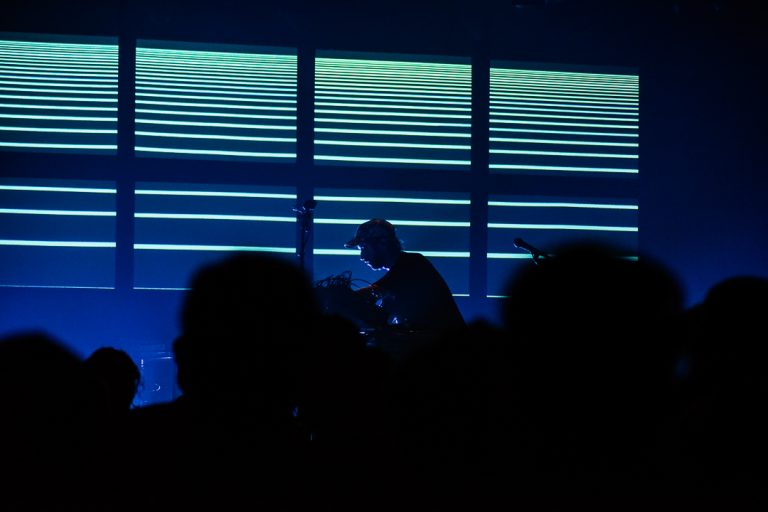
From my new vantage point, I can distinguish the sound sources responsible for this splendid cacophony. Marc Hurtado is positioned behind a table where he triggers rhythmic sequences and immediately obliterates them with a multitude of signal degradation effects. He is equipped with a microphone into which he unleashes sporadic screams that blend perfectly with the blistering musical backdrop. His screams are sent through a chain of slow delays that lend them a certain claustrophobic quality, as if the signal added in real time could not itself escape this thunderous music. Marc Hurtado is firmly planted, his leather jacket and tinted glasses contributing to his imposing presence in the role of industrial DJ.

In front of him, Lydia Lunch leaned against her two microphones. I noticed that one of them was sending a dry signal, without any noticeable effects, while the other was sending a radically different signal, a kind of pool of reverb and modulation, reminiscent of the kind of effects used on Alan Vega’s voice in Suicide. In my mind, they were dubbed the narrative microphone (without effects) and the prophetic microphone (with effects). The narrative microphone seemed to be the one that captured the most words, a more consistent prose, while the prophetic microphone was used for effects of emphasis and repetition; the effects applied to the latter managed to extract the vocal signal from the opaque mass of sound, making certain words more easily discernible. When she is not at the microphones, Lydia Lunch sits at a round table, at the edge of the stage, on which there is a bottle of Hennessy (which was three-quarters empty before the show even started), her glass which is never quite empty, blank sheets of paper scattered about which she frantically flips through, a satchel and a valiant fan which she uses frequently, to the great delight of some spectators.

Publicité panam

Each piece follows a similar formula: Hurtado begins by unleashing an industrial cacophony to set the rhythm, Lydia Lunch rises from the table and heads towards the microphones to deliver prophetic gestures and words, improvised poetry, and socio-political commentary. Her partner punctuates this narrative with screams that thicken an already saturated soundscape, until Lunch returns to her seat at the table and we are left with the resounding DJ for his final bursts of musical violence.

All in all, I was charmed by these musical and conceptual offerings. The two artists, who undoubtedly have a deep respect for the musical career of Alan Vega (and Martin Rev, the other creative genius of Suicide), choose to use the platform of “tribute” as a springboard to convey new messages and revitalize the art in a fundamentally punk spirit. In other words, I understand that when reviving a band and its music, it’s sometimes necessary to adapt it to avoid it becoming stale and stagnant, to rework it to keep the offering fresh and exhilarating, even nearly fifty years later.

Publicité panam
Hardcore / Pop / punk hardcore

Taverne Tour | Wandering Between Pop and Hardcore

by Laurent Pellerin

image de couverture: Faze

Jane Inc.

O Patro Vys is an intimate and relaxed venue that I had previously visited for a hip-hop/jazz jam session. On this Friday of the Taverne Tour, upon arrival, I could have easily imagined myself walking into a nightclub. The electronic rhythms that resonate through the walls perfectly complement the vocals of Carolyn Bezic, leader of the band Jane Inc.

At first glance, I notice the lineup on stage: two backing vocalists to the right of the singer and a keyboardist to her left. The band occupies the stage widthwise, but I get a sense of emptiness. It doesn’t take much for me to realize that most of the music we’re hearing comes from a separate backing track, which seems to be triggered by the keyboardist at the beginning of each song.

Although I see him playing and Carolyn singing, sometimes even adding electric guitar to certain pieces, the fact that half the people on stage are only intermittently involved prevents me from fully engaging with the performance. In this respect, the noisy crowd around me doesn’t help matters, especially during the softer, more intimate pieces.

Nevertheless, I appreciate the stage presence of this singer who seems to stop at nothing to deliver a good show. The band even returns to an energetic repertoire for the last few songs, where the audience becomes more engaged. The singer finishes her set by going down into the crowd, sparking brief dance-offs with the most enthusiastic fans in the front rows.

Publicité panam

CEASE

The Toscadura venue is deeper and wider than the previous one. The vastness of the space is nonetheless filled with fellow fans, reminding me of the exhilarating shows of my teenage years. The punk and metal community has this knack for imbuing any performance venue with a sense of familiar security.

I enter right at the beginning of the set. If the silences between Jane Inc.’s songs were filled by the crowd at O ​​Patro Vys, here they’re filled by the screeching feedback of the guitar and bass. Four musicians, monolithic amps at the back of the stage; I’m ready to receive what CEASE has to offer. Without wasting any time, the guitarist unleashes a fast riff before we’re hit by a violent wall of sound. The musicians are busy with their instruments while the singer oscillates between displays of intense aggression and exhaustion. The next twenty minutes unfold in this way: the band blends blast beats and heavy riffs, the interplay of tension and release achieved through frequent breaks of a few seconds where we’re deprived of tempo, pulled between these moments of weightlessness and the plunge back into the cacophony.

.

Faze

The musicians don’t even need to play for me to sense their confidence. I watch them calmly set up their equipment; the drummer makes numerous micro-adjustments to his snare and toms. At first, I can’t quite tell who will take the microphone, which, for me, is an excellent sign in this kind of musical context.

After a few minutes, the singer steps forward and asks the technician to dim the stage lights. He opens his eyes wide, smiles, and gives a thumbs-up.

The drummer launches into a tom ostinato as the guitars wail in feedback, a typically hardcore introduction that inevitably raises the audience’s heart rate. The excitement reaches its peak when the singer lets out a scream, and the music floods the room like an explosion. Faze’s « concrete » side is immediately revealed. The singer writhes in frenzied jubilation, like a leech that’s been salted, barely managing to grab the microphone to unleash a cascade of echoes with his rhythmic howls. The band’s stage experience shines through in the naturalness of this commotion: the musicians’ proprioception is impressive, each of them constantly swaying without ever colliding with one another.

The famous trombone is quickly unveiled, played for thirty seconds before being abandoned to the crowd. At times, it reappears, carried by a body that rises above the arms of the crowd.

Their set is generous in intensity, inviting us body and soul to join the happy clamor of this second evening of the Taverne Tour.

I leave Toscadura feeling sated, as if purified. I have a smile plastered on my lips and my ears ringing.

Publicité panam
Minimalist

Danger : Delicate Glass

by Frédéric Cardin

In a fairly full hall at the Montreal Conservatory, the aura of Philip Glass permeated the audience present. We were eager to be there to hear the last four quartets of the famous composer. All the more famous because he recently gave Donald Trump the cold shoulder by cancelling the premiere of his fifteenth symphony at the Kennedy Center in Washington. In reaction to the addition of the name ‘’Trump’’ before that of the former Democratic president. Bravo. Nothing more to say about that.

Unusual Glass

The last quartets by Glass are still quite recent and have rarely been played to date, at least here. The Molinari Quartet is preparing them for recording next August. They will be added to the others, already digitally recorded, and will form a complete set that we look forward to hear.

These latest quartets, from Glass’s chamber music perspective, are innovative, even often astonishing. You hear harmonies that were never really explored in the first five, better known ones. Melodies are sometimes distant from the sumptuous fullness of the usual Glass style, and architectural support is different from the repetitive cellular motivism to which the American composer has accustomed us (for example, in Quartet No. 9, King Lear. See further down).

They are, therefore, dangerous for interpreters because they are not “intuitive.” Traps are set everywhere, and it is easy to break their narrative and discursive strength. It often relies on very little, on tiny details that must be perfectly rendered, at the risk of seeing the entire structure crack.

The Beethoven effect

I dare to compare these quartets to Beethoven’s last ones. For Philip Glass, they might have this significance. Of course, not in terms of style and philosophical and spiritual aspirations, but certainly for the place they seem to give to the renewal of the master’s technical language. To the seeds planted for the next generation of Minimalists who will claim his school of thought.

The Bent Suite, taken from a film score, paints sober landscapes that accompany the story of the persecution of homosexuals under the Nazi regime. The score features several passages for solo, duo, and trio. A kind of intimacy of sounds, then. A refined aspect that requires careful control of sound projection, at the risk of sounding harsh. It happened a bit yesterday, in the fourth movement, for example.

Quartet Satz (Movement in German) was written for the Fifty for the Future project by the Kronos Quartet (for which Montrealer Nicole Lizée was also involved). It is a piece of barely 8 minutes, in the shape of an arch that starts in calm, swells with sound intensity before returning to tranquillity. Beautiful, effective, perfectly rendered by the Molinari.

Renewed Classicism

The String Quartet No. 8 is, they say, a “return to Glassian classicism.” My ears still tell me that it dares very unusual melodic detours for the composer. This quartet is a minefield that constantly tests the ensemble’s accuracy and the rhythmic cohesion of a group. On arpeggios with sharper lines and narrower note intervals, melodies or a dangerously chromatic counterpoint are superimposed. The final movement imposes exchanges of arpeggiated ascents and descents that are very difficult to coordinate between the instruments, at least to ensure the ideal fluidity. The Molinari came out of it with a few scrapes, but without losing its vitality, though.

A masterpiece and a legacy called Lear

The program concluded with the masterful String Quartet No. 9 King Lear. It was commissioned by Glass in 2022 to accompany a production of Shakespeare’s King Lear in New York. The composer delved deeply into the story of this mad king, who died in a storm with his daughters, to write a score that is divided into substantial pieces that return and metamorphose throughout the journey. Different from the usual method, then. In general, Glass reuses repeated motifs, short and almost atomic in their individual simplicity. Here, the arpeggios are certainly present, but embedded in larger musical pieces, each carrying its own personality, atmosphere, and character. These movements are reused alternately with others, then transformed. As if the Glassian architecture here were formed not from unique bricks, but from prefabricated blocks.

Above all, this quartet presents striking ideas, such as the rumbling cello, which seems to prepare for the final storm, or the strokes with the tip of the bow creating a frosty effect, like cracking ice. The King Lear Quartet is a masterpiece. If this were to prove to be Philip Glass’s musical testament for the quartet, it would be a memorable one that will be played often and for a long time.

The Molinari excelled here and mastered the deployment of this rich and very touching construction. 

Coming next

There are still several months before the recording, which leaves enough time to make some adjustments and fine-tune everything. What is certain is that the emotional involvement is there, and so is the conviction.

Let’s note that the usual violist, Cynthia Blanchon, who just gave birth (congratulations!!), was replaced on short notice and superbly by Sebastian Gonzalez Mora, a musician with the Montreal symphony.

Upcoming concerts by the Molinari Quartet:

March 29, 2026 (Glass and others) Molinari Foundation 

May 28, 29, 30, 2026 (Shostakovich) – Conservatory Hall

Post-Punk

Taverne Tour 2026 | A Journey into the Depths of La Sottarenea

by Simon Gervais

On February 13, my Taverne Tour continues under the banner of post-punk at La Sotterenea, the quintessential underground venue. The space lends itself perfectly to music that works through tension, repetition, and shadowy zones. I step into this troglodytic environment just as the dark, low-end frequencies of Bonnie Trash begin to resonate.

Formed in 2013 by twin sisters Emmalia and Sarafina Bortolon-Vettor, the all-female quartet delivers heavy riffs blending post-punk, goth rock, and doom. The singer recites her lyrics in a deep voice that chills you to the bone. She cuts a striking figure: shaved head, leather clothes, tattoos. Chin raised, she locks into a defiant stare. Their horrorgaze songs probe the horror lurking within the everyday—diffuse violence and ordinary mortality. A lucid darkness and singular heaviness give the performance an irresistible pull.

Publicité panam

We step outside for some air, then head back underground for Jessica93. After a slightly laborious soundcheck, Geoffroy Laporte jokes, “We’re a bunch of screw-ups, it just takes a bit more time.”

Alone on stage, the French artist launches a track that feels like a rock-infused drum machine. Using a loop pedal, he layers in a thick bass line that reinforces the intoxicating pounding of the programmed drums, then tears into a searing guitar for frenzied solos. Long hair falling over his face, Nike sneakers, Adidas track pants—none of it detracts from Jessica93’s resolutely hard-edged presence. You can sense shoegaze and grunge influences, with touches of desert punk.

The lyrics are muttered in French—at times shy, at times strikingly intentional. “It’s a love song called La colline du crack,” he says at one point. The loops, distortion, and relentless pounding all come together in a DIY, noise-driven result that feels almost post-apocalyptic. It’s impressive to see a single man carry the weight of such an experimental project.

This second night of Taverne Tour at La Sotterenea offered stunning discoveries within the endless underground spaces of our souls..

Alt-punk / Garage Punk / Grind Punk

Taverne Tour | The Punks Take Over

by Loic Minty

CEASE: A Necessary Violence

The powerviolence group CEASE from the steel town of Hamilton, Ontario, are one of programmer Rose Cormier’s golden nuggets. CEASE have all the cards. The singer steps on stage already looking furious, an emotion that only increases in intensity. Deafening feedback tears through the room before the drummer and bassist tumble into violent convulsion. Immediate sensory overload. The singer, boiling inside, lets out steam. Face flushed red, eyes on the verge of collapse, muscles straining from the neck. Screams you feel in your bones.

Though the words are barely audible, the breakdowns carry a kind of mantra. “I can’t afford it.”

Reminder that a two-bedroom is $2,148 and a one-bedroom is $1,809, according to today’s Hamilton Spectator (2025).

In Hamilton, and in Canada at large, the unaffordability of basic needs is becoming a form of complex trauma, one that now feels alarmingly understated. CEASE teaches us to say no when it hurts. They remind us that no one has ever won their rights by politely asking for them. Tension unravels into exasperation. Violence erupts like pus from an old wound.

“We’d really appreciate it if you could walk from one side to the other like a caveman.”

Among the culprits is a stringy guy sprinting back and forth, nearly putting a hole in the wall. The 4’11” girl in front of me is the only barrier between them and the camera I borrowed. She has a huge smile on her face.

Publicité panam

La Sottarenea: The Terrorizing Act of Mickey Dagger

Mickey Dagger is an absolute nut job. Even among the most rugged and frightening stage personalities we have seen so far, there is usually some separation, some self-awareness that keeps them sane when they go home at night. With Mickey Dagger, it is hard to tell whether it is an act at all or whether he is doing this out of pure necessity to relieve his tormented soul.

He sings over a Martin Rev–inspired rhythm machine, while two guitarists and two saxophonists drone at psychedelic velocities. With a long slapback delay on his voice, he slips into a stream of narration, gesturing through a violent scene of betrayal before crashing to the floor in an endless scream, his eyes never losing focus.

The melodrama borders on comical, made even funnier by his total commitment to it. The longer it goes on, the more I find myself breaking into a smile at Mickey Dagger’s theatrics. It could have felt excessive, but the music, which is simply incredible, holds everything together. The band executes this twisted atmosphere of experimental industrial punk to perfection, while somehow keeping the form accessible. The songs evolve chaotically but return to strong motifs, with Mickey’s impressive vocal range cutting cleanly through the noise. It ends with Mickey Dagger kneeling with his back to the crowd, as if being arrested, before miming shooting himself in the head. “You’ll never get me.”

Publicité panam

Sala Rosa: Quebec’s Wild Child

It would be impossible to talk about last night without mentioning Enfant Sauvage’s unforgettable, possibly historic, concert at Sala Rosa. In a place and time when Québécois identity is under scrutiny, Enfants Sauvages are, as their name suggests, untamed. With Enfants Sauvages, there is no shame in taking pride in where you are from. “On vient de Saint-Roch tabarnak!” (
we are from Saint-Roch”). Wearing a one-piece denim overall with a bedazzled fleur-de-lys on the back, the singer showed us exactly where to put that inhibition.

With veterans of the scene on stage, the music dipped and dove through breakdowns and blistering tempos that pushed past their limits until even one guitarist’s hand started bleeding. “Pas besoin de guénilles esti, quelqu’un pitchez-nous votre chandail!” (“No need for a rag, someone throw a t-shirt up here!”). In an instant, five shirts were thrown onto the stage to serve as makeshift bandages. Their riffs feel indebted to the riot grrrl movement, but with something heavier rising from hardcore, a kind of feral, animalistic grunge.

But the punk-garage-hardcore band is about more than music. An entire theatrical piece unfolds alongside the lyrics. Two twins in blunt bob wigs strip at opposite ends of the stage, illuminated by flashlights held by hooded figures. The whole scene feels like a Pussy Riot flash mob.

They chew apples and spit them into the crowd, fling paper planes toward the bar, and pretend to call God on a landline. Between trying to keep up with the spectacle, the bloodied guitarist shredding relentlessly, and the singer nearing full-frontal nudity as she unbuttons her one-piece, Sala Rosa transforms into a madhouse of poetic chaos. Leaving feels like falling from a cloud.

Whatever may happen tomorrow, last night at Taverne Tour continues to vibrate into today. The festival feels bigger this year, with nearly every venue overflowing and the music surging through the city like an open current, each room humming with urgency, sweat, and the thrill of something that refuses to be contained. Let’s call it punk.

Publicité panam
Alternative Rock / Post-Punk

Taverne Tour | A First Post-Punk Evening Under the Red Lights

by Simon Gervais

Thursday, February 12th, the first night of the Taverne Tour 2026 at the Belmont invited fans of abrasive textures and tense grooves to a lineup decidedly focused on post-punk. Outside, a biting cold served as a reminder that February in Montreal makes no compromises; inside the tavern, the atmosphere gradually warmed up as the room filled.

Alix Fernz – Une entrée en matière dense et habitée

photo par Aabid Youssef

Wearing a sports jersey from what appears to be an obscure hockey team, Alix Fernz opens the evening with nervous post-punk, driven by heavy grooves and lyrics declaimed with a tense and raspy intensity.

The compositions are built around solid hooks, well-placed rhythmic breaks, and soaring keyboard passages with organ-like accents that at times add an almost liturgical dimension. The guitar, precise and poignant, occasionally introduces skillfully measured dissonances.

A physical music, oscillating between tension and trance, that conveys a certain urgency to live life to the fullest. In her lyrics, Alix Fernz explores the consequences of burning the candle at both ends with a paradoxical energy that almost makes us want to imitate her.

Hot Garbage – Hypnosis Through Repetition

Hot Garbage continues with a more circular approach, relying on repetition as the rhythmic engine of their compositions. The motifs accumulate and intertwine, creating a hypnotic effect that quickly spreads to an increasingly mobile crowd.

“We’re Hot Garbage,” the singer declares at the end of the set with disarming confidence, like an ironic manifesto. Behind the apparent nonchalance lies a mastery of textures and dynamics that fits perfectly within the post-punk DNA of the evening.

Publicité panam

Yoo Doo Right – Incandescent Krautrock and total immersion

Bathed in an enveloping red light that lends the stage an almost spectral quality, Yoo Doo Right stretches out its long krautrock and post-rock crescendos. The trio patiently builds its pieces until reaching a veritable wall of sound, dense yet clear.

The drummer hits hard, the bass and guitar hold their own, it’s a real blast, to the point where some audience members pull out their earplugs. The vibrations ground Yoo Doo Right’s live sound in something profoundly physical, evoking vast and evocative, almost desert-like landscapes, where repetition becomes trance and volume acts as a kinetic, cinematic, and visceral force.

Protomartyr – A cry from the heart beneath the jacket

Then came Protomartyr, the evening’s most anticipated act. Seeing singer Joe Casey take the stage in a jacket immediately made an impression: a look somewhere between a sober crooner and a disillusioned poet. A man who seems to carry the weight of years and who transforms this baggage into raw, expressive material as soon as the music started.

The band remains true to its signature raw new wave sound: a taut groove, an existential urgency, and vocals imbued with a certain malaise. The intensity is such that a genuine mosh pit erupts in the crowd, complete with body surfing, the true physical explosion of the evening.

The rhythm section is also formidable (special mention to the drums, tight and driving), and the sound quality is impeccable. On stage, Casey drinks a beer between bursts of sound, as if to better convey this blend of cynical lucidity and ardent abandon that fuses into a genuine surge of life. In the front row, the fans religiously recite the lyrics of each song.

It’s music that makes you want to let loose as much as it makes you think. To survive, perhaps, but above all to live life to the fullest.

This first evening of the Taverne Tour 2026 offered a coherent journey through different incarnations of post-punk, from its most current forms to its new wave roots. A solid, immersive opening that launched the festival on a note that was at once dark, vibrant, and resolutely alive.

Publicité panam
alt-rock / Breakbeat / Rock

Taverne Tour | Scouring for Light on Saint-Laurent

by Loic Minty

La Sottarena: Welcome to the Experiment

Korea Town Acid had, in my opinion, stolen the show during MUTEK two years ago. Her music is cutting edge, her approach totally experimental. What was she doing at La Sottarena with two hardcore punk bands? Something about a video game? Most of her set seems to have gone completely over the crowd’s heads, which somehow made it even more special for me and the handful of other people I could see bobbing in ecstasy. Her set jostled between an eclectic selection of breaks, orchestral pads, jazz chords and soul samples, which she was launching live, a mind-boggling technical feat.

Korea Town Acid

To call her simply a DJ would be like doing the same to Arca, technically accurate, but wildly insufficient. The word feels too small for what unfolds. Both move far beyond that narrow frame, less selectors than conjurers. In a previous interview with PAN M 360, K.T.A. describes a constant readjustment with the crowd, but as she occasionally looked up for vibe checks, nothing but a slightly tipsy “woo” girl was cheering her on.

Her set ended somewhat anticlimactically, with the announcer barely acknowledging this fantastic performance, instead promoting the video game.

“So for this evening we-”
“Koreaa Town Acid!! Woooo!”
“Yes, give it up for Korea Town Acid, and next up we have Nuha Ruby Ra.”

The stage presence was excellent. Nuha Ruby Ra had swagger like M.I.A., a demented smile and a commanding tone that could cast a spell. “Get fucking closer to the stage.” Without noticing, my feet moved forward. As for the music, she said herself: “This set is experimental, we came all the way here to test out material.” It was like an atonal Channel Beads, or maybe the singing was out of tune. With that comment from Nuha, it became hard to tell apart what was intentional or not. Taverne Tour is about bringing your A-game, and this felt just slightly disconnected, with the guitarist not looking too inspired to play alone over backing tracks, and Nuha maybe more aware of this gap in reality than she could admit. After three songs, I kicked it for Casa.


Casa Del Popolo: Gymshorts Takes the Bit all the Way

Gymshorts

At Casa Del Popolo, Gymshorts was playing and it was anything but self-indulgent. With members from Providence and Boston, they conjured a scene of gritty DIY East Coast musicians that just love what they do.

Between each verse and chorus, the lead singer and guitarist, Sarah Greenwell, dipped back to give her bandmates a chuckling smile as if she were egging them on. It worked. Both the guitarist and bassist jumped fervently like it was an early iPod ad. A welcomed change. The music took me back to simple times. It had a well-dosed air of 2000s pop-punk, but Greenwell’s raspy low voice rang deeper into influences like Ana da Silva of The Raincoats. Just on the verge of losing control, yet always completely emotionally present.

It felt like each two-minute song was their last and if you had seen this band on some fortunate evening at Barfly, you would be raving about it for years. I only left because I didn’t want it to end.

While I was leaving, Greenwell began playing a song about American racecar driver Jeff Goldblum, while playing a Jeff Goldblum-themed guitar. Oh, did I mention she was wearing gym shorts? If you want to get in on the joke, I highly recommend going through their discography, with one of her top hits being DUI IUD, a song about, yes you guessed it, getting a DUI instead of an IUD.


Sala Rosa: Reaching for the Heavens

My first impression walking in was a burly man with a cowboy hat who smiled at me from the corner of his mouth. We could write an entire essay about Sean Nicholas Savage’s iconic performances, but for the full story I’ll hand it to our Sala Rosa correspondent Laurent Pellerin’s review.

Sean Nicholas Savage

Christopher Owens: The Cherry on Top

The outsider weirdness of Daniel Johnston, the edgy honesty of Elliott Smith, and the lightness of Neil Young combine to make Christopher Owens. Possibly one of our generation’s greatest songwriters, as Sean Nicholas Savage put it. And I defer. Christopher Owens made me believe in love again. He gives a twist to the qualms, a hope to the misery we always knew existed but were too stubborn to let wash over us. He, on the other hand, had nothing to hide. It felt safe, yet uncomfortable. It felt like growing. He stumbled as he walked, but it was always in the right direction.

Between songs there was some awkward stage banter, something about how the film “The Plumber” had changed his life. The rest was hard to decipher. It always felt like it could go south, but it didn’t. He held that fine line of being both vulnerable with himself and open to us. A true gift on this first night of Taverne Tour, the likes of emotional honesty and deepfelt joy I haven’t experienced since the Beverly Glenn-Copeland show.

Christopher Owens

Last night, Taverne Tour reminded me that if you know what you’re looking for, you’ll find it.

indie / soft-rock

Taverne Tour | Soft Snow, Soft Sound

by Marilyn Bouchard

The opening night of Taverne Tour began under a soft snowfall on Thursday, February 12. Over at the Esco, Vanille set the tone with a vaporous and delicate soundscape. Singer Rachel, dressed in a gown the same blue worn by Lady Gaga during her halftime performance, appeared on stage surrounded by her collaborators: Vincent Huard-Tremblay on bass, Victor Tremblay-Desrosiers on drums, and a guest guitarist and keyboardist joining the usual trio, in front of a crowd already buzzing for the launch of Mort Rose.

Despite a few off notes at the start, they quickly found their footing and delivered an atmospheric collage of songs drawn from their albums Soleil 96, La clairière, Tu me vois comme je suis, and more recently Un chant d’amour, offering a glimpse into their universe, at times soft and romantic, at times retro-folk. The audience was largely receptive, swaying gently with the music, though some seemed eager for the explosive energy that Mort Rose was set to bring.

Personally, I found the musical journey pleasant and the discovery refreshing. A perfect program to build anticipation ahead of the much awaited launch of Mort Rose’s new album, full of rhythm and dynamism, an impression perhaps less widely shared among the die-hard alternative rock fans gathered for the event.

Afro Fusion / classique

Successful Evening at The OSM: Steven Banks Makes The Saxophone Shine

by Jeremy Fortin

On Wednesday evening, the OSM presented the concert López, Childs, and Mahler: Hope in Exile, a rich and diverse program that explored the different facets of classical music.

The first part of the concert featured two contemporary pieces, beginning with Perú Negro by Jimmy López, composer-in-residence with the OSM. This six-movement work was the ideal way to start the concert. Drawing inspiration from Afro-Peruvian music, López takes us on a journey through Peruvian culture in a rhythmic atmosphere, punctuated with effects and strongly supported by percussion.

The concert continues with American saxophonist Steven Banks, who is visiting to perform composer Billy Childs’ saxophone concerto, Diaspora. The piece, which traces the exile of the African American people, illustrates a dark world rooted in fear and internal strife for this people sent by ship to America by slave traders.

Steven Banks’ performance lived up to expectations. Not only did the saxophonist deliver a series of virtuoso passages, but he also demonstrated great sensitivity during the cadences surrounding the three sections of the piece. After two dramatic movements, the work ends on a much more joyful note, illustrating the resilience of the African American people.

As for the second part of the concert, Rafael Payare continues his cycle of Mahler symphonies with the composer’s Fourth. If you are used to associating Mahler with drama, think again, because this is certainly not the case with this symphony. Here, Mahler uses a much more classical language than in some of his other works.

Payare, for his part, successfully illustrated the numerous changes in character, as well as the wide range of nuances required to bring the piece to life. The concert ended with the fourth movement, which featured soprano Nikola Hillebrand, who stepped in to replace Vuvu Mpofu, who was unable to attend. The German soprano gave a brilliant performance of this final movement, offering a particularly interesting vocal texture.

EDM

Igloofest 2026, Week 4 | Analog synthesizers and nostalgic EDM at -14°C

by Antoine Morin

Sometimes electronic music can seem disconnected, almost unreal. And yet, on Thursday evening at Igloofest, it proved to be deeply embodied. It was a memorable evening, tinged with unexpected nostalgia. Moments when an entire crowd seems to be truly listening are rare, but that night, on the banks of the frozen river, Igloofest transcended the simple framework of a winter festival.

Publicité panam

LAURE

The evening kicks off around 7:30 p.m. Outside the venue, I can already hear that familiar kick, somewhere between 125 and 130 BPM, echoing in the distance. When I arrive, the venue is still quiet, almost shy. There’s not much activity, and the crowd is sparse. And yet, something intrigues me: LAURE is already at work on the main Sapporo stage.

A Montreal-based DJ and producer, LAURE opens the evening with precision and intelligence. She knows exactly how to set the mood, how to turn up the heat without rushing things. Her selection navigates between melodic house and deep progressive, carried by synth leads with nostalgic colors, subtly anchored in classic house rhythms. An atmospheric, emotional, and elegant sound, where each transition seems designed to prepare for what comes next. Nothing flashy here: finesse, control, and the ability to gently gather the crowd in front of the stage.

Weval

At around 8:30 p.m., it was time for Weval, my real favorite of the evening and already one of my favorite electronic music groups for several years. The Dutch duo, based in Amsterdam, is on a North American tour to promote Chorophobia, their latest album released in 2025. It’s hard to describe them better than this: ambivalent, daring, and deeply free in their approach.

Weval navigates a hybrid zone, somewhere between EDM and more experimental electronica, flirting with IDM. Their music, richly adorned with polyphonic analog synthesizers, exudes an almost organic warmth, reinforcing that omnipresent feeling of nostalgia. They open their set with a remix of Alesis by Mk.gee, before moving on to several tracks from Chorophobia, an album that is more eclectic and adventurous than the rest of their discography.

The audience listens attentively. Few phones are raised. Just bodies standing still or moving gently. A true moment of grace.

Elderbrook

Headlining the event, Elderbrook brings the evening to a close. A clear reminder of the emotional power of EDM when done right. His set navigates between remixes, notably by RÜFÜS DU SOL and John Smith, and original tracks from his own repertoire. Unifying classics, capable of bringing an entire crowd together in a single moment.


At that moment, in the heart of the pit, I find myself transported back to 2016, when EDM and raves were at the forefront of mainstream electronic music. Everyone is in sync. The bass beats, hands are raised, eyes meet. Despite the cold, which feels well below 14°C, the connection is total. It’s a sincere, beautiful moment, unique to this evening.

For a Thursday night, the event far exceeded my expectations. It was a powerful, memorable evening that thousands of festival-goers were lucky enough to experience. If any of these three names come to Montreal in the next few months, here’s my advice: go. No matter what the temperature.

Publicité panam
Subscribe to our newsletter

Inscription
Infolettre

"*" indicates required fields

Type of Suscribers