Experimental Techno / Minimal Techno / Techno

S.A.T. | The Intracellular Techno of Marie-Davidson & Wata Igarashi

by Laurent Pellerin

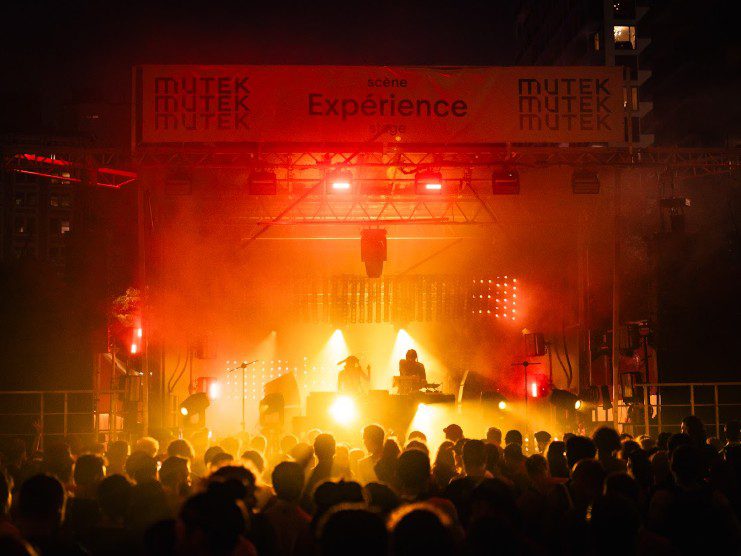
The room is almost empty when I arrive. The projections move slowly and catch the eye, sparse but impressive. The first DJ, Asha from the Ether collective, sets the mood for the evening. I sit down near the bar, enjoying the calm before the storm. Soon, the room is packed.

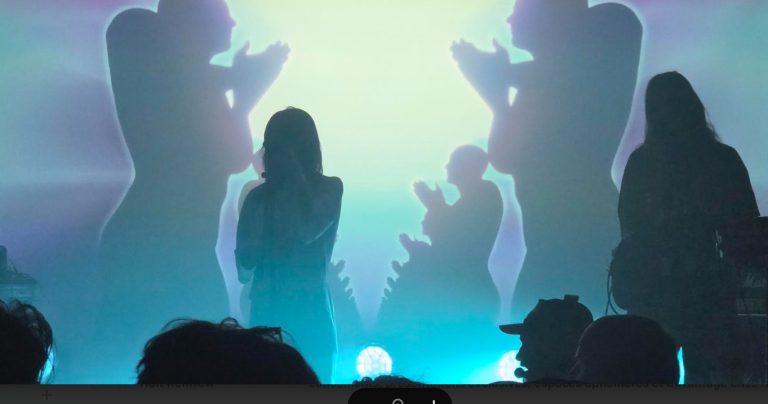
The illusions of spatial depth, generated by projections on the dome walls, constantly oscillate between immense intergalactic depth and claustrophobic intra-cellular oppression. If I had been slightly more sensitive to these drastic changes in spatial perception, my listening experience would certainly have been negatively affected. However, the visual programmers knew how to calibrate the intensity level so that a feeling of unity emanated from the audio-visual stimuli; a kind of general synesthesia of the energy deployed between sounds and rhythms, colors and shapes.

We move forward a few minutes before Marie Davidson takes the stage, squeezing into the enthusiastic crowd as best we can.

Publicité panam

Marie-Davidson

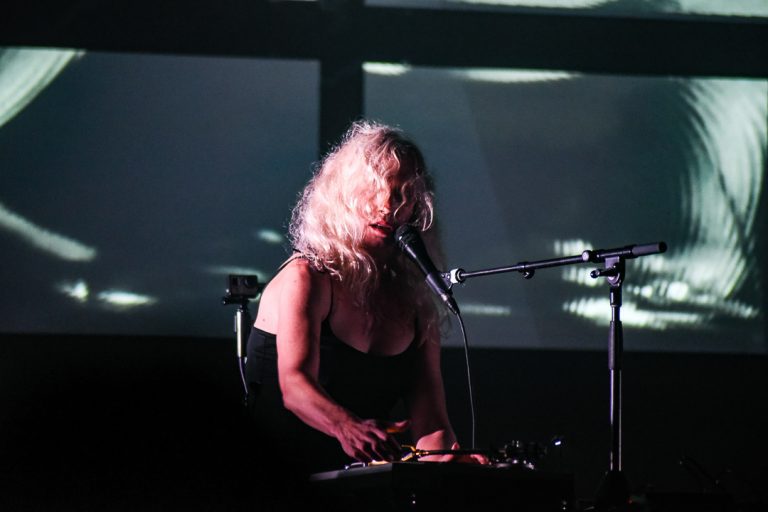
As Marie Davidson takes the stage, my attention shifts to her DJ booth. The energy in the room changes instantly, and the already enthusiastic crowd becomes even more excited. Everyone is now facing forward, either out of attachment to the tradition of live concerts or in the hope of seeing the musician at work. From my position, just a few rows away from the stage, she is difficult to spot. Her set retains a certain similarity to her music, which is heavily influenced by sequencing, with a slightly kitsch aesthetic. Very Berlin in its approach, almost Cartesian in its construction. There is a nod to the minimalist beats of Kraftwerk, mixed with the electro-funk energy of Afrika Bambaataa.

After returning from a short ten-minute break, I noticed that the BPM had increased by 5 to 10 BPM. Marie was preparing for Wata Igarashi’s arrival. We moved forward to take a few pictures. Behind Marie, a young woman danced and gestured with fluid movements, carefully observing her shadow on the wall. She could have been a friend, a family member, or an actress hired to participate in the overall experience.

Wata Igarashi

I spot Igarashi standing to the right of the stage, a benevolent observer who seems interested in the projections and appreciates Marie’s performance. He is possibly the only person in the room whose body does not react to the music.

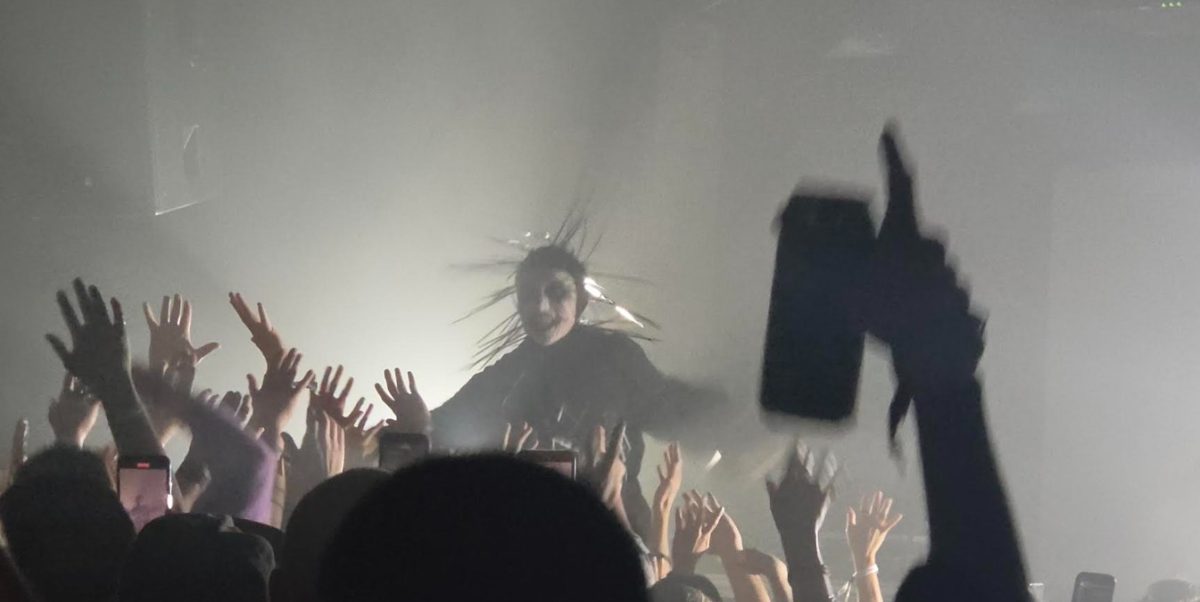
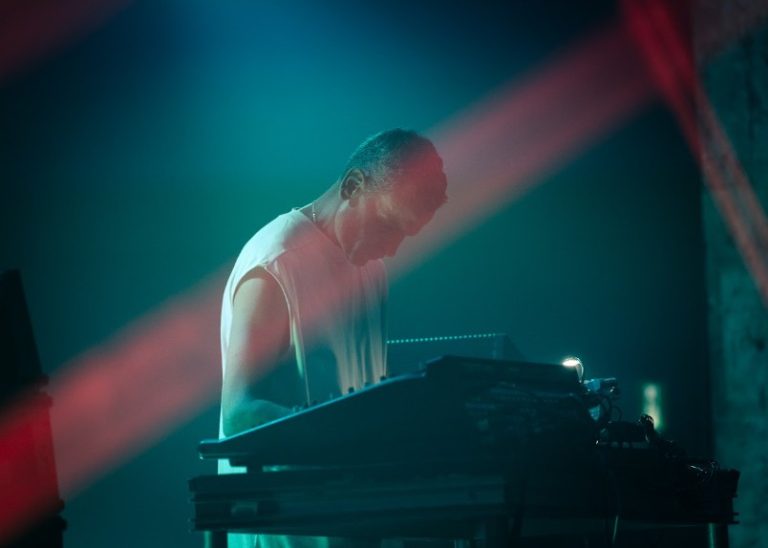
When Wata Igarashi arrives behind the turntables, we enter a world apart. He begins quietly, setting off sirens. Not metaphorically, but literally sirens like those heard before the arrival of a tsunami. They accelerate and pile up until they become an orchestra of toads. It is in the depths of this imaginary environment that Igarashi’s endless trance begins.

Deep kicks driving square rhythms punctuated by snares, which nevertheless expand into complex forms. Direct techno, yet imbued with a narrative mystery, suspended in drones detached from the rhythm.

It’s a fairly straightforward techno set, but with a mysterious element, a narrative that develops in the atmosphere of its drones, completely detached from the rhythm. The music and projections reach that higher level of intensity that the crowd has been waiting for. The projections are less frequently organic and take on a stroboscopic aspect that, once again, complements the music admirably. Noisy, repetitive textures remind me of Actress’s Shadow from Tartarus, hypnotizing and dislocating the soul from the body.


Time passes without us noticing; it’s 2:30 in the morning and suddenly my body sends me an astral text message: it’s time to go. I come back down to earth, into the cold of a well-deserved cigarette.

Publicité panam

Ramon Van Engelenhoven: Piano and Elegance

by Pietro Freiburger

At Salle Bourgie, a captivating concert was given by the young Dutch pianist Ramon Van Engelenhoven, who took the audience on a journey through a varied program: pieces from the great repertoire, contemporary music, and his own transcriptions of film scores. The idea of presenting in the first person to give a little context to the audience, which was quite large and warm, was also appreciated.

I remember discovering Ramon Van Engelenhoven in 2018, when I found a video of Debussy’s Images I on YouTube. What struck me were the purity of the sound and the elegance of the musical idea; several years later, it is still the structural balance and sonic refinement that appeal to me.

The concert opens with Mozart’s Sonata K330, well thought out and well performed. The control of sound, phrasing, and ornamentation is excellent, with the most intense moments occurring in the second movement. This is followed by Ravel’s Pavane pour une infante défunte, performed with structural clarity and sonic beauty. The concert continues with two pieces by Tagreshi, a young composer and friend of the pianist, which exploit the full range of the instrument, creating an aura of mystery and lyricism.

The second part of the concert opens with Rachmaninoff, with two Preludes from Op. 32 and two from Op. 23, which transport us into enveloping atmospheres and seductive lyricism. Two transcriptions by the pianist close the concert: a Suite from Herrmann’s Vertigo and The “Ride of the Cossacks” from Waxman’s Taras Bulba. And it is precisely in the transcriptions that passion and intensity overwhelm us. The admiring audience is treated to an encore, Poulenc’s Novelette No. 1, which once again showcases Engelenhoven’s sober and measured style. A pianist to watch.

Photo credit: Florence Geneau

Minimalist / Modern Classical / orgue / Post-Minimalist

Stellar: Organ and Circus in sync

by Frédéric Cardin

A very beautiful idea to combine the organ with the arts of the circus! At first glance, one might think that it is the organ that needs the acrobatics of the other to increase its visibility and popularity. But once seated in the packed Maison symphonique here in Montreal, and paying attention to the “vibe,” one realises that quite a few people were there to enjoy the organ and the music offered in the program. Particularly the excerpts from the music of the film Interstellar by Christopher Nolan, which Hans Zimmer memorably dressed with a score of minimalist/epic colours, where the organ takes a lot of space. On its own, this film music has contributed more than any “democratisation” activity to give a new “coolness” to the king of instruments.

In short, the large audience seemed to be waiting for it. And there was no disappointment, the soloist Jean-Willy Kunz showcasing his most beautiful and grand gestures to powerfully fill the entire hall. The final resonance had no time to unfold before the thousands of people were already applauding.

100 years of organ music

Beyond this iconic music, the audience was able to hear a selected journey through the last hundred years at the organ: the Cortège et Litanie by Marcel Dupré (1922), the Banquet céleste (1928) by Messiaen, works by Philip Glass (Mad Rush and Études 6 and 8), Spiegel im spiegel by Arvo Pärt, and two pieces I was not familiar with: the Toccata Andromeda (1999) by Paul Halley and the very recent Limina Luminis (2023) by Olivia Belli.

Symbiotic acrobatics

The acrobatics offered by Cirque Le Monastère were quite classic, but their union with the music brought a touch of often seductive poetry. I was particularly struck by the very beautiful hair suspension act on bungee, which, with Pärt’s ethereal music, lifted the audience with it into a very appealing and serene weightlessness. Also, the MultiLED cable act, in which Manolo Gonzalo twirled to a Glass Etude, had a rather attractive cyber-chic vibe.

The Cyr wheel number was perfectly suited to fit with Glass’s Mad Rush and its fluttering arpeggios in perfect harmony with the swirling rounds performed by artist Cléa Perion. Camille Tremblay dared to do something that probably no one had done before: a balancing act partly performed on the organ keyboard! Jean-Willy Kunz did not seem too thrown off by it. The finale, with all the artists gathered and Olivia Belli’s post-minimalist music, offered a satisfying conclusion.

The designers of the show had the good idea not to feel the need to accompany each piece with choreography. Thus, Cortège et Litanie, Le Banquet céleste, and part of Interstellar could be appreciated simply as music, played on stage by Jean-Willy Kunz. The organ therefore did not serve exclusively as a mere backdrop, but rather as an equal partner with the circus.

A beautiful idea, simple and effective, successfully executed.

Choral Music / Jewish Traditional / Sacred Music

ArtChoral | Authentic Intercultural Encounter in The 9th

by Alain Brunet

One Tuesday at lunchtime in February, music lovers at Le 9e concert hall witnessed a truly intercultural experience: the encounter between the ArtChoral Ensemble and Jewish identity through choral singing, both sacred and secular. This concert coincided with the release of the album Hallelujah on the ATMA Classique label, which shared the same theme as this superb program.

From the outset, the choral music of Montreal composer Jaap Nico Hamburger exuded a palpable spirituality. The melodies of The Uninterrupted Melody were presented in two relatively short sections: first, a slow and silky sequence with the lament-like title “How long will you forget me, forever?”, followed by “Rescue them,” a more syncopated discourse dominated by female voices. This work falls within the contemporary repertoire of music inclined toward spirituality, Jewish in this case.

This concert, it was noted, was not modeled on the new album. The increased role of the excellent tenor Gideon Zelermyer, who participated in the album Hallelujah and who is responsible for the choral direction of the Montreal synagogue Shaar Hashomayim, is in my opinion the most significant musical contribution of Leonard Cohen’s final album, You Want It Darker.

The tenor’s first performance was with ArtChoral, where he sang Min Hametzar, a piece composed in 19th-century France by the Jewish composer Jacques Fromental Halévy. The language and text lend a unique character to this choral work, placing it firmly within a European aesthetic, rather than a strictly Eastern one.

The following piece was performed by the choir without a principal soloist, an aria by Ernest Bloch composed in the 20th century, Y’Hiyu L’ratzon. Here again, the singing is typical of its choral modernity; only the text distinguishes it from the period from which it originates. This was followed by a song in the same vein, but with greater melodic and harmonic depth, courtesy of Leonard Bernstein, typical of the great modern choirs of the 1950s and 60s.

This Western aesthetic can also be associated with the choir personnel as such, if we compare it to Jewish choirs of sacred music, which are traditionally male in Orthodox services.

We find vocal inflections particular to these male choirs and also vocalises of the cantor, not unlike those of baroque or early European music, not to mention certain micro-intervals below or above the note provided for by the tonal system.

We find vocal inflections particular to these male choirs and also vocalises of the cantor, not unlike those of baroque or early European music, not to mention certain micro-intervals below or above the note provided for by the tonal system.

These two brilliant performances were interspersed with the ever-popular “Hallelujah” by our very own Leonard Cohen, performed in a choral version with a succession of highly creative soloists in an arrangement by Andre van der Merwe. An excellent choice of artistic direction by Matthias Maute, conductor of ArtChoral.

This confirms once again the beneficial, even life-saving, effect of music in the intercultural lives of human beings of goodwill.

Classical / Classical Period / musique contemporaine

Daniel Bartholomew-Poyser at Obiora: Charisma and Clarity

by Frédéric Cardin

A concert by the EDI-wise Obiora Ensemble is enough to make anyone happy. One, the orchestra is good, two, the atmosphere is cheerful and family-friendly (there are young people everywhere!) and three, you often make some great musical discoveries there, alongside some good pillars of the repertoire.

Last night at the Pierre-Mercure hall in Montreal, we got all of that. In addition, it was also Daniel Bartholomew-Poyser’s first concert as Principal Guest Conductor. The man has charisma. He speaks good French and of course English, in a spontaneous exchange between the two languages, “Montreal style.” He has a sense of humour and sympathetically betrays his passion for the classics. One can say that, in terms of image and marketing, Obiora seems to have made a good choice.

READ THE INTERVIEW WITH THE GENERAL MANAGER AND CO-FOUNDER OF THE OBIORA ENSEMBLE, ALLISON MIGEON, WHO TALKS ABOUT DANIEL BARTHOLOMEW-POYSER

On the musical side, we also discover an artist who greatly enjoys constructing his ensemble according to very strong criteria of clarity and precision. The man is a detail refiner.

The cradle of the classical symphony, for once

A given at the start of the concert, when we were given Haydn’s rarely heard first symphony. As Bartholomew-Poyser said amusingly, no 104, or 103, or 88, or any other without a no. 1! The conductor immediately established his vision of hyper-articulated music, driven by chiselled rhythms. A nice introduction, notwithstanding the fact that it is still Haydn not yet totally at the peak of his art of concision: the second movement is too long.

In order to give the wind section the opportunity to shine, the conductor chose to follow up with the delicate and neo-classicist Three Short Pieces for wind quintet, by Jacques Ibert. A resolutely French universe, made of elegance and instrumental purity, very well interpreted by the first chairs of flute, oboe, clarinet, bassoon and horn of the ensemble.

A world premiere of a tornado

 Then the sky was amber, a concerto for viola with the character of a symphonic poem followed, in its world premiere. The new creation by Iranian-Canadian (Toronto) Saman Shahi evokes, in a language oscillating between contemporary atonality and cinematic chromaticism, the building of a storm, first in the distance, then approaching and enveloping everything, before subsiding and leaving behind a devastated landscape capped by the evanescent beauty of an amber sky (hence the title of the work). Soloist Sharon Wei navigated the gusts of Shahi’s highly expressive music with a combination of virtuosity and sonic power. By turns resisting the storm as best it could and commenting thoughtfully on a landscape left bloodless, Wei’s viola resonated with power.

The attractive modernity of Caroline Shaw

I really love the music of the composer who followed in the program: Caroline Shaw. The American knows very skilfully how to blend the techniques of the modern avant-garde with accessible neo-tonal writing. Her ideas are often simple but constructed with great efficiency. The piece chosen by Bartholomew-Poyser, Entr’acte, is a tribute in the form of a deconstruction of classical language (a nod to Haydn), both harmonic and rhythmic. As in a pulse organised by inhalations and exhalations, a simple and elegant melody is regularly tortured, disarticulated, before returning to its original state. It is fine music, pleasant to discover and stimulating. We eagerly await the next “destructive” iteration to see what tactics the composer will use to illustrate her point.

Pulcinella 

Stravinsky’s Pulcinella ended the evening. A way for the conductor to use the full technical possibilities of the ensemble. A very correct version, if not for some sourness in the first violins, the oboe not demonstrating the desired narrative poise in the Serenata (2nd movement), and a slightly too high number of tears in the horns later in the work.

Beyond this nitpicking, we appreciated the exceptional precision of the construction of the portraits and the scenery by the conductor. As he showed us from the beginning of the concert, Bartholomew-Poyser weaves almost arachnid webs with his orchestra. Such diligent work will certainly yield very beautiful results in the medium term. We will appreciate, perhaps, the addition of a holistic binder from him, an overall timbral velvet that will prevent him from falling into excessive sonic granularity. But that will come in due time.

In the meantime, the new principal guest conductor has demonstrated very fine qualities of musical direction, but also of communication and artistic choices. I will be very pleased to see and hear what he will do in the next three years of his new contract.

musique contemporaine

‘’Fougue concertante’’ at the SMCQ: Gen Z at the helm

by Frédéric Cardin

The Fougue concertante (concertante fervour) concert by the Société de musique contemporaine du Québec (SMCQ) presented three concertos of very high musical quality last night, performed by as many soloists from Gen Z. At least it seems to me, at a glance from a man of the age of Gen X. Maybe one or two are actually in the previous category, two or three years over? Well, whatever, it made a good title…

The first of the winter-spring 2026 concerts celebrating the 60th anniversary of today’s honourable institution of contemporary music, Fougue concertante thus provided an opportunity for three young soloists to shine in a recent concerto, Catherine Cherrier on percussion, Élise Poulin on oboe, and Bailey Wantuch on violin.

LISTEN TO THE INTERVIEW WITH SMCQ’S ARTISTIC DIRECTOR ABOUT THE ONGOING CONCERT SERIES (In French)

A very touching tribute

As a prelude to the main program, the SMCQ paid tribute to Margareta Jerić, a young Montreal-based composer of Croatian origin, who passed away at just 43 years old in November 2025.

The Echoes of the Adriatic, a work accompanied by video images of an old Croatian sardine production factory, deals with great vivacity with the opposition between the beautiful and the ugly, nature and industry. It is a playful, pixelated kind of music, where each note feeds the next to create a very seductive whole. The disappearance of this artist who studied with Ana Sokolovic (of Serbian origin) is all the more regrettable because she was in the process of building, with her former teacher, a kind of Balkan connection in contemporary Montreal music.

Musical divertion

In (d)Tourner (a play on words in French meaning to divert), Philippe Leroux evokes circularity. Not necessarily that of an object located and moving, but rather, for example, sounds in the scenic space or the rotation of melodic and rhythmic movements. And, as the title indicates, this round is not conceived as a perpetual refrain, or a repetitive and tonal approach like that of the minimalists, but rather as a movement leading to expansion and transformation in an atonal but beautiful environment. For the listener, this circularity is initially difficult to detect. We are here in an applied conceptual abstraction. But as the twenty-minute piece evolves, the idea takes shape better and better and crosses the space between the stage and the audience. Through a rather dense writing, the sonic “movements” take flesh and consistency. Until the last gestures of the soloist, who must turn on herself while playing the marimba, striking her sticks against each other and ending on the snare drum. Twice. Beyond this physicality imbued with theatricality, and finally giving physical incarnation of the core idea, Catherine Cherrier delivered an impeccable and dynamic performance.

LISEZ L’ENTREVUE D’ALAIN BRUNET AVEC PHILIPPE LEROUX

”Varèse who swings”

Following was a superb discovery for your humble chronicler: the excellent Trame I by Martin Matalon for oboe and ensemble. Made of sound interweavings and inspired by a homonymous poem by Jorge Luis Borges, Matalon’s concerto is a bubble of pleasure of some fifteen minutes where the infinite coloristic possibilities of the oboe and the ensemble offer a real buffet for the ears, in addition to inviting head nodding because the gentleman has an excellent sense of rhythm. “Varèse who swings,” to paraphrase the artistic director of the SMCQ, Simon Bertrand, with whom I was chatting before the concert. Élise Poulin, admirable in her virtuosity and flawless precision in this formidably demanding writing, all with a radiant instrumental sound, offered an impressive reading of this music.

The night’s Grail

The last work on the program, also the most substantial, was Graal Théâtre by the Finnish Kaajia Saariaho, a muscular concerto of about thirty minutes, for violin and orchestra. This entirely acoustic concerto, a rarity for Saariaho, who likes to incorporate electronics into her music, displayed an almost romantic textural and characterful breadth. There are many traits of a grand concerto inherited from the 19th century tradition: lyrical outbursts, athletic double strings, episodes of spectacular virtuosity, etc. All in the lady’s typical shimmering, crystalline language. To say that the young Bailey Wantuch, a Chicago native but firmly established in our metropolis now, was good, would be a gross understatement. The young lady of diminutive stature nonetheless exudes an astonishing and communicative expressive force. An exceptional violinist, certainly. Wantuch is also part of the brand new Quatuor Mémoire, which I recently told you about in a very positive review of their first album Chronos, Kaïros et Aiôn (READ THE REVIEW HERE).

Mentionnons avant de terminer l’apport de très très haute tenue de l’ensemble de la SMCQ sous la direction infaillible de Cristian Gort. Un ensemble presque entièrement renouvelé depuis l’arrivée de ce directeur musical efficace, bien que discret. Impeccable prestation en support à des solistes qui pouvaient se concentrer totalement sur leur jeu sans craindre quoi que ce soit.

The SMCQ has shown us that rumours linking a certain type of “generation” with laziness or negligence are just nonsense, at least in the creative and contemporary art scene. Here, three children associated with ‘Generation Z’ took control of creativity and took us on a pretty good journey with them. Getting back on board as soon as possible, please!

Indigenous peoples

Alanis Obomsawin and Jeremy Dutcher, Two Generations of Indigenous Beauty

by Ariel Rutherford

This Wednesday evening at Bourgie Hall took place under the theme of Indigenous transmission. A dialogue between generations, the nonagenarian Alanis Obomsawin, Abenaki filmmaker and multidisciplinary artist who can easily be described as mythical, and the thirty-something Jeremy Dutcher, power singer, composer, musicologist, visionary, two-time winner of the Polaris Prize.

At 93 years old, she walked slowly arm in arm with her musical director Radwan Ghazi Moumneh, leaning on her cane before sitting down in the center of our field of vision. Greeted with a standing ovation, she undoubtedly appeared to us as a leading figure of modern indigenous culture.

Having not performed in front of an audience for some time, she couldn’t hide her touching nervousness as she took her place in front of the microphone. There was a palpable solemnity in the room as she began the first verse of Odana, the opening track from Bush Lady, an album released in 1988 and revamped in 2018 by Constellation.

It is understood that the grand lady did not have the physical resources necessary for a great performance, that her voice had aged…

It was far from perfect, but that wasn’t the point: the point was to see this major artist, there before us, breathing new life into her early work. A tribute, in fact. It felt like family, like a lullaby sung by our grandmother. It was beautiful because it was her, possibly for the last time in such a setting. Because it was important, because it was the appearance of a legend. There was a warmth in that fragile voice, carried by the music of the frame drum, flutes, English horn, and violins. Fittingly, Obomsawin concluded her short performance with a Cree nursery rhyme before slowly leaving to a second ovation.

Let’s not forget the second part of the evening: Jeremy Dutcher is a fantastic showman, full of verve and humor, whose powerful tenor voice thrilled the audience. A flamboyant figure who carries the torch, two generations after Alanis Obomsawin. Resurrecting ancestral melodies in Wolastoqey, English, and French, engaging with the past through century-old recordings, the singer deeply moved the audience. Accompanied by drums and a bass clarinet, he also accompanied himself on the piano in the style of a jazz trio. In short, Jeremy Dutcher offered us beauty.

I will conclude by quoting the friend who accompanied me: “When it’s really good, I can no longer criticize. I am only capable of loving.”

  • By Ariel Rutherford with editorial support

Baroque / Early Music / Electronic / musique méditerranéenne

Tarta Relena : A Mediterranean Spell Across Centuries

by Z Neto Vinheiras

In a full house at Sala Rossa, this last Thursday January 22 was an evening of vocal communion – an echo of the currents beneath the centuries, the Mediterranean landscapes and an incredible permeability between genres, languages and techniques. A humungous spectacle crossing geographies, time and humanity.

Honouring both the sacred and profane, the ancient and contemporary, Marta Torella and Helena Ros braid stories with their voices and in their voices there is gravity – it’s a dance between a soprano and a contralto, balancing, sustaining each other, confronting the crowd. They embody the contrasts in which are crafted the threads of continuity, the siren tapestry with all the stories needed to be told and heard. There is a synchrony and kinship between the two on stage that is not even telepathic but that they seem to be made out of the same dust.

The duo from Barcelona arrives in Montréal after a good week in the US touring their most recent album “Ès pergunta” (Latency, 2024), conceptualising the inevitability of fate in this tension between human and nature. It’s a lyrical plasticity, a unification of time frames and an elastic range of techniques. Tara Relena’s music is so much about the voice, the languages, the stories and the mysticism, that the use of the electronics here are only an accommodation to the contemporary, an extra layer of gravity in a scene that is a weighty present.

Throughout the night, Ros and Torella also tell us the stories behind their own process of making this album, including the happy accidents that resulted in an extra track “Odniramat” which happened by mistakenly reverse the recorded track “Tamarindo” – being so obsessed with the energy of the fate, they learned the reversed lyrics and melodies and kept the track. Which makes me think, in their conceptual framework, how timeless time and fate themselves can be. A past stretched to infinity and back is no past anymore but continuity. It is part of the same matter.

Nevertheless, Ros and Torella are not just singing to us on a stage; they are inviting us in to really listen – they want us to hear what the sirens have to tell us about fate, which is not a very serene one. At the end of the night, they gift us a Georgian singing  a cappella encore with Mingjia Chen and Linnea Sablosky, who are together on tour performing Meara O’Riley’s Hocket for two voices, an absolute must see performance as well!

Caprice Baroque and Chocolate at 9e: Much More Than Just a Snack!

by Alain Brunet

Matthias Maute, conductor, flutist (recorder and traverso), composer, and artistic director of the Ensemble Caprice, has devised a delightful concept bringing together the Baroque repertoire: a lively and virtuoso quintet evoking this era and… chocolate.

Discovered and adopted by the conquistadors in the Americas, the famous cacao bean was introduced to Spain before crossing the Pyrenees and winning over France. The arrival of chocolate in Europe coincided with the Baroque period, providing an excellent opportunity to establish the link through a French Baroque program.

A highly entertaining program with an even greater focus on chocolate!

Highly popular since its revival, Le 9e was almost full on the late afternoon of January 20, marking a resounding success in terms of attendance and the concept put forward by the Caprice, ArtChoral, Opéra M3F, and HausMusique ensembles.

Although the program featured great French composers such as Marin Marais, Jean-Philippe Rameau, Marc-Antoine Charpentier, and François Couperin from the outset, one had to be truly passionate about this ancient repertoire to be familiar with the works. As suggested by Matthias Maute, it was best to let oneself be carried away by the proposed journey and enjoy the pleasure generated by these performances.

The first pair of pieces highlighted the ensemble as a whole: Mathias Maute and Sophie Larivière on flutes (recorder and traverso), Jean-Christophe Lizotte on baroque cello, David Jacques on baroque guitar, and Zya Tabassian on baroque and oriental percussion—remember that the link between the West and the East was much more evident in the Baroque era.

So we will first be treated to a Spanish Sarabande by Rémi Médard, followed by Marc-Antoine Charpentier’s fearless Chaconne, to set the mood for this distant era.

Lanchas par bailar, a work by an unknown composer, and Jean-Philippe Rameau’s Airs et danses pour le théâtre, the second pair of pieces on the chocolate menu, demanded all the technical skills of the flutists, whose two-part polyphony gave us the opportunity to contemplate these instruments, which are difficult to master and too little known to music lovers.

The (small) ensemble Caprice then followed with a third pair of works: Les délices de la solitude (The Delights of Solitude) by Joseph Bodin de Boismortier and Vertigo (a title chosen two and a half centuries before Alfred Hitchcock) by Joseph-Nicolas-Pancrace Royer. The first was percussive and the second was captivating for the flutists’ playing, as well as for their conversation with the baroque cello, which responded beautifully, not to mention the strong bond established with the other members of the ensemble.

Chocolate triumphed before the performance of Marin Marais’ Les Folies d’Espagne and Le tic-toc-Chocolat. We all greedily devoured the chocolate egg we were given at the entrance, while the flutes and light percussion played their hearts out.

Ziya Tabassian’s drums and percussion launched the final assault: pretty Parisian Contredanses, Rigaudon, calm Rondeau, very rhythmic Poivre, jagged Prince Torge, reassuring Manches vertes, which one imagines to be an ancient version of the well-known Greensleeves, all concluded with a powerful exchange between flutes and percussion, entitled Les sept sauts.

Much more than just a tasty snack!

Kim Richardson & ONJ: Not Cutting Any Corners in Honoring Ellington

by Harry Skinner

The most surprising thing Kim Richardson said last Thursday (January 15) as she shared the stage with the Orchestre National de Jazz de Montreal was also the very first thing she said. She came on after two concise renditions of Duke Ellington’s ‘What Am I Here For’ and ‘Cotton Tail’ and said straight away “Je suis absolutment terrifiée//I am absolutely terrified”. As it was, she had been dealing with issues with her vocal chords in the leadup to the concert – her first of the year, such that her ability to perform at all may have been in doubt. It was a refreshing moment of vulnerability from Richardson that would ultimately prove to be unnecessary; one wouldn’t have guessed at any point throughout the show that they were listening to a singer who was struggling with her voice. 

As the concert progressed it became clear that a point had been made to highlight as much varied Ellington repertoire as possible, an endeavor that was undeniably successful. Throughout sixteen selections of this sold out concert presented at the PdA Cinquième Salle, Richardson and the orchestra managed to cover the classics like ‘Caravan’ and ‘Take the A Train’ while still making time to introduce the audience to more obscure and less conventional parts of the Ellington canon. The first song that Kim Richardson sang, for example, was a selection from the 1941 musical revue Jump For Joy Entitled ‘Bli Blip’. The song features a surprisingly sparse and angular shout chorus, not unlike the sort of sound Thad Jones would achieve decades later.

A highlight of the show was the way that Kim Richardson’s personality shone through in her singing. This was never more clear than in the Billy Strayhorn ballad ‘Something to Live For’, or in ‘Imagine My Frustration’, an arrangement by pianist Jimmy Jones. This arrangement in particular had a sound that leaned more towards classic R&B, with repetitive riffs in the horn section over a 12/8 time feel – a perfect selection for a singer with the soul and R&B background Kim has. ‘Imagine My Frustration’ was probably the point in the show where we saw her the most in her element.

For the most part, selections in the concert were kept short and succinct to allow for a greater range of repertoire. As such, there were few extended solo sections. A notable exception to this was in Perdido, which featured an absolute behemoth of a trumpet solo from David Carbonneau. It would be hard to disagree with director Marianne Trudel when she suggested that the piece could have been written for him instead of the great Clark Terry.

Last night, the ONJ set out to highlight two great musicians – Kim Richardson and Duke Ellington – in very different ways. One was onstage, while the other composed the bulk of the program. The audience, however, was left with a strong understanding of both musicians and their unique voices, with neither upstaging the other.

Electronic

Igloofest 2026 | On Two Stages, A Real Winter Evening

by Léa Dieghi

It was cold on the opening night of Igloofest 2026. With a wind chill of -15°C, the festival site was surrounded by a cloud of smoke formed by the breath of the audience, the food trucks serving poutine, the various heated areas set up to warm up, and the famous marshmallow campfires scattered here and there.

The line of people waiting to enter the general assembly with their tickets was particularly long on this first evening. Although the doors opened about twenty minutes late, the audience was extremely impatient, shivering in the cold and stamping their feet with excitement at the thought of finally being able to hit the dance floor and enjoy the other activities at the festival. As soon as they entered, people literally ran to get to the front of the main stage. Thursday evening’s lineup was certainly one of the most eagerly awaited of the week, with tickets sold out both on site and online.

Publicité panam

SCÈNE VIDEOTRON

At the Vidéotron small stage checkpoints, we had Liv K and Cult Member, two established figures on the Montreal electronic scene.

Very active on Montreal’s fringe scene, Liv K is a DJ and programmer for Parquette, a transitory cultural space with a queer vibe that is heavily involved in the rave scene. Although she is more frequently seen at events organized by collectives such as Flush, Bijou, and Discono, this was the DJ’s first time at Igloofest. Her eclectic and energetic set ranged from classic four-on-the-floor techno to remixes of contemporary hip-hop music, with a few Doechii tracks thrown in here and there.

As for the popular artist Cult Member, who has carved out an international reputation in the electronic music scene, he delivered a captivating set combining techno and Rally House, with influences from club music and French House staples such as Thomas Bangalter.

These two sets, with their slightly different yet complementary energy, were musically one of my favorite experiences of the evening… Although most of the audience spent most of their time in front of the main stage… Had we forgotten that the Videotron stage existed? Or did we not see it, hidden away at the back? Or was it the effect of Disco Lines, the star producer whose track No Broke Boys exploded on social media this summer, who was playing on the main stage?

SCÈNE SAPPORO

It took a while for the front of the stage to fill up, probably due to the long line at the entrance, but also perhaps because of the audience’s excitement to explore the venue. But after only an hour and a half of opening, Gudfella, whose real name is Kyle Domingo, was already playing in front of a packed crowd. As the opening DJ on the Sapporo stage, he delivered a performance worthy of his reputation: a danceable, groovy set mixing house, techno, pop, and disco. The American artist, covered in several layers of clothing, danced behind his turntables, unzipping his coat a little, proof of the energy he put into his set.

And as the audience pushed further and further toward the front of the stage, the crowd soon turned into a compact mass. I have rarely seen such a tightly packed, crazy crowd. People were pushing against each other, each unknown body pressed up against other unknown bodies. And with the arrival of Disco Lines, the headliner of the lineup, the crowd’s energy seemed to reach its peak. The mix of house music, pop, and commercial music remixes met the expectations of the crowd, who had come here in large numbers partly to see him.

Honestly, it was madness on the ground. People were climbing on each other’s shoulders, some were pushing hard, shoving others aside to get to the front, beers were flying through the air, wetting hair and hats.

For a moment, I rejoiced at no longer being agoraphobic: in such a confined space, I would most certainly have had an attack.

When the long-awaited song “No Broke Boys” by Disco Lines and Tinashe finally started playing, the audience, mainly made up of Generation Z, seemed to literally explode. They danced, shouted, sang, and pushed each other. Civility was replaced by fury.

While this set wasn’t necessarily what I tend to like or look for, I have to admit that the energy was there, and despite the dense crowd, I was still able to squeeze in a few dance moves and leave with lots of laughter and wonderful memories.

Africa / afro-soul

Floric Kim, Musical Antidote to a Freezing Montreal Evening

by Sandra Gasana

Despite the freezing cold on this January Thursday, it didn’t discourage several people from attending Floric Kim’s long-awaited concert. You’ve probably heard of him from his interview on MUZ, but seeing him on stage for a full show was a first for me.

Surrounded by renowned musicians from Montreal’s artistic scene and Damaris, a promising backup singer and guitarist, Floric Kim takes the stage like a star. His clothing makes as much of an impression as his powerful voice. Dressed in jeans from head to toe, stylish bell-bottoms, and a denim vest with rings, this young artist and designer was able to do both that evening: wear his own clothing brand and deliver a show worthy of the name.

From the very first song, he sets the room alight, while in Freedom, he brings out his blues and soul side. He is fluent in French, English, and Kikongo, sometimes mixing several languages in the same song.

He reveals not only his talents as a singer, but also as a dancer on some of the more upbeat tracks, and as a storyteller. On the track Suzana, which is a tribute to his sister and in which he denounces sexual abuse, he switches from singing the chorus to storytelling, immersing us in both worlds. Watson Joseph’s bass, Dav’s guitar playing, Steven Mapou’s piano, and Raphaël Ojo’s drums allowed him to move from one to the other quite naturally.

Hendry Massamba couldn’t not take part in this concert. Indeed, you rarely see one without the other. So he played percussion in the second half of the concert, before swapping places with Raphaël for the last song of the evening.

Speaking of the second part, Floric’s outfit was even more spectacular than the first. This time, he appeared on stage wearing an outfit to which he had attached several Barbie dolls. And this is entirely representative of the character: using everyday objects and integrating them into fabrics to turn them into works of art.

That said, one person almost stole the show that evening: a young dancer of Haitian origin named Dashny, who had mastered African dance moves to perfection. “Are you sure you’re Haitian? I was told that Haitians were more like lovers with their kompa,” Floric said to the young man. A few minutes later, he invited Dashny back on stage, this time to improvise to his hit Mama Pray For Me, and he blew us away.

That’s kind of how Floric is too. He calls himself the Nkundilisateur and seems to enjoy promoting other artists, whether it’s inviting Veeby or LYDOL to improvise some singing or dancing, or calling on dancers from the Nyata Nyata school to come and give a few demonstrations on the dance floor. This adds several minutes to his tracks without ever getting boring.

Floric took several dips into the crowd during his show, sometimes joined by audience members who wanted to let loose that night. This was particularly the case during his hit song Million, another highlight of the evening.

In the end, the -17 degree weather may have discouraged many people from coming to see this artist at the height of his career, but those who did attend clearly enjoyed themselves.

Subscribe to our newsletter

Inscription
Infolettre

"*" indicates required fields

Type of Suscribers