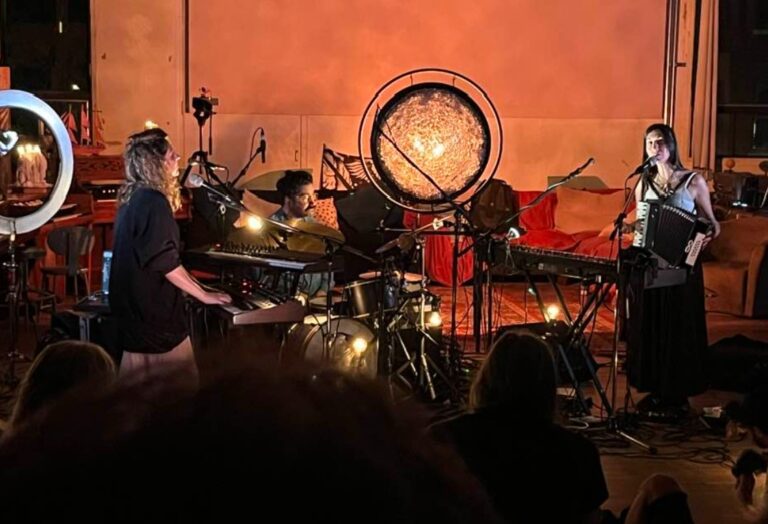
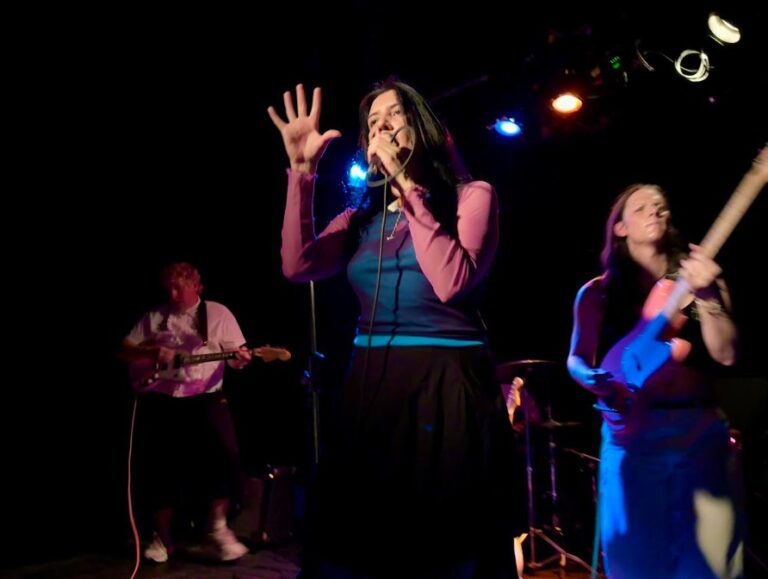
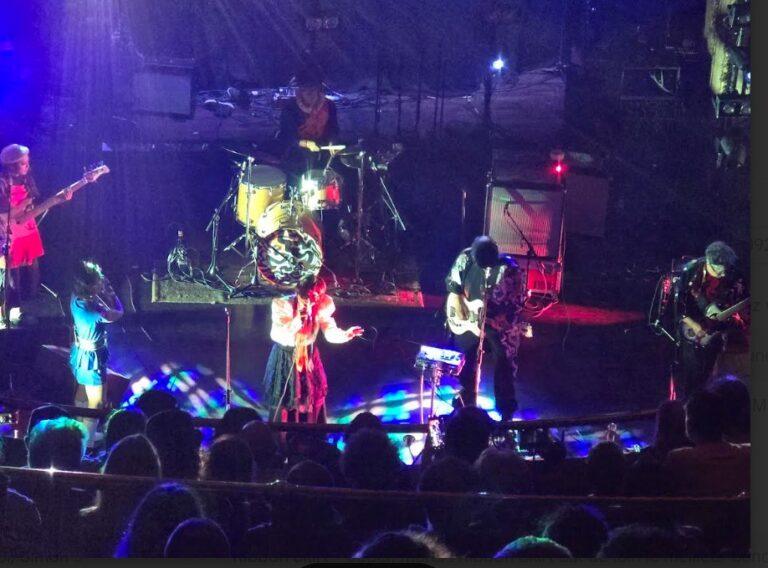
The trio CHANCES took advantage of the Pop Montreal Festival to launch their new album And Now You Become A Seeker. This is the third offering from the trio, composed of Chloé Lacasse, Geneviève Toupin, and Vincent Carré. Here, transparency is essential: Geneviève Toupin, alias Willows, is part of my family. Nevertheless, I hope to present an honest review.
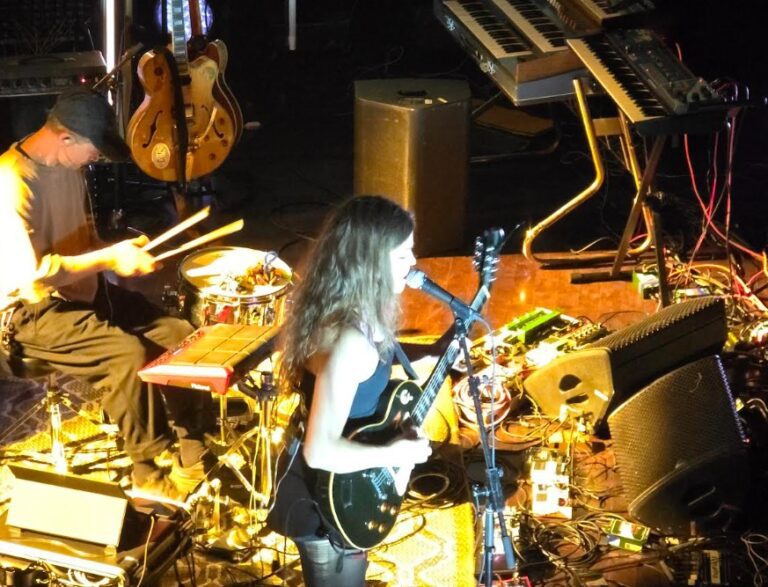
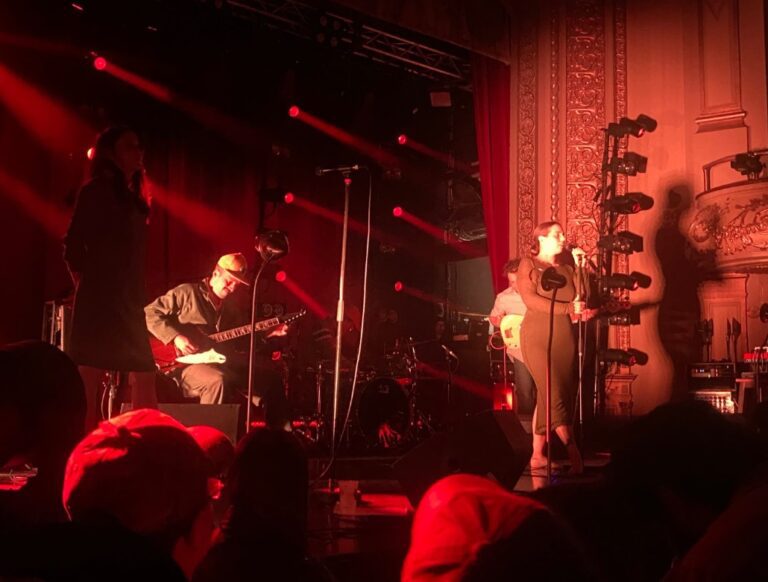
Vincent Carré handles the percussion, while the two women play both keyboards and guitars. But it is above all the vocal duo they have formed over the past twelve years that stands out with great power. Their complicity is evident in the ease with which they harmonize their voices and complement each other. It gives you goosebumps.
With CHANCES, it’s not virtuosity that strikes you. It’s the ability to create a very special overall sound. Vincent Carré is a very creative drummer, aided by special effects that make his drums sound like synthetic melodic instruments. Then the keyboards, guitars and voices envelop you. You are captivated, but happy.
In fact, both on the album and during live performances, the band wanted to play as much as possible “live.” There are very few pre-recorded loops. Chloé Lacasse sometimes plays the electric guitar with a bow; Geneviève Toupin occasionally plays the accordion.
After Connection (2021), which flirted more with indie rock, And Now You Become A Seeker takes us back to a more alt-folk-electro universe. We float in the stratosphere, sometimes calm, sometimes anxious, sometimes mysterious. “Someone told me that we make sensitive cosmic punk, and that makes sense,” Geneviève Toupin tells me with a laugh. On this latest album, there is a greater desire for freedom and longer musical formats. The experience is one to follow. It will evolve.
Un être humain tourne en rond sur scène. Kee Avil tente sans relâche de prouver son humanité. Elle hurle et la réverbération uniformise le son. Elle erre, mais reste toujours consciente du cordon du micro qui la retient. Elle danse et les lumières stroboscopiques prennent le dessus.
Elle nous demande sans cesse ce que nous attendons d’elle : « Vous voulez que je vous sourie ? », demande-t-elle.
Kee Avil se bat pour faire ses preuves, pour nous prouver qu’elle est humaine. Elle l’est.
Ce dimanche 28 septembre, Kee Avil offre une performance profondément connectée. Elle crée des scènes fantastiques de décomposition et de renaissance. Elle se déplace sur scène avec des mouvements prudents, semblables à ceux d’une marionnette, et des yeux brillants. Sa musique, qui s’est transformée en un sludge ambiant sensible, vous emmène dans un monde chimérique et en décomposition, tandis qu’elle lutte pour tenter d’arrêter cette décomposition.
Il y a une volonté d’être vue qui prend le dessus sur la performance, un enfilage et un retrait constants du masque. Derrière elle, une image générative fongique pulse à fond, inspirée des thèmes et des visuels du dernier opus Kee Avil, Spine . Cet album de 2024, son deuxième chez Constellation Records, joue avec les mêmes thèmes que ceux reflétés dans sa performance : fragilité, désintégration, préservation et tentatives de contrôle.
Elle utilise une large palette de techniques avancées, allant du doublage de sa voix à l’utilisation d’un archet sur la caisse claire par Kyle Hutchins, l’autre présence sur scène, rendant l’expérience encore plus hallucinogène. Bien que le son soit profondément immersif, Kee Avil conserve certains éléments tangibles. La guitare n’est jamais complètement noyée et les grognements dans son chant ressortent souvent. Elle reste ancrée et connectée à un son reconnaissable. Cet ancrage rend la performance encore plus émouvante.
This Saturday, at Hémisphère Gauche, Andy Boay held the stage and our attention. It felt like stepping into someone else’s faded memory of 2012 Montreal, familiar, but ever so slightly warped. The word that best describes his performance is mesmerizing. One half of Tonstartssbandht, the guitarist and singer stopped in Montreal on his North American tour for his new album You Took That Walk For The Two Of Us.
Throughout, his long, flowing songs let you walk with him and forget you’re at a concert with other people.The care taken with the spatialization is undoubtedly part of what made his performance so immersive. Pulsating, dynamic panning hit at just the right moments, letting the long songs pull you forward.
Sonically, the set combined lyric delivery reminiscent of ’80s beachy jams, and the sound processing and electronics of modern dreamy electro-pop like ML Buch or Laurel Halo, creating an unexpected yet cohesive experience. Every song had an undeniable heartbeat that the crowd swayed to and was hypnotized by. The use of drum loops was perfectly mixed in and out of the performance, keeping a very alive feeling. This was aided by Boay’s simple use of high and low cut filters to fade from one part to the next.
The sonic experience was matched by Boay’s stage presence; he knows how to put on a show with David Byrne-like moments of choreography and projected images on the back wall. The projections were part black-and-white microscopic cell-like fractals, part psychedelic computer screens. The shifting between colour and black-and-white visuals felt like the current stark experience and nostalgia that the whole evening fluctuated between.
All in all, I hope the second half of his tour goes this well. Andy Boay puts on a great solo show.
POP MTL | Fat Dog live is cocaine and velvety escapades
by Sami Rixhon
Some musicians are better listened to on albums. That makes sense, as some are more comfortable in the studio. Others, however, are better on stage. It is on stage that we discover them at their best. Fat Dog falls into the latter category.
A recently formed London-based band (formed during COVID, in fact), Fat Dog has clearly impressed everyone who has seen them live since the release of their debut album, WOOF., last year.
Comments found under this video by Anthony Fantano discussing the album (and giving it a 7/10 rating) confirmed the trend, as did the overall word of mouth on the Internet.
It’s intriguing, we must admit.
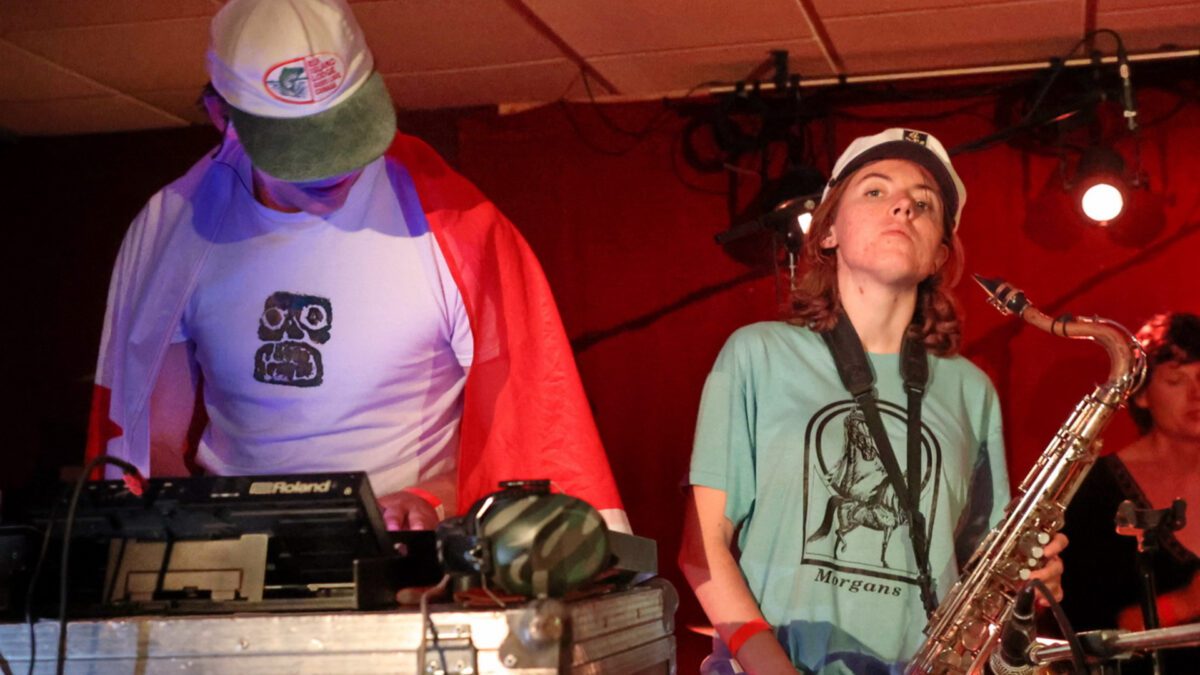
The English band took to the stage around 10:40 p.m., after two opening acts, even though the show was advertised as starting at 8 p.m. on the POP Montréal website. Sorry to sound like Patrick Lagacé, but when the wife is waiting patiently at home and the Canadiens game is over, it’s annoying to waste precious time on a Saturday night. Anyway. Fat Dog, now a six-piece, takes the stage at Toscadura, with the band’s keyboardist proudly displaying a large Canadian flag, which he will wave repeatedly towards the end of the show. Well, we would certainly have preferred a Quebec flag, as white goes much better with blue than red, but it’s not bad, and we applaud the effort.
Fat Dog plays a post-punk style that is much more focused on energy than anything else (à la Viagra Boys), with a certain amount of technical skill on the part of the instrumentalists and, surprisingly, occasional Middle Eastern influences that enrich music that is not necessarily the most eclectic.
Because let’s face it, Fat Dog isn’t exactly highbrow music. It doesn’t reinvent the wheel in any way, nor does it claim to be revolutionary. But my God, on the other hand, it’s devilishly enjoyable.
If you’re at the back of the room, you’ll find yourself constantly nodding your head, and if you’re at the front, you’ll be caught up in a never-ending mosh pit.
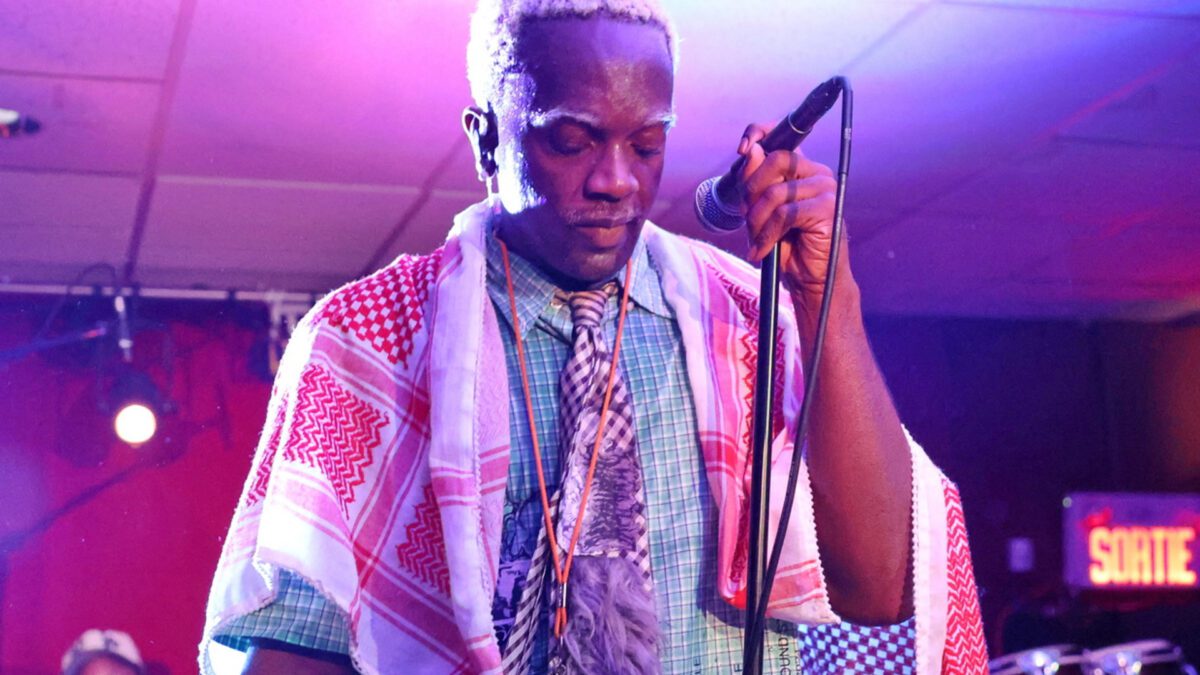
Fat Dog’s singer, Joe Love, looks like he’s completely wasted on every substance in the world at once. But even intoxicated and utterly nonchalant, he manages to get the crowd going. La Toscadura seems so rudimentary as a venue that you get the impression the floor is going to collapse under the enthusiasm of the audience. To be seen (again) when they next come to Montreal. Woof!
Montreal’s Fresh Wax kicked off the evening at around 8:30 p.m. The duo (a bassist and a drummer) handle the rhythmic, melodic and bass parts of their music, much like Royal Blood. Their songs, however, are heavier and more mathematical, reminiscent of the sounds of early 90s post-rock bands, sprinkled with a distant Robert Smith-style microphone mix.
It’s a decent start to the evening, but nothing more; the music is too disjointed to be truly enjoyable.
Next up, Godly the Ruler, a non-binary American musician, delivered an energetic set, but failed to create the same crazy atmosphere seen during Fat Dog’s performance.
The artist also bases almost their entire universe on energy, swearing by ‘blood, sweat and tears’, in their own words. But therein lies the risk: without a clear and enthusiastic response from the audience, Godly the Ruler’s performance is immediately tainted and fails to have the desired effect.
And yet, the music isn’t bad. Godwill Oke, his real name, reminded me of the fiery Tyler, the Creator at the beginning of his career, drawing on the most aggressive aspects of Goblin and the loudest aspects of Cherry Bomb.
Crédits photo de Fat Dog et Godly the Ruler : Pierre Langlois
Meghan Remy, aka U.S. Girls, was back in Montreal in all her glory, surrounded by musicians and backing singers.
This Saturday, 27 September, at the Rialto, the Toronto musician and producer behind U.S. Girls was enthusiastic and filled with emotion to be back on a Montreal stage, which she told us she particularly enjoys.
For the occasion, she performed excerpts from In a Poem Unlimited and Bless This Mess, and the latest album, Scratch It, interspersing the show with passionate dance sequences and funny personal anecdotes, such as about her short-sightedness.
The artist, who enjoys collaborating with other artists on writing and production, revisited some of her more recent songs, including “State House (It’s a Man’s World),” “Rosebud,” “Dear Patti,” “L-Over,” and classics such as “Overtime,” “Bookends,” and “4 American Dollars,” much to the delight of fans swaying slowly in front of the stage. We were also treated to an original cover of Fiver’s “Rage of Plastics” with an experimental pop version.
All in all, despite a few minor sound issues (interference and a backing vocalist missing from the mix on one song), the energy was there and the audience was charmed.
The quintessential Palestinian pioneer rap group, DAM (Da Arab MCs) electrified us on Saturday, the fourth night of POP Montreal.
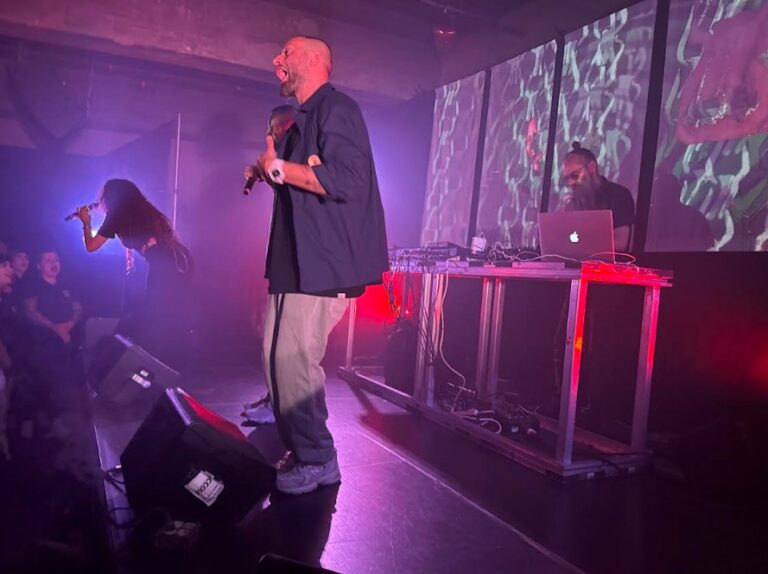
Rapping mainly in Arabic, but also in English and Hebrew, Tamer Nafar, Mahmoud Jreri and Maysa Daw admitted to being affected by jet lag at the start of the show. That said, they had no shortage of energy on stage.
With one banger after another, the hip-hop group fired up an audience nearly two-thirds of whom were Arabic-speaking, many wearing keffiyehs as a symbol of resistance for the Palestinian cause. For one of their hits, “Emta Njawzak Yamma,” Maysa made surprising use of the microphone, creating a particularly amusing sound effect. Special mention goes to Maysa, who taught us how to shout the Arabic cry of celebration and took a moment to recite some of the lyrics translated into English, so that newcomers could understand their meaning.
I had tears in my eyes a few times, my mind naturally wandering to Gaza and all the suffering and injustice endured there. I was also touched by this cultural sharing that defies all barriers, even in a room adjacent to a Maxi kosher grocery store located on the edge of Outremont. This coexistence that endures beyond conflicts touches me deeply.
It was a show that was both moving and meaningful, but not without lightness and joy. It just goes to show that one does not preclude the other and that resilience will always prevail.
Shortlisted for the 2025 Polaris Prize for their album Bite Down, Montreal indie rock duo Ribbon Skirt delivered a magnetic and frenetic performance at La Sotterenea on 27 September.
Anishinaabe singer and guitarist Tashiina Buswa was charged with a chaotic, highly contagious energy. She ventured onto the sound system, into the crowd, then curled up or lay down on stage.
Her partner, multi-instrumentalist Billy Riley, the bassist and the drummer were just as energetic, resulting in a very embodied and flamboyant performance, full of movement.
Ribbon Skirt’s indie rock is charged with visceral emotions. This powerful charge carries influences from the garage and grunge of recent decades, post-punk from the 90s, and perhaps a little pop punk from the 2000s.
Their next EP, PENSACOLA, due out on 3 October 2025 on the Mint Records label, is intended as a kind of epilogue to Bite Down.
It was with grace and pleasure that Montrealer Elle Barbara performed at the Rialto on Saturday, 27 September, opening for U.S. Girls, to present a bouquet of inspired compositions and covers.
The artist (formerly Jeff Barbara) and her musicians joined their fans for an uninhibited performance full of self-deprecating humour, at times bordering on burlesque.
Dressed in a tight-fitting pastel jumpsuit and sporting long brown hair, Elle revisited her disco-pop repertoire, sometimes psychedelic, with great humour. She placed particular emphasis on songs from her latest album, Word On The Street. In this context, Elle created a performance in which she marries herself!
Also a videographer, she accompanied the song “Hitler, Satan & Associates LLP” with images of her own creation. The songs “Justice Complice,” “Caramelized Onions,” “BBQ All-Dressed” and “Word on The Swing” were also combined with certain reinterpretations, including a very sensual version of “Beat It” that brought smiles to the audience’s faces. Finally, she gave a nod to Délice Créole remixed, for an evening full of rhythm and colour where the avant-garde took centre stage!
POP MTL | Jules Reidy, The Thread of A Mysterious Story
by Félicité Couëlle-Brunet
Friday evening at POP MTL, I happened to come across the world of Jules Reidy, an artist from Berlin, originally from Australia.
It all began almost incognito. After Una Rose’s concert, as the stage emptied amid a flurry of technicians, a discreet figure placed a classical guitar, then another electric one, followed by a computer and a few controllers on a small central table. With their modest appearance, you’d have sworn they were part of the technical team.
Then the lights go out. Silence. Jules returns, this time alone. Not a technician, but the artist himself. They delicately step forward, pick up their electric guitar, and position themselves in front of the microphone. Each gesture is measured, tender, almost timid. Little by little, a presence takes hold, subtle and magnetic.
The first note resonates. The voice unfolds, soft and narrative, like a thread guiding us through a mysterious story. Behind it, electroacoustic textures gradually build: strange, enveloping, constant layers, to which the guitar responds with striking precision and intention. The two worlds fit together perfectly, creating a hypnotic balance.
Autotuned vocal effects are added, recalling a hard and ethereal pop, in the continuity of the evening that heralded the next set, that of Chanel Beads. The loops accumulate, slowing down time, plunging the room into a gentle trance. We are no longer just listening to music: we are floating in a suspended space.
Jules puts down his electric guitar, patiently adjusts his electronic textures, before returning with the acoustic. Rawer, rougher, it shifts the atmosphere, adding an unexpected depth. Always graceful, always taking their time, they let each sound breathe, each silence count.
And the audience, captivated, lets itself be drawn into this slow construction, as if witnessing an intimate ceremony where everything unfolds with intention.
A rare moment. Hypnotic. Touching.
Jules Reily does not give a concert: he opens a passage, a space where time becomes emotion.
POP MTL | Latin Night at Piccolo Rialto, Almost Hot
by Alain Brunet
We were expecting a torrid night at the Piccolo Rialto, lasting until the wee hours. It was less hellish than expected. The highlight of the night was Isabella Lovestory, who is said to have just crossed the wall in New York, where she is about to be propelled even higher.
A Montrealer originally from Honduras, she plays a more hardcore reggaeton style, often played much faster, with clearly atypical sound effects despite her pop inclinations. Isabella also plays heavily on Latin kitsch, given her sexy midinette look, wiggling around the four corners of the stage.
More rap than singing, her vocal delivery is certainly fiery, but a tad muddled, disheveled, a little lost in the maelstrom. Not bad, we agree, but we’re waiting for the special effects! With a budget that matches Miss Bombshell’s ambitions, we’ll replace the inflatable animals, the Valentine’s Day balloons, and this world of softcore doggies adorning the stage, including the main person concerned. Special mention to her excellent and very creative DJ, the New Yorker Ali RQ, to be watched closely.
An hour earlier, we had arrived in the basement of the Rialto for Jashim, who shines in the Montreal underground for his reggaeton deconstructions and his Afro-Colombian non-binary stance. However, his onstage offering was more conventional than his recordings, which are completely refreshing for their originality and aplomb. Barely half an hour on stage, Jashim left stage right, after a sexy guest provided a counterpoint with her much more neutral, decidedly gender-neutral look.
POP MTL | TEKE::TEKE Still And Always Unclassifiable
by Marilyn Bouchard
Montreal band TEKE::TEKE delivered a concert that lived up to the expectations of their ecstatic crowd this Friday, September 26th at the Rialto Theatre as part of their appearance at POP MTL. Presenting a collection of their inspired discography, they played through their albums Hagata, Shirushi, and even Jikaku (EP), not to mention the favorite Ezio’s Family, featured on the new Assassin’s Creed.
Flamboyant costumes, eccentric masks, projections of geometric or cloudy figures: we understand that the seven accomplices offered a crazy performance where the energy was at its maximum, both on stage and in the audience.
We were treated to original solos from Yuki Isami on the transverse flute, a complex score from Étienne Lebel on the trombone and some moments of raw power from Maya Kuroki on vocals, who was magnetic. Japanese inspiration… unclassifiable!
Inhabiting the stage like her home, sometimes dancing in a contemporary manner and sometimes shouting into the megaphone, she took us on a tour of the plays Meikyu, Setagaya Koya and Ai No Kozuna with passion.
In front of around a thousand people having a blast on the dance floor, the Rialto was transformed into a place of festive trance, worthy of the biggest festivals.
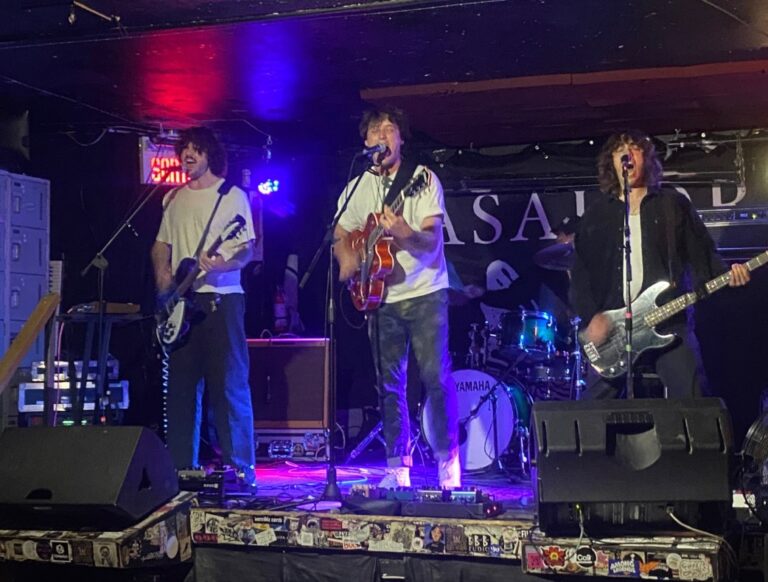
The four friends from Kingston didn’t wait long to set the stage alight at the Hémisphère Gauche this Thursday, September 25th as part of POP MTL. It was in front of an audience of around thirty people and a black stage backdrop bearing their name that the gunners of Kasador, bearers of Ontario rock & roll, opened their late-night performance.
They immediately warmed up the atmosphere with Youth, immediately setting the crazy tone and the supercharged energy of their performance. They played excerpts from Broad & Bloom, Youth and their most recent EPs Kasador I and II with intensity, passing through Could’ve Loved You, Talk About It and Skeleton Park.
The fun and complicity between the members was palpable and Cameron, visibly amused, offered us some well-aimed kicks in the air to mark the accents of Stephen’s percussive playing. Halfway through, the crowd began to loosen up with them just in time for the most danceable, culminating with R.I.P Me Down for an anticipated finale. A short but electrifying concert, which made us forget the rain by offering us 45 minutes of raw emotion and gentle rock.