danse / Poetry

Entering Myth’s Speakeasy

by Juliana Cortes

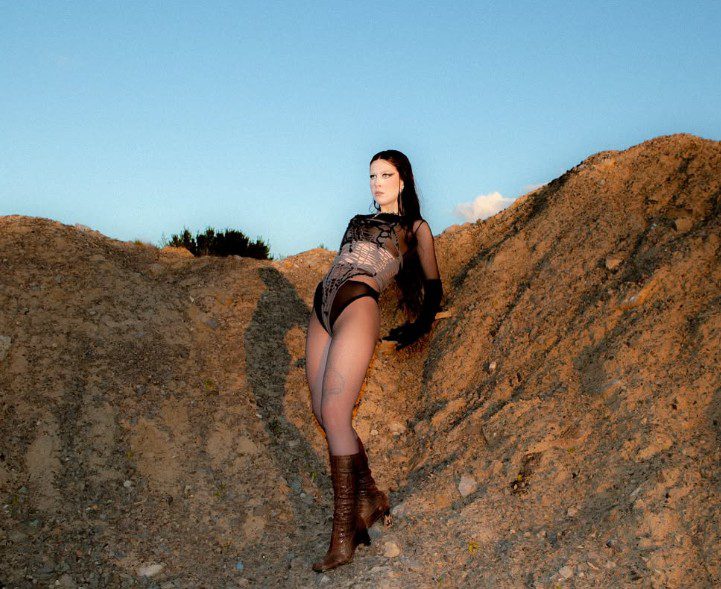
Triumphant, elegant, and poised, Myth sits on a divan, looking at the audience one by one as we enter the room with her piercing eyes. She appears comfortable, yet ready. The set-up feels mysterious, creating a sense of exclusivity that only a select few can access. The setting and her clothing clearly allude to the speakeasy era. In this underground basement party scene, people could drink, make music, and forget, or perhaps transmute, what was happening outside in the world. My first reaction was to enter the space carefully, to witness with full attention what was about to happen on stage. Myth slowly stands up, looks at the audience, and with her breath takes over the space. In silence, we see her move between total engagement and ease. The articulation of her movements immediately moved me; I could feel the strength required to remain fully connected to breath and body.

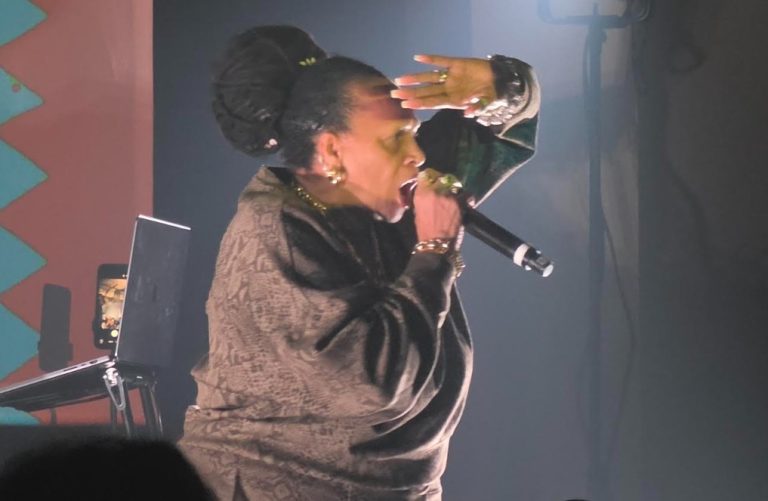
Myth honors Montreal’s dance and music scene, particularly the way jazz and house exist as both past and present, feeding each other. This is illustrated by the presence of Samantha “Sam I Am” Hinds with her singing and DJing, and Jason “Blackbird” Selman through poetry and trumpet. The three artists enter a conversation that moves between poetry, singing, movement, beats, and trumpet. Their exchange is seamless, with each artist having moments to shine. As a spectator, I felt drawn into the performance from my seat, instinctively bouncing my head to the rhythm. Myth’s body becomes a catalyst within the scene; her performance takes us into her inner world. We learn about her journey as a dancer who does not simply want to perform for entertainment, but to convey a message. It was difficult for me to hold back my tears as I understood that Myth was reminding us that when life is hard, dance can be the medicine that carries her—and many of us—through life’s ups and downs. I recognized the sacredness of dance and how, for me, it has become a way to know myself better, to make sense of my own roots, and to begin building a reality that encompasses all the pieces of who I am.

Speakeasy is also an homage to the Montreal dance scene: “a city she loves, but that does not always love her back,” a city that is far from easy to navigate or fully inclusive. The speakeasy theme made me think about how street and underground dance styles still do not have the place they deserve. Yet they continue to grow, evolve, and welcome people who are searching for a home. Sometimes these dances receive a spotlight that is difficult to share with everyone. However, dance is always happening—in church basements, community centres, schools, homes, family gatherings, and on the streets—as one of the poems suggests. As someone who is still searching for her place in this community, I found myself reflecting on the spaces where I have danced and the people who have made those spaces feel like home.

As a dancer, all I can say is thank you, Myth. Thank you for taking us into your inner world, for sharing your strength, and for being honest about the challenges that come with making art. The message felt clear: we no longer have to “speak easy.” We must be loud, take space, and create a reality where our histories and identities are fully welcomed.

Photo Credit: Renata Carmo

Baroque / Persian Classical

Constantinople, Holland Baroque, Saint Francis of Assisi, Sultan Al-Malik: the necessary fusion of hearts and soul

by Frédéric Cardin

Constituting the very last stage of a Canadian tour, the Montreal concert of the Dialogos project, merging the ensembles Constantinople and Holland Baroque, was held at the Bourgie Hall last Saturday, March 21, 2026.

What a beautiful and touching musical and artistic experience! Dialogos is the most recent album by Constantinople, created in collaboration with the Holland Baroque ensemble, and released under the Pentatone label. I will not revisit the ins and outs of this meeting based on the very real dialogue that took place between Saint Francis of Assisi and Sultan Al Malik in 1219. I mention all of this in my review of the album.

READ THE REVIEW OF DIALOGOS

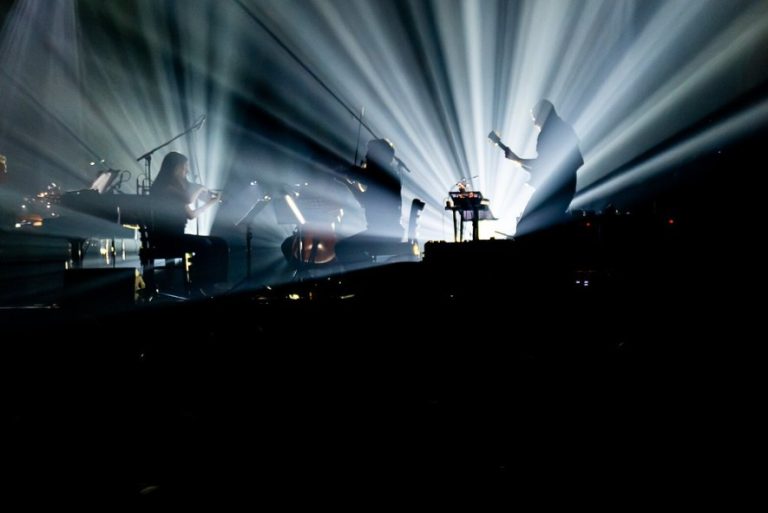
I will therefore focus on the concert itself. The music, all composed by members of both ensembles (except for one), unites different aesthetics in a very successful ecumenism. The microtonal sounds (significantly softened, though) of the traditional instruments from Constantinople (Kiya Tabassian’s setar and Didem Basar’s kanûn) intertwine very naturally with the classical polyphonic lines of Holland Baroque. The finely chiselled and unified rhythms in impressive coherence, the sparkling colours of both the classical strings and the percussion (delicate but essential Patrick Graham) and the setar and kanûn, as well as the voices of Tabasian (wonderful traditional Persian singing) and Adrián Rodríguez Van der Spoel (mediaeval singing), all contributed to transporting us to another realm where beauty and goodness are not pejorative, and are especially not perceived as a weakness.

I remember another equally inspiring fusion from Constantinople a few years ago: the marriage between the poetry of Omar Khayyam and the music of Bach. We were in the same inspiring waters last Saturday.

Bravo to everyone who participated in this stimulating and hopeful meeting.

Alt-Pop / Dance-Pop / Indie Pop / Pop

Ariane Roy is a Show To Remember

by Samuel Lemieux

As I watched Ariane Roy’s fans lining up, laughing and giggling, I asked one what it was like to see her live. “It’s breathtaking, it’s more than relevant in the age of feminism and limitless freedom of expression, and she embodies Marjo’s rock attitude mixed with harmonies and a voice as graceful as Les Soeurs Boulay and all that on melodies as catchy as those heard by fellow artist Marie-Mai in the 2000’s.”

Ariane Roy had her first hits with medium plaisir, which was released in 2022, and in 2024, along with Thierry Larose and Lou-Adrianne Cassidy, they offered the public a live album titled Le Roy, La Rose et Le Loup, which was positively embraced by critics and fans as a masterpiece. It served as a sweet reminder of J’ai vu le loup, le renard et le lion and 1 fois 5, both live albums recorded during la fête national du Quebec, featuring Gilles Vigneault and Robert Charlebois amongst other great names of the Quebec music scene of their respective eras.

In 2025, Ariane came up with an album titled Dogue, music featuring French lyrics sung with electro-pop melodies, all the while being quite refreshing from her last album in 2022.

Virginie B opened the night, bringing Charli xcx vibes with a soft voice screaming atop Brit electro-pop vibes. The set was a mix of Yoko Ono’s soft, extended vocal range with Lady Gaga’s hard-hitting pop music and theatrical looks. Virginie B woke us up and got us warmed up before the main act. Thus followed the long-awaited Ariane Roy. 

Silence, lights, action, Ariane Roy comes up on stage dressed in a white robe topped with a plaid red velvet corset and a yellowish tie. Her eyes, contoured with glitter, shine as she sings the lyrics to the title track “Dogue.” The crowd is hectic, everyone is singing the chorus, and for a moment, we all harmonize together with Ariane Roy. Odile Marmet-Rochefort is playing the keys while harmonizing on the backing vocals with three back vocalists who act as support during the performance alongside Dogue’s producer, Dominique Plante, who plays saxophone, flute, bassist and guitar, who also comes and brings support on backing vocals. 

The songs flow as the act is gradually heating up with songs like Kundah and Bonne Fête kicking the pace up, encouraging the crowd to jump and dance like there’s no tomorrow. Following with songs like Une cigarette sur le balcon presented as a tale of little Ariane Roy, who worries for her mother, who smokes only in troubling times. The feeling of powerlessness is something we’ve all felt—one day, seeing our parents weep and cry alone in the dark of the night. I must say this allowed me to bond a bit more with the superstar, as I felt we all shared a human touch, although she swims in fame and fortune. 

Photo by Rose Cormier

Another great moment came as she sangCe n’est pas la chance, a song about homeless people featuring Arcade Fire guitar-esque riffs and ending with a solo by Plante, bodies colliding, grinding one upon the other, while they unleashed a thunderous run of arpeggios that had the crowd fired up. 

Tu voulais parler starts soft but picks up the pace, and electricity radiates in the hair as Ariane Roy encourages everybody to dance and sing, not caring about what others might think or say. The show ends with an encore featuring Banc de parc, a song nodding at George Brassens Les Amoureux sur les bancs publics; a second song titled Ta main, which embodies the more organic sound of her previous album medium plaisir and to top it off, she sang Fille à porter, a fan favourite featuring Lou-Adriane Cassidy on vocals. Although it would have been nice to see her co-star come and sing with her on stage, fans were exhilarated at the end, and applause echoed endlessly after the final bow of the band on stage. 

Ariane Roy deserves all her success; she is grateful for it all and took the time to thank all the people who helped out on the show. She embraced two Quebec flags that fans had brought, a great nod at the rising independent movement rippling across Quebec’s lakes and rivers. I must admit, I was flabbergasted. With a diversified setlist, moves like Jagger and such beautiful staging, Ariane Roy’s show is one that I will remember. It was refreshing and great to see how alive our local artists are and to see fans sing most of the songs. I can definitely say Quebec’s local culture is truly alive and breathing! If you missed her, she is currently touring around Quebec, with the next date on March 27 at Laval-des-Rapides. She will also play in Lavaltrie on April 9. 

Photos by Rose Cormier

Garage Rock / indie / Psych-Rock

Vincent Khouni’s “Accident” Comes to Life

by Loic Minty

I slowly made my way to the Escogriffe for Vincent Khouni’s release show for his new album “Accident”, my superstitions were high having just listened to his song about a bicycle accident.

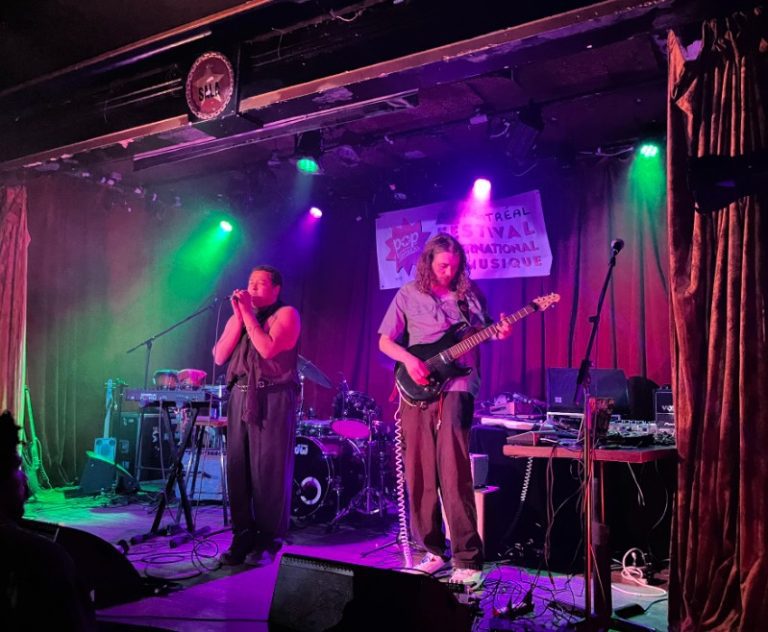
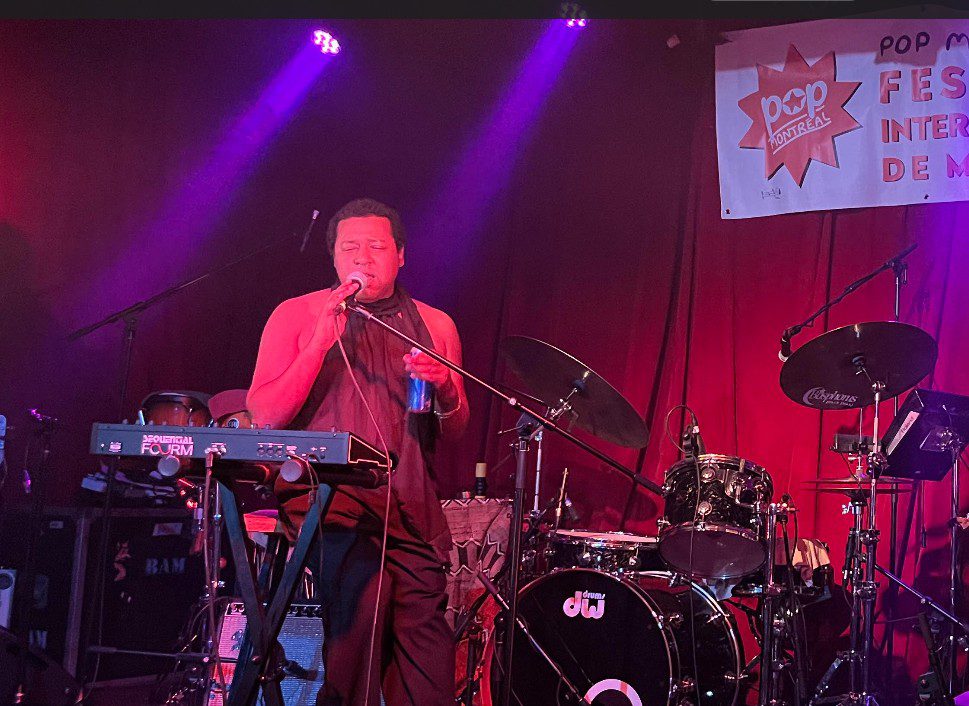
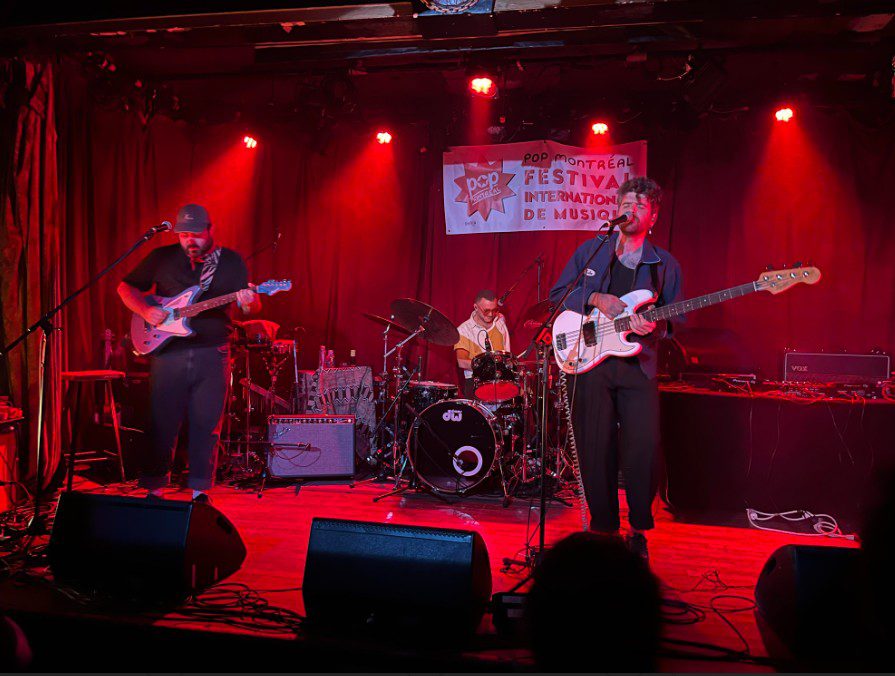
Vincent Khouni’s set started off with a low resonant drone, kicked off by the drummer’s sampler, usually a good sign in any concert. It could have been the intro to a doom metal song, but instead the sunburst guitar fluttered through a series of classic indy chords. Instant dream. Submerged in hot groovy basslines, sprinkled over with the keyboardists soft sequences on a prophet. An age old recipe for success.
It was enticingly soft, and could carry you away into eternity if it wasn’t counter-balanced with Khouni’s soft-edge voice. He reminds of King Gizz’s Stu Mackenzie, or the Oh Sees’s John Dwyer; singing with a higher, nasal overtone, emphasizing drawn out vowels. In fact, the entirety of the experience had a sense of nostalgia drawing from mid 2010’s psych and garage rock scene. 

Around the middle of the last song, Vincent Khouni went full Kikagaku Moyo, diving off into the deep end of guitar solos where few find their way back. 

One of his pedals sent off waves of pitch modulation, which buried under a wall of delay, sounded more like a wailing siren than a guitar. Khouni looked in his element in these moments, drawing the large crowd’s attention even further.

It worked well within Escogriffe’s context, which historically has welcomed more indie bands than one could ever imagine, but I’m curious to see how the band would perform given more space. If this was Accident live for the first time, it felt less like a crash and more like something slowly unfolding.

expérimental / contemporain / Musique de création

5ilience at Quai 5160: A Bold and Contrasting Program

by Jeremy Fortin

With a program full of contrasts, 5ilience performed Devinim on Wednesday at Quai 5160 in Verdun. The woodwind quintet captivated the Verdun audience, taking them on a rhythmic, harmonious journey where movement reigned supreme.

“Astro Errante,” by Mexican composer Abraham Gomez, immediately transports us into the world of the quintet. Beginning with a restrained opening, the piece unfolds as the musicians’ notes soar. This is followed by a much more rhythmic second section, characterized by a recurring rhythmic motif that creates a dialogue among the musicians.

On a completely different note, Gravité, by composer Florence Tremblay, begins with a mass of sound that evolves through the musicians. As the musicians enter and exit in succession, this sound mass evolves in depth and dissonance. A natural crescendo builds, amplified by the bellows, giving the audience the impression of a continuous wave.

In contrast to the previous piece, Letters to a Friend by composer Theresa Wong is based on a rhythmic pattern that repeats throughout the performance. The inspiration for this sequence? The translation into Morse code of a poem that a friend sent her before her death. Through a combination of percussion, instrumental playing, and contemporary techniques such as slap-tonguing, the composer reimagines Morse code for the listener throughout the piece.

The concert continues with two pieces that could not be more different from one another. Summa, by Estonian composer Arvo Pärt, embodies simplicity and fills every corner of Quai 5160. “Devinim,” by composer Ufuk Biçak, is the most lively piece of the concert, with a highly rhythmic opening and a melodic motif that weaves between the musicians.

The concert’s sole new work, Pauline, composed by the ensemble’s saxophonist Thomas Gauthier-Lang, begins with a series of sustained tones interwoven with multiphonics and brief, more rhythmic interjections from the oboe. As the piece unfolds, a rhythmic dimension emerges. An acceleration of the tempo leads to a series of melodic flights by the instrumentalists, over a rhythmic ostinato that remains present throughout this second section.

All in all, a powerful and striking performance for the audience at Quai 5160.

Brazilian / Forró / Reggae

Jota Pê Enchants Montreal: Between Laughter, Stories, and Emotion

by Sandra Gasana

We discovered many sides of Jota Pê during his very first concert in Montreal. Not only does he have one of the most beautiful voices in Brazil, in my humble opinion, but he is also an excellent storyteller and very funny on stage. Throughout the evening, he alternated between songs, stories, and jokes.

Accompanied by two excellent musicians who came with him from Brazil—Weslei Rodrigo on bass and Kabé Pinheiro on percussion—he appeared on stage wearing his famous hat, which has become his signature. Dressed in a very minimalist style, the artist began alone on guitar, soon joined by the bass, and then the percussion kicked in. From the very first song, he engaged the crowd and got them involved in the performance.

The stage was set for a fiery evening in front of a big crowd at the Belmont.

This was the third stop on his very first Canadian tour. He began in Vancouver, then Toronto, before finishing in Montreal. He played several songs from his albums, mainly Dominguinho and Se O Meu Peito Fosse o Mundo, both released in 2025.

« J’espère qu’à la fin du concert, vous vous sentirez mieux que lorsque vous êtes arrivés – I hope that by the end of the concert, you’ll feel better than when you arrived,” he told the audience before launching into the song Tá Aê.

Between songs, he shared stories, including his meeting with the great Gilberto Gil, who once invited him over for dinner. During that evening, he had the unfortunate mishap of breaking a crystal glass, which has since become a running joke. But what really stands out is the way he tells these stories: he knows exactly how to keep the audience’s attention, leaving them hanging on his every word.

One of the evening’s highlights came during the song Feito A Maré, which he recorded with Gilsons, the trio formed by the sons and nephew of Gilberto Gil. The entire venue sang at the top of their lungs while the bassist—whose scarf perfectly matched his bass—added a few lines with a kompa-like feel. We heard touches of reggae, forró, rock, and even a bit of samba.

A few covers were also part of the repertoire of the artist from Osasco, in the state of São Paulo, including A Primeira Vista by Chico César, performed with a reggae twist, and A Ordem Natural das Coisas by rapper Emicida, whose concert we also covered. In fact, Emicida reportedly called Jota Pê when the song was released to congratulate him on this version.

But the most powerful moment of the evening undoubtedly came during the song Ouro Marrom, which he performed alone on guitar and which speaks about the reality of being a Black man. The song won the award for Best Portuguese Language Song at the Latin Grammys in 2024. His voice resonated through the room as the audience turned into a massive choir.

« J’ai trop parlé, je vais laisser mes musiciens parler à leur tour – I’ve talked too much—I’ll let my musicians speak now,” he said, before giving the bassist and percussionist the floor for their respective solos. The percussionist even added his cavaquinho to the mix, along with body percussion. And as if to keep us awake as the night grew late, he ended the concert with a burst of energy, followed by an improvisation session between the three musicians.

« C’est le dernier concert de la tournée canadienne. J’aimerais remercier les productions Showzaço d’avoir rendu cela possible, ainsi qu’à JØY Brandt pour la première partie – This is the last concert of the Canadian tour. I’d like to thank Showzaço Productions for making this possible, as well as JØY Brandt for the opening set,” he said before leaving the stage around 2 a.m.

In my opinion, the mission was accomplished—we left feeling better than when we arrived.

Electronic / Experimental

SAT | Between Dreams: When Listening Becomes Sleeping

by Loic Minty

I woke up at eight o’clock, twenty minutes after the representation had ended.

In any other context at the S.A.T., my dozing off at the tail-end of a representation would mean a crushing defeat for the artist, but in Between Dreams it meant the complete opposite. As I had spoken to artist Claire Kenway earlier that week, she explained how the project was actually meant to induce sleep.

I came prepared with a tired body from the cold weather, and a readiness to finally give in to my previous battles against the S.A.T.’s inconveniently comfortable beanbags.

The film began in a warm orange hue that filled the room. In the first 5 minutes, my lucidity was washed away by imperceptible waves of gradient colors and noise; in the next 15, my eyes couldn’t keep up, and focus turned into feeling. Warmth slowly slipped into deep purples and blues, and into a backdrop of a starry night over which particle systems began evolving into harmonious geometry.

While the dome can be unforgiving when one does not grasp its vast emptiness, Claire Kenway and Patrick Trudeau seem to have understood the task at hand. The relationships between sound and image held a beautiful concomitance, a synchresis of slowness and wavelike gestures that very occasionally met outside of our own imagination. Spatialized delays bounced across the walls, masking the high-cut field recordings and throbbing subharmonic pitches that colored the space. The entire experience felt natural to the environment, and pleasantly welcoming.

From my earlier conversation with Kenway, I held questions in mind on how abstract representations of “sleep architecture”, and statistical models would translate in the dome. While it was not to the degree of precision of a Xenakis score, the music allowed more aesthetic freedom which probably saved us from a 40 minute atonal descent into madness (see Persepolis). Still, conceptual music exists at a delicate intersection between emotionally accessible and intellectually stimulating content. Between Dreams leans towards the former. While some elements of pitch and temporality created important ties to the underlying references to science, there lacked detail in how this applied to texture and composition. At the same time, it could be a bias from trying to decipher Patrick Trudeau’s quantum-scale visual abstractions. So I ask myself, can sound represent this type of complexity?

The experience was nonetheless powerfully memorable, and I woke up from it feeling inspired, and quite happy to know I’ll have to do it all over again to write about the last portion of the film.

Between Dreams might not “explain” the science, but it inhabits its affective space perfectly. The forty minute film was a promising prologue to the eight hour concert to be held on April 10th, and confirms that their sleep formula, although still quite mystical, works like a charm.

Experimental / Contemporary / Free Improvisation

Semaine du Neuf | When the collective becomes an entity

by Z Neto Vinheiras

“Nada nos quita lo bailado” is already by its title a pretty direct message that whatever the differences, whatever the oppositions, we’ll keep moving and we’ll keep dancing – together. It is a popular reference for that which can’t be taken from us – our memory, our history, our experiences.

I suppose that’s exactly what Ana Maria Romano wanted to bring to this form of composition, a collective one, where every musician, with their own individual baggage and story, is part of the process and the product as a whole – the collective becomes an entity. As a listener, I could feel the interconnectedness and the horizontal process of this piece becoming what I was experiencing in Sala at that moment.

I am always specially interested in hybrid formats and constellations of differences and contrasts – although with an apparent separation both sonically speaking and on stage, between acoustic instruments and the electroacoustic apparatus, Ana Maria Romano, Lori Freedman, Daniel Áñez, Noam Bierstone and Pablo Jiménez’s No Hay Banda made us feel like there was one for the night. As much relevant as is it is now in such a complete distorted world we’re living in, we could hear the speakers shouting “No borders! No nation! Stop the Deportation!” and a Free Palestine, echoing through the room: field-recordings made by Romano at the International Women’s day march that happened the last 8th of march in downtown Montréal. Once more insisting in the intersection of our motives and existences. Known by her strong policies on gender activism and intersectional feminism, Romano treated the collaborative creative subject the same way – non-hierarchically, permeable, listening, sharing, playing and doing together.

The piece itself evoked sometimes feelings of tension, sometimes strange stillness or ambiguous contemplation. Sometimes too, an electronic trance. A well sustained place for improvisation and collaboration – certainly leaving the room very inspired, thank you!

expérimental / contemporain / Multidisciplinaire / Musique de création

(MTL X Monterrey) + (saxophones + dance) = The Breath of the Body

by Jeremy Fortin

A collaboration between composer and choreographer where music and dance become one—that’s what two quartets, one made up of saxophonists and the other of dancers, brought to life. On Wednesday, Quasar presented the result of its collaboration with the Monterrey Higher School of Music and Dance. In a packed hall, the ten artists (four musicians and six dancers) immersed the audience in their world for the Canadian premiere of the concert Le souffle des corps.

Created by Mexican composer Alejandro Padilla and Quebec choreographer Danièle Desnoyers, Ouverture opens the program. In the darkness, the saxophonists’ breathing can be heard from backstage. Moving in tandem with the dancers, their entrance onto the stage occurs amid the musicians’ staccato breathing. As the dancers execute their movements in response to the saxophonists’ notes, the piece intensifies with the arrival of slaps, generating even more sudden movements from the dancers. The piece continues in a crescendo, complicating the piece’s language and liberating the dancers’ movements.

Interwoven with musical interludes composed by Chantale Laplante, the program flows seamlessly to keep the audience engaged with the movements unfolding on stage.

Next is Antichambre, by composer Eduardo Caballero and choreographer Lila Geneix. At each corner of the stage, the four saxophonists perform a series of sustained notes that, as the piece progresses, intensify in both volume and the dissonance of the chords played by the quartet—a tension that is reflected in the dancers’ movements.

Tres espacios, by composer Olivier St-Pierre and Mexican choreographer Jaime Sierra, explores movement characterized by sustained sounds produced by the instrumentalists. The piece gradually gains depth through the use of slap and polyrhythms.

This musical progression is thus also reflected in the dancers, who conclude the piece by freely taking over the entire stage and dancing to the sound of the saxophone.

Strange Attractor was created by the only all-Mexican duo: composer Miguel Vélez and choreographer Brisa Escobedo. Starting face to face, the dancers’ movements are dictated by the sound of the keys played by the saxophonists. Built as a crescendo, this piece is punctuated by a brief lull before resuming at full speed in a choreography where the dancers are torn between two opposing movements that clash.

The program concludes with Une même voix, by Quebec composer Sophie Dupuis and Mexican choreographer Daniel Luis. One by one, dancers and saxophonists take the stage. The piece is structured in this way, with each saxophonist playing a different motif. This blend of motifs creates an irregular rhythm that fuels both the music and the dancers’ movements.

In short, the music helped foster a meaningful dialogue between the musicians and dancers, and between Montreal and Monterrey.

Publicité panam
expérimental / contemporain / Free Improvisation / musique actuelle

Semaine du Neuf | Nous perçons les oreilles: Surrendering Body and Mind to the Music

by Alexandre Villemaire

Nous perçons les oreilles, a duo formed by the instrumentalist couple Jean Derome and Joane Hétu, presented a free-form improvisational collaboration with dancers Sarah Bild and Susanna Hood on March 14, 2026, at the intimate black-box venue La Chapelle. A creation that paid tribute to the musicality of the body, in keeping with the theme that ran through this edition of Semaine du Neuf.

Upon entering La Chapelle, we are greeted by a large open space featuring, as its sole installation, three microphones and a table upon which is arranged a motley assortment of objects and instruments that Joane Hétu and Jean Derome will use to shape the musical world that will unfold before our eyes. For although the work is titled “Aux confluents des âmes”, there is no underlying theme or organized anchor point that formally guides its structure. The only element running through the creation of this work is the intention expressed in the program notes, written jointly by the protagonists:

The body, the voice, and the rhythm

invite one another to move toward each other,

to weave an invisible fabric

where dreams take shape,

where the story unfolds before our eyes.

It is a fascinating experience to witness the unfolding of this fleeting world of sound and visuals and, as a spectator and listener, to enjoy making connections and crafting one’s own narrative. That is what makes the experience unique. The various sounds generated by the two musicians—using aluminum plates, wood blocks, slide whistles, water bottles, ocarinas, thunder drums, bows, melodicas, fans, various mouth noises—personally evoked for us at times the rustling of fallen leaves and natural landscapes, and at other times themes such as death, madness, and birth. An idea is sparked by a texture or a movement, and the performers respond to one another, adapting to create moments where music and body become intertwined.

We should also commend the focus of dancers Sarah Bild and Susanna Hood of the Frying Pan duo, who brought a unique depth to the various moments of this performance—not only through their expressive movements, but also through their facial expressions, which added a touch of theatricality to the piece.

The second half of the evening featured the performance titled “Du vivant”, bringing together Jean-François Laporte and his “Table de Babel” (Totem Contemporain) and the group “Tours de Bras”, with Éric Normand (electric bass and objects), Philippe Lauzier (bass clarinet and objects), and Annie Saint-Jean (projections and image manipulation). They added a stylistic dimension to the evening.

photo: Marie-Ève Labadie

While the complexity of the opening performance hinged on the immediacy of the present moment and the use of instruments, the performance of this co-production by Totem Contemporain and Tour de Bras relied on a broader sonic complexity generated by more sophisticated technical means.

There was something transcendental and almost meditative about seeing and hearing this soundscape, driven in part by Laporte’s imaginative instrument-making—notably the power generated by a truck horn powered by a compressor. Two approaches, two complementary ways of engaging with the material, yet the same sense of surrender and letting go in the music, for both the musicians and the audience.

Title photo: Céline Côté

Publicité panam

musique de film

The magic of Miyazaki comes to life with the FILMharmonic Orchestra

by Frédéric Cardin

Saturday night, the FILMharmonic Orchestra paid tribute to composer Joe Hisaishi, a loyal partner of director Hayao Miyazaki, the genius of Japanese animated film for the last 50 years. As a result, the entire magical and benevolent universe of Miyazaki’s characters came to life in the minds and hearts of the audience filling the Wilfrid-Pelletier Hall at Place des Arts in Montreal.

Impeccable Classicism

Hisaishi’s music is of impeccable romantic classicism. The silky melodies carried by the strings are accompanied by the pleasant chirping of colours from the woodwinds and percussion, as well as the sometimes heroic bursts from the brass. It is music filled with caressing tones, bathed in safe harmonies, but which, thanks to the composer’s talent, prevents the music as a whole from falling into the banality of uninspired writing. Hisaishi takes us with him into this world of simple sweetness and beauty, inhabited by an extra touch of youthful wonder.

That said, as conductor Francis Choinière mentioned during one of his interventions (short and effective, let us emphasise), Miyazaki’s world (and by extension Hisaishi’s music) carries within it, equally, the naivety of childhood through its fairy-tale worlds and a heartfelt dose of more advanced reflection on the environmental crisis, the transition to adulthood, and freedom.

From Kiki to Mononoke, and of course Totoro

Kiki’s Delivery Service kicked off the evening with its delicate theme. Then, the excerpt Requiem from Nausicaä of the Valley of the Wind reminded us of Hisaishi’s classical roots with this melody derived from Handel’s Passacaglia, cleverly adapted for the needs of this soundtrack. An excerpt from the music of Princess Mononoke, a masterful score curiously underlined in this concert, followed before diving into a substantial suite of themes from one of Miyazaki’s most iconic films: My Neighbour Totoro. Hisaishi’s pen for this film, with its exquisite sweetness and simplicity, blossoms with captivating melodies for the strings and fine, graceful touches for the woodwinds, with Gershwin-esque tones that stand out strongly in certain places. No big, evil villains in this film and its score, no tearful drama, no full-blown battle, just the friendly and fascinated tenderness of discovering a parallel world filled with gentle creatures. A music that feels so good, you cannot not love it deeply.

The second part of the concert gave us two long suites from two essential films of the Miyazaki canon: Spirited Away and Howl’s Moving Castle. If Chihiro is not lacking in effective passages, it is Howl’s Moving Castle that stands out. Especially with that incredibly memorable waltz. But not only that, because the story, although classic Miyazaki, still contains some of the most epic moments in all of the master’s films. The music reflects this with great acuity, while remaining true to the composer’s leitmotifs: simplicity and quality.

Two encores, including a reprise of the Totoro theme with the entire audience as an ad hoc choir. Everyone left the room humming To to-ro, To tooo Ro.

One drawback: the amplification used gives a filtered and less natural colouration to the strings. One begins to wish that the FILMharmonique Orchestra would perform at the Maison symphonique instead. But well, it’s a detail that ultimately has little consequence on the success of this enchanting evening that we would be ready to experience again at any time.

And that anytime could be March 21 in Quebec City, as the same program will be given at the Grand Théâtre. People of the capital, don’t miss it.

DETAILS AND TICKETS

expérimental / contemporain / Multidisciplinaire / Musique de création

Semaine du Neuf | Lovemusic: A Clash of Bodies and Sounds

by Jeremy Fortin

On Thursday, the Lovemusic collective presented Protest of the Physical at La Chapelle scène contemporaine. It was a daring concert that explored the intersection of the body and music. The result? A diverse program performed with great sensitivity by the collective’s members, though it occasionally missed the mark.

The concert opens with “In die Ferne, dem Berg zu” by German composer Annette Schlünz and choreographer Anne-Hélène Kutujonsky. In my view, one of the concert’s highlights, the piece begins with the musicians dropping a handful of pebbles onto the floor. The relationship between the pebbles and the musicians is certainly ambiguous, but the pebbles hold a certain significance for the performers. Once they have taken their places at their instruments, the group’s artists mingle on stage, continuing to breathe as if their instruments were part of them and their breath emanated from them.

The piece ends as it began—with the guitar—using glissandos to guide the dancers’ movements as they search for their precious stones.

Hands, Drum—Three Bones by composer Nik Bohnenberger continues the concert. This piece is designed to be interactive, with the audience expected to perform the movements displayed on screen in order to alter their own listening experience of the piece. While some effects do not impact the listening experience itself, the biggest issue arose in the attention paid to the musicians during the piece—which was very little. Constantly distracted by the screen, the listener must therefore choose between listening to the piece or following the instructions displayed on the screen.

Seed, a piece by composer Bethany Younge, is certainly interesting from a conceptual standpoint. Featuring musicians who seem alienated from their instruments, we can sense the tension they share with them. The musical aspect thus unfolds along these same lines, where what is played stems from the very movement of these bodies on stage as they resist their instruments.

Inferno, by composer Helmut Oehring, concludes the concert. Blending music and sign language, the piece is a real slap in the face. As the cellist begins the piece by bowing her strings in sync with the soundtrack, a crescendo builds until she unleashes her instrument while letting out a series of screams. When the other musicians join in, the piece undergoes a drop that marks the beginning of the second section, performed entirely in sign language. A third section, blending body percussion and instrumental playing, reaches its climax as all four perform at the peak of their abilities, reintroducing—this time on the clarinet—the cries of despair heard earlier.

Subscribe to our newsletter

Inscription
Infolettre

"*" indicates required fields

Type of Suscribers