Electroacoustic / musique acousmatique

Akousma | Daphne Oram’s Echoes, Joseph Sannicandro, Rehab Hazgui

by Joséphine Campbell-Lashuk

On October 30th, Akousma presented their second night of acousmatic and electroacoustic music. Daphne Oram’s piece opened the first block.

An analog hum takes over; small sounds spin around us like friendly aliens. It is part singing bowl, part synthetic bell, all old-school grainy reverb. It’s a warm, enveloping piece that inhabits us like hope itself. Oram plays with distance, letting some whirls hover farther away. This use of subtlety keeps our attention on the details, so even as the piece begins to grow, we can still hear the resonance of the small sounds. The central part of the piece brings a countercurrent of darkness, train-like rhythms that swell and fade, giving way to the return of the hopeful soundtrack.

The next piece, by Joseph Sannicandro, strikes us as quite particular; it kicks us from Oram’s mystical world to the bank of a very real river. We hear water, rustling, and people. The sound remains close to us throughout, the river traveling from left to right while the white noise stays constant. The piece, “al-rambla / Las Ramblas,” stays firmly in the realm of water. At first, it simply rocked me thoughtlessly, but its constant recurrence made me acutely aware of its subtle variations. There seemed to be no repeated water sound; each held its own pattern and tone. This made every one of them feel special, as if Sannicandro were crouched by a river or creek, listening closely to its voice. In the second half of the piece, one moment struck me as an incarnation of claustrophobia, when the white noise was suddenly pulled away, the environment shifted indoors.

The last piece, “Chôra (creation)” by Rehab Hazgui, begins with vitality. Two resounding explosions hit us, followed by a haka taken straight from the New Zealand House of Commons, announcing resistance, change, or destruction. The people’s voices strike us clearly, making us sit up with attention. Next, drumming takes over, floating above our heads. It feels as if these drummers have ascended past this plane, beyond here and now. On our level, a synthesizer lulls us. While this is lovely, it lacks the same intense urgency that made the opening so striking. It seems to simply wind down and rest there. This Akousma program was incredibly diverse, a rare opportunity to hear works that go beyond what is usually expected in such settings.

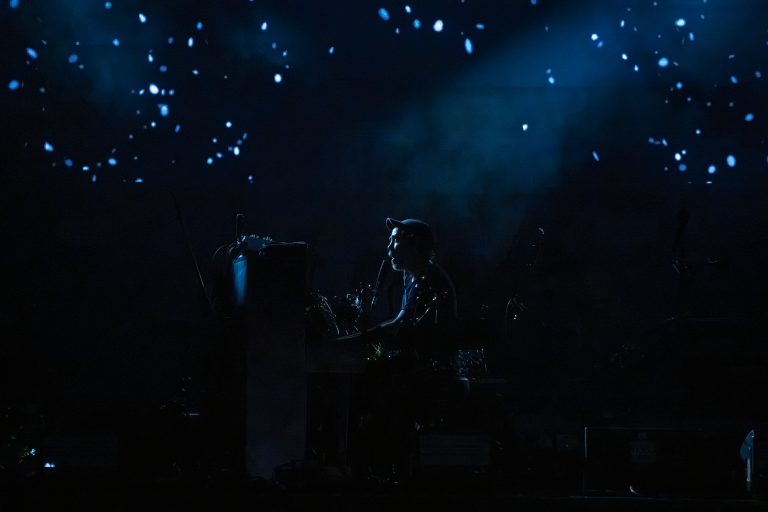
Photo of Joseph Sannicandro from Akousma Instagram page

Publicité panam
Country / Folk

Odie Harr at Casa del Popolo : A Joyful Montreal Chaos

by Félicité Couëlle-Brunet

Montreal’s own Odie Harr filled Casa del Popolo to the brim for their sold-out show last night, and the energy was nothing short of contagious. I hadn’t seen them since their first gig at Turbo Haüs, but the spirit was just as alive, maybe even wilder this time. The stage was crowded with fiddle, accordion, trumpet, trombone, and a rotating cast of friends who seemed to appear and disappear mid-set, feeding into the band’s spontaneous rhythm.

Odie Harr’s performances are rare gatherings… Apparently, the full ensemble only manages to reunite during shows, which makes each one a singular event. Their music blurs the line between rehearsal and revelation, balancing folk roots with experimental improvisation. The result is a sound that feels communal and alive, like a street parade squeezed into a tiny venue.

What makes this band special is the way they play for and with each other, no hierarchy, just a tangle of melodies, laughter, and trust. Watching them feels like stepping into a celebration you didn’t know you were missing. At Casa del Popolo, the joy was real, and the chaos was perfectly orchestrated.

Arabic Classical / arabo-andalou / classique persan / Flamenco

FMA | Olé Persia Subtle “Trialogue” Between Three Cultures

by Michel Labrecque

The venerable National Theatre on Sainte-Catherine Street East was packed for the opening of the 26th Montreal Arab World Festival (FMA). A wonderfully diverse crowd—it felt like stepping into Alain Farah’s novel, Mille secrets mille dangers, or its film adaptation. Among the spectators of Iranian origin were Nima Mashouf, recently released from an Israeli prison, and Amir Khadir. A multitude of languages ​​could be heard, sometimes spoken simultaneously. We were in Montreal, without a doubt. And we felt right at home.

But then, in her opening speech, the festival spokesperson sent us a dark message:

“You can’t imagine the outpouring of hate on our social media,” she said, referring to the difficulty a festival like this faces in navigating an era where rising exclusion complicates matters. This isn’t the first time, however: I remember how much the aftermath of September 11, 2001, weakened the festival. It’s resilient, though, and it responds with the quality of its shows.

The FMA thus begins with an original creation: Olé Persia, which aims precisely to unite cultures rather than divide them. Under the musical direction of Saeed Kamjou, we witnessed a blend of Arabic, flamenco, and Persian music and dance. We are already familiar with the links between flamenco and Arabic music, due to conquests and coexistence in Andalusia. But classical Persian and Arabic music have also influenced each other, as Saeed Kamjou explained in an interview you can listen to on PAN M 360.

We were treated to a musical journey that lasted almost two hours.

On the flamenco side, there was the formidable guitarist Caroline Planté and the fiery singer Fernando Gallego. From the Arabic side, there was Montreal oud player Abboud Kayyali, originally from Jordan; from the Persian side, the accomplished percussionist Pejman Hadadi, the tar (a Persian guitar) player Behfar Bahadoran, and Saeed Kamjou on the kamancheh, a bowed instrument, who orchestrated the show. Singing in both Persian and Arabic, a rare feat, was Mina Deris with her sweet and melodious voice.

Let’s say it right away: we were dealing with highly talented instrumentalists, perfectly masters of their instruments, including vocals. And then, the dancers joined us: Rosanne Dion from Quebec, who studied for a long time in Spain, and Shahrokh Moshin Ghalam, a Franco-Iranian master choreographer of Persian and contemporary dance.

The idea behind the show was to juxtapose these three cultures, to illustrate their similarities as well as their differences. The repertoire consisted of works from the different cultures. It was a series of dialogues or “trialogues” rather than a fusion of styles. And, in that sense, it was a complete success.

The audience clearly enjoyed it, judging by the level of applause. I also had a lot of fun, especially when a mini fusion of genres took place. When Behfar Bahadoran started improvising on the tar over Caroline Planté’s rhythm, I started to look away. I would have been curious to hear the Spaniard Fernando Gallego sing in harmony with the Californian-Iranian Mina Deris. Perhaps it’s the uninitiated improvisation enthusiast in me who would have liked the fusion to go even further.

But it was a fantastic inaugural concert. Let’s wait and see what’s next for FMA.

Musique de création

Quatuor Quasar, 40 Years After the Tragic Death of Claude Vivier

by Jeremy Fortin

As part of the CAM tour, the Quasar saxophone quartet presented its program entitled Five Liquid Pieces, a tribute to Claude Vivier, on Wednesday. This concert, which is not its first performance, is part of the events organized in 2023 commemorating the 40th anniversary of the tragic death of the great Quebec composer Claude Vivier.

If this tribute concert features only one work by the composer, it is to highlight Vivier’s mentors, such as his two teachers, Paul Méfano and Gilles Tremblay, as well as those who were inspired by Vivier, such as Florence M. Tremblay, Émilie Girard-Charest and Yassen Vodenitcharov.

The concert began with “Pulau Dewata,” a piece with variable instrumentation composed in 1977 by Claude Vivier. In Balinese, Pulau Dewata means “island of the gods,” a tribute from Vivier to his trip to Bali, where he became familiar with the gamelan, a major source of inspiration for the composer. Blending homorhythms and a sound very close to that of the gamelan, “Pulau Dewata” was undoubtedly the ideal piece to start this concert. Quasar delivered a very respectable performance of this flagship piece in their repertoire.

The concert continues with “Mouvement Calme” by Paul Méfano, which, despite its careful writing combining rhythmic passages of “slap-tongue” and lyrical moments both unfolding in gentleness, unfortunately gets lost within the eclecticism of the concert.

Next up was Gilles Tremblay, who, in 2009, to commemorate the 25th anniversary of Vivier’s death, composed the piece “Levées” for Quasar. This piece perfectly illustrates one of Quasar’s strengths: the dialogue between the different members of the quartet. The piece itself is largely structured around questions and answers, and the potential for dialogue between the instrumentalists. This reaches its peak during a series of short interventions featuring the Quasar musicians’ acting skills, which delighted the audience.

Next, we entered the world of Florence M. Tremblay with “Vapeurs taillées,” a captivating piece that showcased the saxophone’s diverse sounds. But the evening’s biggest surprise was Émilie Girard-Charest’s “Bestiaire,” a completely playful piece blending a wide range of techniques, such as playing only the mouthpiece or the neck, but the most surprising element was the finale with a baritone reed solo. In short, a piece that had the audience laughing like I’ve rarely seen in new music! The concert concluded with the concert’s title piece, “Cinq pièces liquides,” a solid work that, for me, perfectly illustrates the eclecticism of an excellent concert presented by Quasar.

Oiseau de nuit on Stage, by Antoine Corriveau: Beef Effect!

by Simon Gervais

Wild and ferocious, Antoine Corriveau brilliantly performed at Ausgang Plaza on Thursday evening, the Montreal debut of his excellent Oiseau de nuit, an album released on April 25. A title that reflects the man, who is often seen prowling concerts and musical events with his werewolf look.

Shy at first, almost anxious, he appeared on stage, wearing a large red coat and narrow glasses reminiscent of the Inuit iggaak. The formula is complete: guitar, bass, and drums add strength to the project.

The show opens abruptly with Moscow Mule—even as I sip mine—and gradually ignites until it truly ignites during the very sexy Interruption. Alongside him, Cherry Lena, a talented and charismatic backing singer, completes the lineup and sheds some light on the dark feline’s rough vocals. Their stage complementarity creates an atmosphere that’s both ritualistic and intimate. We feel a bit like we’re part of a family, a bit like curious onlookers who have come to discover resolutely energetic material, more so than on the four previous albums.

“It’s been four years since I’ve performed, the last time was during the pandemic and it was a bit weird,” he confides with nervous humility. This initial fragility makes his transformation all the more striking as the concert progresses: the cat gradually invites us to dance in his alley, and the die is cast.

His cavernous, otherworldly voice serves up pieces that are both danceable and narrative, with a rap cadence reminiscent of Dédé in Belzébuth or Leloup in Johnny Go. It’s deliberately disconcerting at times, often catchy. The depth we know from Antoine Corriveau is now dressed in powerful arrangements and a rock attitude.

Moving away from the more austere and airy sound of his debut, Corriveau explores a groovy, densely textured territory in Oiseau de nuit, tinged with jazz, funk and hip-hop. A direction begun in his previous album Pissenlit, released five years ago.

Under the red strobe lights, this cat danced and made us dance, proving that by reinventing ourselves, we can be reborn from our shadows to shine brighter in the middle of the night.

Photo: Compte Instagram Antoine Corriveau

Akousma/ Electrochoc/Tempo Reale | A Fitting Homage to Berio

by Joséphine Campbell-Lashuk

On Thursday the 23rd of October a great collaboration between Akousma, Electrochoc and Tempo Reale came to fruition in the multimedia room of the Montreal conservatory. The lights go down, and an archive of music and sound is reactivated. The first piece of this program, dedicated to the late Luciano Berio’s one hundredth birthday, was in fact not by the Italian composer, but instead a work created by Simone Faraci and Francesco Giomi.

 This work, called In-Naturale, drew from extensive ethnographic and folkloric archives that Berio collected over many years. The piece weaved together voices singing and playful, cartoonish calls. It begins with a simple folk melody that emerges from the back left corner of the room and slowly expands into a sweeping composition that harmonizes a French lullaby with a Russian folk song and fragmented acoustic instruments.

The next piece, Thema (Omaggio a Joyce), offered a glimpse into the remarkable collaboration between Berio and Cathy Berberian, one of the most accomplished and innovative singers of her time. Her voice begins speaking clearly at first, straight in front, then gradually shifts through the room.

The following piece, Chants Parallèles, struck me as far more contemplative. There’s greater ambiguity in the sources used in its creation; it floats between sounding like a soft synthesizer and, at times, a distant choral voice. The second half of this piece was particularly moving because of its sheer delicacy. This contrasted with the final piece, Visage, a theatrical tour de force. In this rare North American multi-channel presentation, it filled the entire room, once again featuring Berberian’s extraordinary talent, her voice shifting conversationally through grunts and gibberish.

This concert was a beautiful dedication to Luciano Berio. I have still heard very few things that sound anything like Berio’s music. He was a composer who reached both forward and back. He created something deeply complex yet so inviting, or ‘accogliente’, as Francesco Giomi put it.

Publicité panam
classique

Thus Spoke the Trombone and the Cello

by Alexis Desrosiers-Michaud

This week at the OSM, there is not one, but two concertos, with two house soloists: trombonist James Box in Samy Moussa’s Concerto “Yericho” and cellist Brian Manker in Ernest Bloch’s Schelomo: Hebrew Rhapsody.

Moussa’s concerto takes its name from the city of Jericho, which, according to the biblical story, was surrounded by Israel before falling within a week. It is an intense work from beginning to end, which gives its performer no rest. Strongly inspired by minimalist music and the presence of an organ, the terror is felt from the first minutes of the work, with a motif of two descending notes (the opposite of Jaws) repeated many times sounding the alarm, and the soloist will be the last to play it. What follows is a series of virtuoso sequences for both orchestra and soloist, leading to climaxes reminiscent of Shostakovich with abundant percussion and strings in the extreme treble, in particular. James Box delivered an exceptional performance combining his powerful, wide-ranging register and flawless coordination. Yericho will keep the audience on the edge of their seats until the very end, who will jump to their feet to congratulate the orchestra, soloist and composer.

Brian Manker would later distinguish himself in a completely different way. As King Solomon, his musical proclamations and phrasing are impeccable, so much so that the massive orchestra behind him never overwhelms him. Like his colleague, his technique is tested, but, like a king, Manker never falters. Like Yericho, Schelomo is a seamless and more fluid work. The musicians play the role of the faithful wonderfully, chanting wildly whenever the king falls silent.

While there is a clear religious connection between the two concertos, the comparison ends there. This is partly because neither Richard Strauss nor Friedrich Nietzsche were Jewish, and partly because the opening of the concert was from the opera Tannhaüser by Richard Wagner, a notorious anti-Semite. This version was very successful, thanks to the accuracy of the woodwinds and the dexterity of the strings, but also to the majestic sound of the brass in the final theme.

The pièce de résistance of this long concert was Richard Strauss’s symphonic poem Also sprach Zarathustra. While the first minute may be well-known, one still has to be able to face the remaining 32, especially after an hour and a half of concert. The endurance test was met with flying colors. One might have expected a slackening of power and precision, especially from the overused horns and strings, but this did not happen. This (another) technically very demanding score gave us the right to very well-balanced contrasts between the woodwinds in the background and the solo violins, as well as interventions from scattered soloists on the lookout. The waltz was played with verve, before plunging back into the abysmal sweetness to which Rafael Payare has accustomed us since his arrival.

classique / période romantique

Festival Vibrations | OUM Celebrates Its 75th Anniversary with the Horn

by Chloé Rouffignac

This Saturday, October 18, the Orchestre de l’Université de Montréal (OUM) opened its season, celebrating the 75th anniversary of the Faculty of Music. Under the direction of Mathieu Lussier, the OUM presented a rich program featuring four Romantic works, all from the late 19th century, including Antonín Dvořák’s renowned Eighth Symphony. However, it was Richard Strauss’s Horn Concerto in E-flat major, performed by soloist Noah Larocque, that was the concert’s centerpiece.

Noting the rarity of the presence of a wind instrument at the front of the stage, Noah Larocque asserted himself from the first notes with a round and powerful sound, and this throughout the piece, which requires great endurance in response to text offering little respite. Despite the abrupt leaps of the large intervals, the melody and lyricism dominated with surprising ease. All in sobriety, yes, but the quality of the performance concluded with a well-deserved ovation.

In the opening of Edouard Lalo’s opera Le Roi D’Ys, we can note the cleanliness and delicacy of the respective oboe and clarinet solos, which already promise the solidity of the woodwind section. A solidity that we will find again in another lesser-known work on the program: La nuit et l’amour by Augusta Holmès, where the presence of the harp is sometimes stifled despite the discretion of the brass, which struggles to make its mark.

This discretion was quickly dispelled by the strong and controlled entry of the trumpets into Dvořák’s symphony, even if more pronounced support from the brass section would have been welcome. The final movement highlighted the precision of the entire orchestra in a triumphant allegro ma non troppo.

A surprising and successful start to the season. See you on December 5th at the Claude Champagne hall for the rest!

Photo: Nina Gibelin

House / Techno

Maceo Plex Closes Piknic Électronik 2025 with a Groovy, Emotional Farewell 

by Julius Cesaratto

For its final edition of the year, Piknic Électronik closed the season in style with a three-hour masterclass from Maceo Plex. Under an unusually warm autumn sky, the veteran DJ guided festivalgoers through one last outdoor dance — a groovy, emotional send-off before Montreal turns the page to winter. 

This special edition of Piknic came with a lively Igloofest activation, bridging the gap between the two sister festivals. Beside a giant inflatable igloo, fans frolicked through artificial snow flurries while the Igloofest Yeti mascots joined the crowd, adding a surreal, playful touch to the night. 

Opening with a selection of slow-paced, groovy vocal house tracks, the American-born producer began carefully building the ambiance. As the crowd warmed up, he turned the BPM higher, pushing into dreamy trance and progressive sounds, peppering in stabs of horns and 808 kicks. As the set evolved, he eased into a two-step rhythm, lifting the energy on what was already an unusually hot autumn evening. 

Hip-hop flips punctuated his performance — 21 Savage’s “a lot” and Young M.A’s “Ouu”  appeared in unexpected moments, each one eliciting massive cheers from the packed dancefloor. 

Later into the night, the tone darkened into tech-house territory, anchored by crisp hand percussion  and familiar 4/4 techno patterns. When the American-born producer layered in 21 Savage’s “No Heart,” the crowd erupted, roaring every lyric back at him. Behind the decks, he stood  triumphantly, pumping his fist, with a large smile of satisfaction beaming across his face 

Strobing white lights swept across what felt like Piknic’s largest crowd of the season, illuminating a sea of faces enjoying their last outdoor dance of the fall. Then came the set’s apex: Cloonee’s  “Fine Night” tastefully flipped for the occasion. As the iconic track rang out, the entire space was euphoric a collective realization that this was the end of another unforgettable summer started to settle in. 

In just a few months, Igloofest’s frigid stage will rise on the Old Port once again, and Montreal’s  festive ritual will continue, this time under the snow.

big band / Jazz

Université de Montréal Big Band | Celebrating 45 Years of Developing the Montréal Scene

by Harry Skinner

Anyone who spends any significant amount of time in the jazz scene in Montreal will understand the foundational role that the music faculty at the Université de Montréal plays in it. Over the last few decades, it has produced a now intergenerational community of musicians without whom the city’s music would not sound the same. As such, the school’s big band has inevitably become a place of development for countless musicians who continue to make names of themselves in the city and elsewhere in the world. With this Thursday marking the ensemble’s 45th anniversary, a Théâtre Outremont crowd was treated to a set of repertoire that was both surprising and classic, featuring the younger generation of students alongside several of their mentors in the faculty.

The night kicked off in style with an original arrangement of Thelonious Monk’s “Well You Needn’t” by lead trombonist Laurent Cauchy. His interpretation of the piece utilized plenty of odd time signatures and a bridge that shifted between half and double time feels, all of which reframed Monk’s melody in a new and interesting way. There is a clear stylistic connection in Cauchy’s writing to that of Thad Jones/Mel Lewis Orchestra alumni such as Jim McNeely and Bob Brookmeyer.

The rest of the set largely followed suit, featuring several (relatively) contemporary takes on standards by acclaimed arrangers such as Gil Evans and Bill Holman. A highlight of the show was Rob McConnell’s arrangement of Lester Young’s “Tickle Toe,” which featured faculty trombonist Jean-Nicolas Trottier alongside Maude Gauthier on the tenor saxophone, trading energetic solos both in sequence and simultaneously.

If there was one thing missing from last night’s performance, it was a lack of featured solos from the students in the band. Of course, It was a treat to listen to the faculty members that were brought onstage throughout, but the audience did not get the chance to get to know many of the ever-present musicians. In fact, the Don Sebesky arrangement of the classic “All the Things You Are” was the only piece that featured more than one student solo. This is not to say that this was to the detriment of the performance, but perhaps a missed opportunity. 

All said, the UdeM Big Band did well to pay tribute to its 45 years, while showing at the same time that it will remain a fixture of Montreal’s jazz community for years to come.

Photo by Nina Gibelin Souchon

classique

Mahler’s Ninth by the OSM: Farewell to a Futile and Frantic World

by Judith Hamel

On Wednesday evening, Rafael Payare conducted the Montreal Symphony Orchestra in the continuation of the Mahler cycle, this time with the composer’s final completed symphony, the Ninth. A highly demanding work that reflects the consciousness of a man who knows his end is near and is bidding farewell to the world.

At the time of composing the work, Mahler knew he had been diagnosed with heart valve disease and was haunted by the recent death of his daughter. Fearing the bad luck associated with ninth symphonies (Beethoven, Schubert), Mahler had avoided numbering his previous symphonic work, but in vain: this Ninth would indeed be the last symphony he would complete.

Payare offers us a reading that is quite different from the classic interpretations marked by great dramatic tension that we associate with Mahler, right from the first movement.

In this first farewell to life, lasting around thirty minutes, it is difficult to find a clear guiding principle to hold on to. Payare’s direction evokes less the gravity of this imminent end than the vertigo of our existence in our modern era, where everything moves at high speed and everything is ephemeral. In fact, his proposal has something profoundly contemporary about it: that of a frantic, saturated world where futility takes hold.

The second movement, a Ländler, opens with a section of tightly knit bassoons and a section of rough strings. Here, Payare opts for rusticity and fully embraces the woody, earthy character. The intoxicating circularity of the rhythm, the warm cooing of the French horns, and the wavering pace of the waltz create a country atmosphere that is both joyful and melancholic. It is a farewell to the simple pleasures of life.

The Rondo-Burleske is delightfully sarcastic. It is a whirlwind of sound, a celebration that descends into frenzy. Each section of the orchestra shines with its density and energy, contributing to this brilliant and chaotic orchestral extravaganza. A gargantuan celebration, carried by a deliberately pompous ending, unapologetically ironic.

The final Adagio presents the acceptance of leaving this world. Payare’s subtlety serves this movement well. He deploys a more sober and internalized gesture, adapted to the delicacy of this last movement. Little by little, he allows the sounds to breathe, until the fear of death fades away. In this long farewell that closes this great symphony, silence becomes the last and most eloquent of notes.

A few seconds of silence were observed at the end of the symphony. This silence filled the space, imposing itself loudly. It was followed by a heartfelt ovation.

Photo Credit: Gabriel Fournier

Africa / Electronic

FLUX | Singeli: Tanzania’s Future-Sound is Here

by Loic Minty

Sisso & Maiko put on a show at the S.A.T. like nothing we’ve ever seen before in electronic music. Originators of the new Singeli sound, the Tanzanian producers have not only invented an entirely new genre, but a new way of experiencing electronic music- at least here in North America. Its novelty is comparable to Baile Funk’s, but Singeli is even more culturally remote, forming its own insular world of sound. Supported by the Ugandan experimental music label Nyege Nyege, Sisso & Maiko epitomize this new wave of music that breaks ties with previous stereotypes of music coming out of Africa. Their sound is a technological embodiment of dance itself, where the body is the final instrument in a chain of digital creation.

At first listen, the rhythms may sound overwhelming, repetitive, but that’s the point, and over time, this impression wears off leaving in its place an ecstatic joy. Through dance, the body melts into the odd geometry of Mchiriku inspired rhythms, the ears tame the percussive sirens of vintage casio keyboards as a kind of cartoonish embellishment. Singeli sound is rich, but also unserious. After 2 songs we were hooked, not just by the uniqueness of the sound, but by the showmanship which gradually converted the initially dazzled crowd into fans.

Whether being blindfolded, playing the keyboard with their feet, or taking their shirts off and dancing a Chura through the crowd, Sisso & Maiko did not hold back one bit when it came to having fun. It was contagious. They could have played all night and we wouldn’t have noticed time go by. And as we danced, jumped, and ran from side to side, our fatigue was transcended. I recalled in my research the origin of Singeli sound which was in the Kigodoro parties, Kigodoro meaning “small foam mattress”, as dancers would collapse after sleepless nights of dancing. If the show hadn’t been stopped at 1am, it is easy to imagine how even a piece of cardboard would have seemed comfortable at 7am.

Subscribe to our newsletter

Inscription
Infolettre

"*" indicates required fields

Type of Suscribers