cloud rap / Electro-Pop / hyperpop

2hollis Brings Gen-Z Rage To MTELUS

by Jake Friesen

I make my way through the dense, sweaty crowd of intoxicated youths. Some let me squeeze by without much issue, others I have to stop and explain that I’m a journalist just trying to get to the photo pit. They begrudgingly allow me to continue my disgusting march to the front of the venue. I feel utterly geriatric in this sea of juvenescence (for the record, I’m 27). When I reach the foot of the stage, I turn to see MTelus packed to the gills with people preemptively holding up their phones for 2hollis’ entrance. I consider how horrifying it would feel to have that many eyes and iPhone camera lenses on me. Against the backdrop of a giant white three-dimensional tiger, 2hollis steps out on stage. The simplicity of his outfit, in contrast to his extreme height and incredibly blonde hair, makes him both angel and alien. The smear of black eyeliner beneath his eyes betrays his imposing aura and reveals him to be a human boy.  

A juxtaposition is quickly formed between an audience that is recording every moment of the performance and moshing extremely hard simultaneously. This makes perfect sense, given 2hollis’ deeply online origin story, blowing up on TikTok while managing to remain surprisingly anonymous. His sound pays homage to the legacy of caucauphenous hyper pop and moody cloud rap that came before him, while continuing to refine this fusion into a dangerously danceable meditation on big feelings. 

The crowd gets so rowdy that 2hollis stops the set at least five times to ask the audience to take a step back. Intensity of this type is not uncommon in the rage genre, but the concern for audience safety is refreshing. 

For the most part, the musical performance itself is standard fare for a cloud rap adjacent artist, a solo performer armed with only autotune and a backing track. However, it was 2hollis’ embodiment that stood out to me. Watching him onstage felt like catching a glimpse of someone dancing alone in their bedroom. Intimate, fleeting, and reckless. The authenticity in his movements feels pertinent to his predominantly Gen-Z audience, who have grown up in the chronically online era, where expressing oneself with such abandon risks being cringe. 

Standout moments from the set include his performance of “cliché,” which brought me to tears watching a couple dance to the song beside me. The intensity of “poster boy” left me feeling like a piece of rock being pressed into a diamond between the heat in the room, the pressure of bodies around me and the flashing lights. After relentless movement and pure hype, 2hollis surprises us all with his only acoustic track, “eldest child.” In that moment, 2hollis is something different altogether; he’s more than a mysterious conduit for some of the most danceable songs of our generation. Without autotune, he’s a talented musician with a voice, a unique human voice. Over and over during the performance, I am reminded of the humanity in the room and onstage. I would be remiss not to mention his encore, in which he played and subsequently replayed his hit song “jeans” three times. I don’t care what anyone says, it was awesome. 

I left the show with optimism about the younger half of my generation, that there is still a deep desire for moving and feeling. That we still want to move intensely and feel deeply together. Long live the rage. 

Photos by Jake Friesen

Africa / Arabic / Electronic

FLUX X EAF | An Electric Fairy Tale with Nadah El Shazly

by Félicité Couëlle-Brunet

The evening has the sweetness of an ancient dream. In the dim light of Espace SAT, a languor floats, an almost tangible melancholy. We whisper, we wait, as if something rare were about to happen. EAF evenings have this quality: they bring together the curious, the music lovers, the dreamers, around a common promise: that of listening differently.

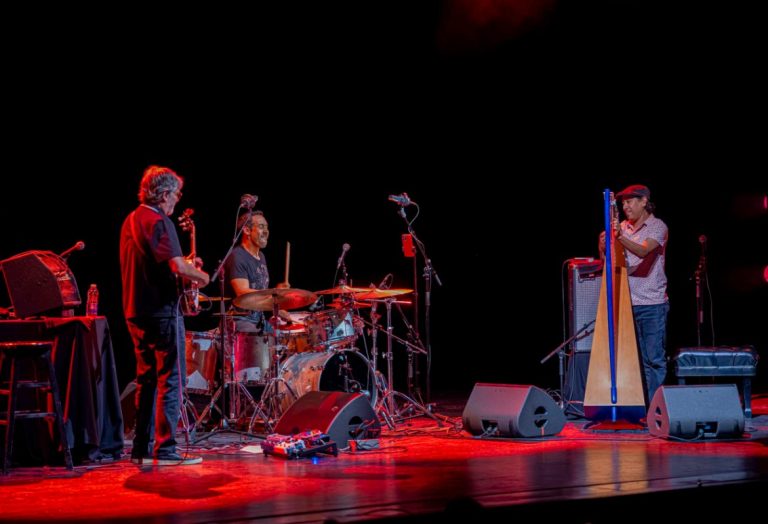
On stage, a harp sits alone, poised in the dim light. Its presence intrigues: what dialogue can emerge between this ancestral instrument and experimental electronics? Enter Nadah El Shazly. A key figure in Cairo’s alternative scene, she is known for blending Arabic vocal tradition with bold electronic textures. Her critically acclaimed album Ahwar (2017) had already revealed this rare ability to combine lamentation and trance, memory and rupture. Tonight, she immerses us in a new, more intimate, more visceral dimension: that of her new album, الشاذلي Laini Tani (2025).

She arrives accompanied by a harpist. Two mirrored presences: one upright, motionless; the other moving, inhabited. Even before a sound rises, we sense that the evening is shaping up to be a ritual. Nadah’s voice cuts through the air in a deep, vibrant way, laden with history. It carries within it the nostalgia of Arabic song, while escaping from it, to inject the strangeness of the present.

Synthesizers and bass intertwine with the harp in a sensual dialogue. The light unites them, making them bloom like two flowers from the same sonic garden. Nadah undulates, moves, breathes the music. But behind her lamentations, we can sense a discreet smile, an assumed mischievousness. At times, she plays with the dramatic tension she creates, almost mockingly. She knows exactly what she’s doing: her voice becomes both tragedy and comedy, gravity and joke. We later learn that some of the lyrics were cheeky, full of humor and irony, a delicious contrast to the solemnity of the tone.

A suspended moment occurs when she announces an improvised game. She steps toward her controller, and suddenly, the sound distorts. Noise emerges, raw, incandescent. Nadah lowers her head, lost in a trance. Electronic pulses collide with traditional Egyptian motifs, as if the past and the future meet in a single breath.

This passage encapsulates the power of her performance: the tension between mastery and abandonment, between myth and machine. When it all ends, an emotional silence fills the room. There is loud applause, but also softly, as if to maintain the spell.

I let myself be carried away by Nadah El Shazly’s voice, without understanding the words. Perhaps it’s better this way: the music spoke in another language, that of bodies, echoes and breath. Thanks to Nadah El Shazly, we all felt like we were living, for the space of an hour, a lucid, sensual and witty moment.

Publicité panam
Experimental

Akousma | A Concert Augmented by Bone Conduction

by Judith Hamel

On October 9, a packed house was held under the dome of the Society for Arts and Technology for the Augmented Concert presented by Akousma. This pioneering event, which for the first time used bone conduction headphones in a structured manner in an electroacoustic concert context, featured four specially commissioned mixed music works.

After a brief presentation by Andrea Gozzi, director of the research-creation project, several thanks from the collaborators and a calibration of our bone conduction headphones, we are ready for the immersion.

Nicola Giannini, La dialectique de la proximité

Posted behind his synthesizers, Nicola Giannini sculpts a dialogue between vastness and intimacy. The first minutes stretch out in various iterative patterns spatialized around us and through our headphones. A voice finally rises through our cochleas: “But I love the sound of this felt pen that goes towards you, towards me, towards us.” Giannini lingers writing with this said felt pen and we hear these gestures in our headphones. A crossing of an organic sound universe created by synthesis, a dialectic of proximity…

Duo Catalão-Thibault, INTIMITÉ INFINITÉ

Equipped with horns, Dominic Thibault and João Catalão slowly cross the space, moving from the back of the dome to the front. At each sound call, they take a few steps. Once they arrive at their installation, around the bass drum, the horns are used to produce windy whistling sounds, now transmitted directly to our headphones, creating immersion and intimacy. Then, the two artists manipulate various objects in interaction with the drum. They explore granulations, friction, complexity of sound mass and timbral qualities. The exploration of sound circularity is particularly interesting, notably through the gesturalization of a metal chain on the bass drum.

The end returns to the beginning with a slow movement of the artists out of the device. This is punctuated by alternating rattles of rattles that gradually fade away until the sound disappears completely.

Ana Dall’Ara-Majek, Polyhedral Rhythms

With his mysterious PhotoTable (an invented instrument), Dall’Ara-Majek places several vials on a glass table equipped with a light-sensitive electromagnetic device. Each vial, depending on its position, generates a distinct sonic response, modulating the density of the sounds and their rhythmic deployment. The sound material comes from modular synthesis and field recordings, creating imaginary landscapes. Around us, sounds of liquid flow and flux unfold. By methodically moving the vials across the surface with frank and calculated gestures, the artist brings out sonic textures that are sometimes tight or sparse, low or high, dense or light, sometimes tonal, sometimes more complex.

An instrument that immerses us in the transformations of matter.

Kevin Gironnay, Espèces d’espaces

To close the event, Gironnay presents a work with soprano Amy Grainger, who recites and sings excerpts from poems transmitted through bone conduction headphones. For a moment, breaths multiply through the dome, spatializing and transposing, sliding inspirations. The poems speak of space, of our souls, of the living. Grainger quotes Georges Perec: “The problem is not so much knowing how we got here, but simply recognizing that we got here, that we are here: there is not one space, a beautiful space, a beautiful space around us, a beautiful space all around us, there are lots of little bits of space.”

This concludes the evening well. An evening of exploration of space, our presence, and the tangible potential of new technologies.

Classical / Classical Period

Faust, Labadie and the OSM | Tributes to Viennese Classics

by Alexandre Villemaire

The Montreal Symphony Orchestra welcomed two powerful musical personalities for its October 8 concert. Bernard Labadie, a distinguished specialist in the Baroque and Classical repertoire, and German violinist Isabelle Faust joined forces on stage to present a program showcasing the Viennese classical spirit. And what better way to express this Viennese spirit than with two of the most emblematic composers of this period, both in terms of their energy and stylistic influence, than Joseph Haydn and Ludwig van Beethoven.

The former easily ranks among the most important and influential composers of the 18th century, notably because of his long life – he died at the age of 77 – and his jovial personality. Everything in Haydn’s music is extremely imaginative and lively, even in the most dramatic passages. Several surprises await the listener at the turn of a musical phrase. The latter also left a lasting mark on the world of music with his passion and by being the gateway to Romanticism in the history of music.

To open, the OSM musicians presented Symphony No. 103, subtitled “Timpani Roll,” so named because of the composer’s characteristic presence and entrance. After a thunderous roll, the first movement opens with an Adagio quoting the Gregorian hymn Dies Irae. This thematic material is faithfully reproduced by the composer, who modifies it slightly by inserting dissonant chords and syrupy melodic lines in the strings. The second movement, oscillating between ceremonial and ironic march, exemplifies Haydn’s humorous side. The third movement features sublime exchanges between strings and woodwinds in a light fanfare effect. The symphony’s Finale displays a variety of colors in different materials that evolve toward a climactic ending.

It is particularly in this movement that we can appreciate the characteristics of Haydn’s language, such as the sudden changes in dynamics that run through the movement. Dynamics and affects that Labadie masters with ease and clarity and where he gives the orchestra space to express itself.

Although Beethoven’s name is strongly associated with the Romantic period, the music of the impetuous Bonn musician is expressed in the style of Viennese Classicism. Known for his strong temperament and emotional fervor, which he transposed into music, Beethoven adopts here in his only violin concerto a more optimistic discourse with a light character, but retaining an intensity of line. Endowed with “clarity, audacious depth, and brilliant technique” (San Francisco Classical Voice), Isabelle Faust embraces the contours of the orchestral sound and offers controlled and sonorous dramatic flights. At first hearing the first movement, we were struck by these qualities of the musician, but also by the very technical approach of her interpretation where the expressiveness of the lines, although perfectly executed and proud, seemed cold. It was in the second and third movements—both linked together—that the expression and quality of Faust’s playing captivated us. The lyricism and gentleness of the Larghetto evoked a noble and majestic character, while the final Rondo, with its multiple thematic ideas and interplay of orchestral textures, brought the evening to a luminous close. Aside from the quality of the performance, the other engaging spectacle unfolding before our eyes was the communication, complicity, and pleasure that emanated from the interaction between Faust and Labadie during this performance. Always in contact, responding to intentions, directions, and phrase inflections with a message, the duo brought these works to life. They thus created a space of expression where intimacy and listening pleasures were combined.

Photo Credits : Gabriel Fournier

Publicité panam
Modern Classical

Quatuor Molinari: Reconstruction and Renewal in Continuity

by Alain Brunet

Dedicated to the late sociologist Guy Rocher, just a few days after the national funeral in which Quatuor Molinari: Reconstruction and Renewal in Continuity participated, this first concert of the ensemble’s season was given in a context of reconstruction and renewal in continuity.

Quatuor III (1994), for string quartet (Op. 30) by the late Bulgarian composer (naturalized French) André Boucourechliev (1925-1997). The piece comprises 6 different sections without a transition marked by a pause, different playing modes are put forward, the composer had bet on an open form where four randomly superimposed voices completed the framework. It starts with long and calm melodic lines with the bow, things then get more complicated, different motifs follow one another and overlap, an atonal explosion occurs, calm returns, the sounds become tenuous, crystalline, and bow strokes resume, and so on. This is a solid work for its time but which blends into the aesthetics of this same period, without really standing out from it.

Dmitri Shostakovich’s String Quartet No. 4 was composed in 1949 and premiered in 1953, coinciding with Stalin’s death, which was certainly not bad news for the composer, who had to live dangerously with his own modernity throughout the authoritarian leader’s reign.

This quartet was composed after the regime had dismissed him from his teaching position and banned the distribution of his modern works. Divided into 4 movements, was quartet no. 4 written out of fear of being too bold? Perhaps… because it seems that the modern components of the quartet are relatively tenuous, and the parts including popular or folkloric references (so dear to the Stalinist regime) often outweigh the modern materials of the work. In short, this “ambivalent” quartet remains excellent even if it is not my favorite of Shostakovich’s 15 string quartets, nevertheless very well performed by Molinari.

In the context of this concert, we will find more vigor and more adventure in this early work, Béla Bartók’s Quartet No. 1, inspired by an impossible love with the violinist Stefi Geyer, who inspired the piece. Constructed in 3 movements when the composer was only 27 years old, this visionary quartet carries the passion and the foundations of his own modernity, embodying his transition from previous eras to his own. The performance of Molinari seemed to me the best of this evening, the cohesion and eloquence of the individual and collective playing suggested an excellent season for this renewed formation.

Violist and chamber musician Cynthia Blanchon was indeed welcomed to Quatuor Molinari on Tuesday. The musician’s introduction was accompanied by the announcement of the revival of the complete 15 Shostakovich string quartets, which, let’s remember, had been canceled at the last minute last spring, due to the defection of Frédéric Lambert due to illness. From one work to the next, we saw the violist take her ease with the quartet, in all aspects of her playing. Establishing her personality as a performer within such an ensemble is not done with the snap of a finger, it goes without saying.

Experimental / Contemporary

FLUX | A Fat Mardi Spaghetti

by John Buck

Mardi Spaghetti @ Flux Festival, October 7th, 2025 Festival Flux collaborated with Mardi Spaghetti on October 7th for an evening of experimental sounds of international origin.

Eduardo Cossio (Perth) was the first to break the silence, his left hand hovering over a pedal chain while the right set an Ebow on a single string of an auto-harp. A trio of blue eyed Ebows joined for a cluster of tightly wound frequencies. There was something desolate in that metallic drone. Stabs from a reverb laden kalimba bubbled under the highest highs and lowest lows of Cossio’s harmonica. I had visions of an abandoned suspension bridge creaking between overgrown shores.

One of the thick steel cables is unwinding, each tiny strand tightest before the fall. Jen Yakamovich and Roxanne Nesbitt (Vancouver) continued the air of suspense on drums, electric bass and two trees of semi-cylindrical bells. Long tones encircled the stage at Casa del Popolo. Jen rolled around the drums with every sort of mallet, brush stick and back again.

Roxanne wielded a wooden bow of ancient styling against the detuned strings of an electric bass propped on the left shoulder. Dense stuttering from the bass rose with flourishes of a riveted cymbal and fell into sparse ambiances centred on bell tones. A slow pulse, our first clear unobscured tempo of the evening, arrived just in time for the bow.

The trio of Pablo Jimenez (Bogota/Montréal), Camila Nebbia (Buenos Aires/Berlin), and Antoine Létourneau-Berger (Rimouski), brought time and tonality back into the abstract with a series of intensely committed improvisations that explored the extremes of their respective instruments. Antoine sat behind a the keys of an Ondes Martenot routed to pickups placed on the various quasi-membranes of a trap set – the skin of snare drum, a gong. Subtle whispering tones often inspired his bandmates to a new level of understatement and fragility.

Camila Nebbia could follow him there, sometimes with the help of a tin can in the bell of her saxophone, now apparently singing from the other room. She’d pull the can out to reveal a cascade of untethered melodies full of rhythmic substance and surprise. Pablo let those rich tones through, bowing his acoustic bass into the texture of a section of violins on a rewinding tape machine. Recalibrate your ears and expectations for music some Tuesday soon.

Publicité panam

Joseph Houston: In All Weathers

by Loic Minty

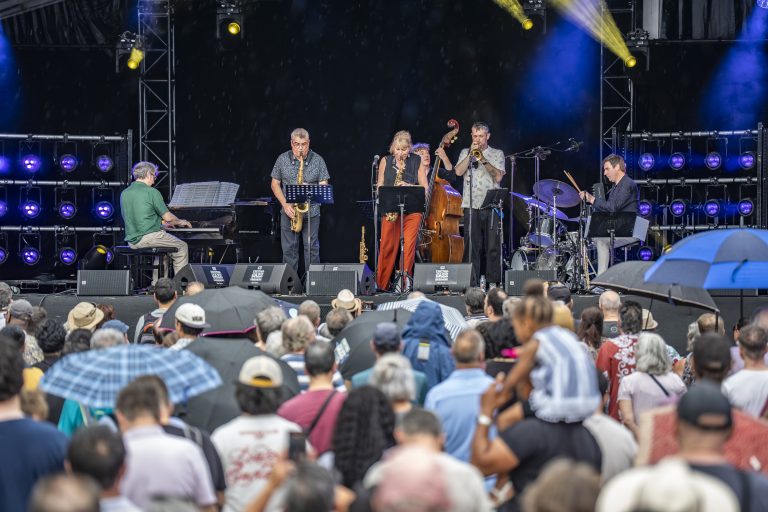
On a rainy October 7th, what could be better than taking shelter in the comfort of a chapel, letting the torrent flow by while listening to its gentle violence. Sometimes slow, sometimes like a thunder of chairs returning to their places at the bell, Joseph Houston’s piano wonderfully allowed us to discover what we could not have previously imagined on such an instrument.

With infinite precision, Joseph Houston cut the church’s resonance into a thousand pieces. Under the pounding rain, we traveled a winding path, from purely serial music at the opening to almost jazzy chords where melodies began to reveal themselves. Held together by detailed and dense scores, the rhythm gave way to changes of speed and carefully unregulated phrasing. A style he made his own with confidence.

This winding journey, ultimately, was not a coincidence, but rested on the superposition of forms whose outline the intellect could only barely define. After almost an hour of exponential growth, the tranquility of its ascent suddenly took on force. In Cassandra Miller’s piece Philip the Wanderer, Houston revealed her unrestrained virtuosity. Heavy as the ground and yet light as incense smoke, her spasmatic left hand created a low drone, while the right developed a floating melody with a romantic air. The whole thing rose in bursts of strums, played as if they had been forgotten, which were heard along a dynamic path: lost, found, then lost again in a din. Without our realizing it, the end of the piece revealed the main tune, which had resonated within us ever since like a distant memory.

Back on our orange chairs, the small red chapel could be heard from far away, for even the storm had joined us. The room, filled with contemporary music lovers, emptied as the audience dispersed, running. The storm, however, remained suspended, as if it wanted to prolong the last note.

Électronique

SAT | Ferias welcomes Ash Lauryn

by John Buck

Ferias invites Ash Lauryn to the SAT There was a certain self-assuredness emanating from Ash Lauryn as she came to the decks over the dance floor at the SAT on Friday October 3.

She had waited in the wings of an eclectic b2b set by Montrealers Lia Plutonic and DJ silktits, taking stock of the floor like a ruler over her lands. Piano chords brought in a mix of Sophie Loyd’s “Calling Out” to mark the first selection and make a formal decree: tonight is for getting down and feeling good.A drop into four kicks to the bar and the crowd was all in agreement. 

Ferias organised this night of revelry, bringing a DJ booth adorned with a forest of gargantuan house plants and incandescent bulbs hanging like mangoes — very much rainforest-in-space. Listeners were evidently here for a weekend party. A few serious dancers demanded space around the outer edges. 

Ash held firm attention throughout a set of uplifting mixes. The tones and grooves hugged closely to what listeners have come to admire from the force behind blog and radio show Underground and Black: soulful R&B vocal tracks, chord stabs and fiery instrumentals.

An infectious hook from “Freak Like Me” by Adina Howard embodied the atmosphere. The dance floor packed close. A virtuosic organ solo from “Much More,” (Luis Radio and Fabrizio Monaco), melded into an equally adventurous synth joint that I’ll have to keep an ear out for. 

Dance music is best served thick and unrelenting. Next Canadian date @ Standard Time in Toronto October 31st Underground and Black on NTS radio.

art sonore / Poetry / Soundtrack

FLUX | Poetics of Transmission and Poetry of Consciousness

by Judith Hamel

It was in the intimacy of the Indigenous artist-run centre, daphne, that Tanner Menard and Martín Rodríguez presented two unique performances on Sunday evening as part of the Flux Festival.

While waiting for the performance to begin, we wander among the exhibits Prelude to the Return of the American Indian by Buffalo Boy and Ne Karahstánion. This place itself inspires a sense of peace of mind, a communion among those present.

A few minutes after eight o’clock, Martín Rodríguez appears wandering through the galleries, wearing a beige uniform, rain boots, and a black cap adorned with gold. Loud chirping can be heard from his bag. After several detours through the space, he stops in front of the kitchen and takes out two radios and two transmitters. He fetches a ladder, places one of the radios on it, and invites the audience to gather around this new altar.

Using sound archives: birds, bullfrogs, bells, bees, trucks, cars, human voices, several explorations of interference between radio-transmitter pairs unfold. Rodríguez then creates the interference by playing with the distance between the transmitters and the radios. Each of his gestures affects the broadcast: he leans, straightens, withdraws into space; he moves objects, combines them, opposes them; he creates the interference with his own hands, erecting his transmitters like a fragile house of cards.

His performance ends with a nap, wrapped in a white jacket decorated with colorful embroidery, cap pulled down over his eyes, abandoned among the urban sounds.

After a short break, Tanner Menard takes his place. At the intersection of sound and visual poetry, his work is rooted in a search for a post-polarity-unity life and a vision of the world based on interdependence and drawn from love.

After a few shared breaths and our eyes closed, Menard recites his first poems. Around him, a pool of candles and four radios broadcasting white noise. In front of each, a bowl of water collects their waves. After this moment of poetic performance, he sits down at the computer, which projects these visual poems onto the wall. Everything is accompanied by his recorded voice and a musical score that embraces the texts’ forms in their intentions and intensities.

His words tell us about the fragility of contemporary existence and our common isolation: “The only “we” that exists is the common experience of multiplicitous isolation.”

Finally, he hands us the candles that came with him, consciously placing them in our hands. Then, with a ritual gesture, he sprinkles us with a few drops of water.

As we leave the place, the street appears different. This shared listening invites us to rethink our common individuality.

This shared moment invites us to rethink what connects us, our overall way of being alone.

Publicité panam
Baroque / Classical

Arion At Her Majesty’s Service

by Alexandre Villemaire

To open its 45th season, Arion Baroque Orchestra has adopted this formula of the Concerts de la Reine. Under the aegis of Marie Leszcynska, wife of Louis XV between 1725 and 1762, the Concerts de la Reine offered the court excerpts from vocal works or even movements from symphonies, more suited to the setting of the royal apartments and private salons. In the splendor of the ballrooms of the royal palaces, works were thus played for the pleasure of royalty. It is with this idea of ​​arranging disparate pieces that Mathieu Lussier built the repertoire of this concert, from instrumental music to vocal music.

With this underlying theme of femininity in mind, Arion opened its season with a work by a female composer – a first for the ensemble in 45 years. Taken from a small pastoral opera, properly named Le Concert, Mademoiselle Laurant’s arias, symphonies, and dances possessed a lightness and lyricism very much of the period, oscillating between animated, interior, and royal character. In comparison, the excerpts from the Prologue to the opera-ballet Les Génies or Les Caractères de l’Amour by a certain Madame Duval presented a wide variety of dynamics, notably the Air des Génies, which was particularly original in its multi-thematic construction.

Besides these two composers, if there was a queen at this edition, it was the Canadian soprano Emma Fekete. Winner of several prizes and grants, including that of winner of the Metropolitan Opera’s Laffont Competition in 2024, the 17th and 18th century repertoire was not yet on the slate of the young lyric artist who could be heard above all in Carmen (Frasquita), Le nozze di Figaro (Barbarina) and L’enfant et les sortilèges (Bergère, Pastourelle).

The work she did to sculpt her voice in the vocal aesthetics of the Baroque era was simply excellent. The crystalline high notes are precise, the vocal line blends into the orchestral mass with great control of timbre, and the articulation and pronunciation are of great clarity.

Particularly captivating was the performance of the aria “Vents furieux, tristes tempêtes” from the comedy-ballet La Princesse de Navarre by Jean-Philippe Rameau. The constant, breathless roll of the orchestra, which illustrated the storm’s tempestuous nature, was magnified by Emma Fekete’s committed and embodied performance. In each of the pieces she performed, the soprano demonstrated mastery of form as well as a strong stage presence, giving each excerpt the appropriate depth, whether in the imaginative “Rossignols amoureux” from Hippolyte et Aricie or the rarely performed arias from Scylla et Glaucus by Jean-Marie Leclair. Emma Fekete captivated the audience with each of her performances with her luminous timbre and the intelligence of her interpretations.

In front of a respectable audience, Mathieu Lussier’s troops kicked off a season which, in keeping with the intentions of its artistic director, aims to showcase the repertoire of little-performed composers as well as the richness and variety that 18th-century music has to offer.

Photo Credits : Tam Photography

Publicité panam
expérimental / contemporain / Musique de création

FLUX | Our Footsteps Echoed Between The Chapels

by Judith Hamel

From the chapel of the Cité-des-Hospitalières to Scène Contemporaine, Friday, October 3rd, gave rise to an astonishing musical journey divided into four segments. Nearly three and a half hours for the works of Navajo artist Raven Chacon (in particular) and Quebec composer Katia Makdissi-Warren. Sound, space, community.

Here is the thread of events:

7:06 p.m., start of the first part

Chapel of Cité-des-Hospitalières

Two pieces by Raven Chacon opened the evening, the first axis of this sonic journey. Horse Notations, performed by six musicians, draws its energy sources from the gait of the horse. It unfolds incessant rhythms. The individual instruments combine and blend together to create a new rhythmic and timbral unity.

This is followed by Voiceless Mass, a spatialized septet that questions “the futility of giving a voice to those who don’t have one.” The loose voices of the instrumentalists move through space. The organ’s hyperbasses vibrate in the chapel, the columns extend and color the sound, while the musicians stationed upstairs add their own resonances. The sounds circulate and emerge. The chapel becomes master of the work.

around 7:50 p.m., start of the procession – Tiguex VI: Procession of descent (Procession 1)

From the steps of the chapel to the hall of the contemporary scene

First, we must fight against the hum of insignificant conversations: nervous words, worries about appearances, laughter.

The city, in this context, seems strangely silent. Car traffic is reduced to a drone, the screeching of tires becomes melodic motifs, while the fleeting bicycles produce sonic gestures (passage, resonance, emptiness). When we walk en masse, our noise follows us; we cannot escape it. It imprisons us in a perception of the world.

The musicians (brass and reed) guide us through their bodies along various paths. On several occasions, the group splits, separated by a pedestrian traffic light or a street. We then hear, for example, a flute in the distance, blending with the sounds of the urban landscape. The work is experienced in a relationship between the individual and the communities they encounter.

La Chapelle / Scènes contemporaines, around 8:50 p.m., start of the third part

The Bozzini Quartet, along with two guests, Noam Bierstone and Allison Burik, present three chamber works by Raven Chacon that deploy multiple extended techniques. Double Weaving captures the attention with its percussive homorhythms. The Journey of the Horizontal People features bird whistles, bowing, and plays on shifts between the parts, which, not having the same bar lengths, give a lively flow to the work.

at 9:43 p.m., start of the fourth part

Presented for the first time in Montreal, Katia Makdissi-Warren’s Écliptique offers a journey through the musical traditions of the north, south, east, and west. These different horizons are represented in tableaux with the help of a variety of sound and musical objects, leading to a final “sunrise” that leads back to the south.

A few electronic devices broaden the spectrum of sound possibilities, notably a loop between an exciter placed on a bass drum and a microphone which generates an impressive variety of feedback sounds, guided by the sensitive gestures of Raphaël Guay.

Sound, space, community… Our footsteps will have echoed between the chapels.

Publicité panam
Publicité panam
acadie / Americana / Country / Orchestral Pop

OSM | Salebarbes’ Hits at the Maison Symphonique

by Judith Hamel

For four consecutive concerts in as many days, the Maison symphonique welcomed the unexpected alliance between Salebarbes and the Montreal Symphony Orchestra, a gamble aimed at transposing the festive country/Americana of the Acadian group into a symphonic setting.

As soon as you enter the venue, the contrast with the usual atmosphere is striking. The audience, clearly from far away, is made up of loyal fans, ready to clap and sing along with their favorite band.

The enthusiasm is immediate: “Hey Francine, this is amazing!”, “Wow, look at this!”. From the first notes of the hit “Good Lord”, a handful of spectators stand up, while the others fidget in their seats.

For the occasion, the venue has drawn all its curtains across the wooden walls to muffle the venue’s natural acoustics as much as possible. Salebarbes dominates the sound system, while the orchestra remains confined to the background. The strings appear at times, but are deprived of substance, victims of acoustic compromises that stifle their potential. Antoine Gratton’s arrangements thus struggle to assert themselves, the intrinsic density of the band’s songs leaving little room for truly listening to the orchestra.

However, a few moments qualify this observation. The opening entrusted to the OSM gives a promising impetus to the concert, and later the macabre song Joe Richard stands out for its ballad style, which leaves more room for the orchestra.

Later, the Pierre-Béique organ of the Maison symphonique resonates and impresses in C’est la vie, a wedding ceremony for Pierre and his Mademoiselle. Finally, the inauguration of the new song Ma maison c’est toi marks a moment where the balance between the orchestra and Salebarbes seems more accomplished.

All in all, the concert flows very well, visibly well-honed over more than 180 concerts. There’s no boredom. The musicians’ versatility constantly keeps the show moving. Each one takes the microphone in turn, the drums change hands, and sometimes the performers abandon their respective microphones to sing in a semicircle, barbershop style.

The popular success is undeniable. The room is full and the audience’s enthusiasm is evident.

Photo: Antoine Saito

Subscribe to our newsletter

Inscription
Infolettre

"*" indicates required fields

Type of Suscribers