Africa / Afro-Colombian / Eastern European / japon / latino / Musiques du Monde

Mundial Montreal | A World Tour for The 15th Edition

by Sandra Gasana

Colombia, Japan, France, Lithuania, and the Democratic Republic of Congo were represented on this second day of Mundial at Café Campus. We were treated to a musical tour around the world, wandering from room to room, from one universe to another.

Less Toches

To kick off this 15th edition of Mundial, Less Toches brought their infectious energy back to Café Campus. You’ve probably seen them on several Montreal stages since their appearance at Syli d’Or or MUZ. In a 25-minute show, they managed to set the place on fire, thanks in part to the band’s percussion instruments but also to the accordion. Added to this are the voices of the musicians providing backing vocals. Cumbia is at the heart of this Colombian band’s universe, but they don’t hesitate to add bolero, sung in French no less, to demonstrate their versatility, before returning to cumbia in the same song. The camaraderie between the musicians was palpable, giving the impression of a house party teleported onto the stage. They took care to address the audience in both of Canada’s official languages, ensuring that they reached the many broadcasters in the room. Their electrifying energy appealed to the audience, who even had the opportunity to sing along with them.

Maïa Barouh

My favorite part of the evening was undoubtedly this Franco-Japanese artist with her eclectic style, who has mastered the art of performance. She began her performance in the audience with her two percussionist sidekicks, megaphone in hand. Unfortunately, this part was not visible to the whole room, but she brought that energy back to the stage a few minutes later. Dressed in a patterned kimono and traditional Japanese hats, she spoke sometimes in English, sometimes in French between songs. Patterned Japanese lanterns decorated the room, setting the mood for her mixed-culture universe. She blends traditional Japanese songs with rock, electro, and rap, adding her own unique theatrical touch. She dances at times, shouts loudly at others—in short, she constantly surprises us. In addition to singing, she plays guitar on a few songs and finishes with the flute, which she plays while singing, revealing all her talents, one after the other. Her song “Je ne suis pas Chinoise” (I am not Chinese) addresses this quest for identity and her frustration at being greeted with “Ni Hao” (hello in Mandarin) on the street. She got the audience involved, making them sing in Japanese, accompanied by the percussionists who were also her backing singers. She will be in Ste-Hyacinthe and Gatineau in the coming days, giving us the opportunity to discover her talent.

Sutartronica

The bar was already set very high with Maïa, so it wasn’t easy for the next group to do better. Three women, all dressed in white dresses, appeared on stage, accompanied by a DJ/musician. Together, they mix Lithuanian polyphonic songs with electro, reminiscent of Gregorian chants but with a modern twist. They were rather shy at the beginning of the concert, but as it went on, they loosened up, adding dance moves and stage presence. On some tracks, the DJ added rhythmic sounds from his computer, while on others he played his electric guitar instead. Their music takes us back in time, even several centuries ago, when some women were treated as witches because they sang. “If we’re here tonight, it means they didn’t succeed,” adds one of them, who seems to be the leader of the group. They sometimes sing a cappella and even taught us a few words in Lithuanian. What began as a solemn, almost religious performance ended in a festive atmosphere, combining singing, hypnotic harmonies, and dancing.

Killabeatmaker

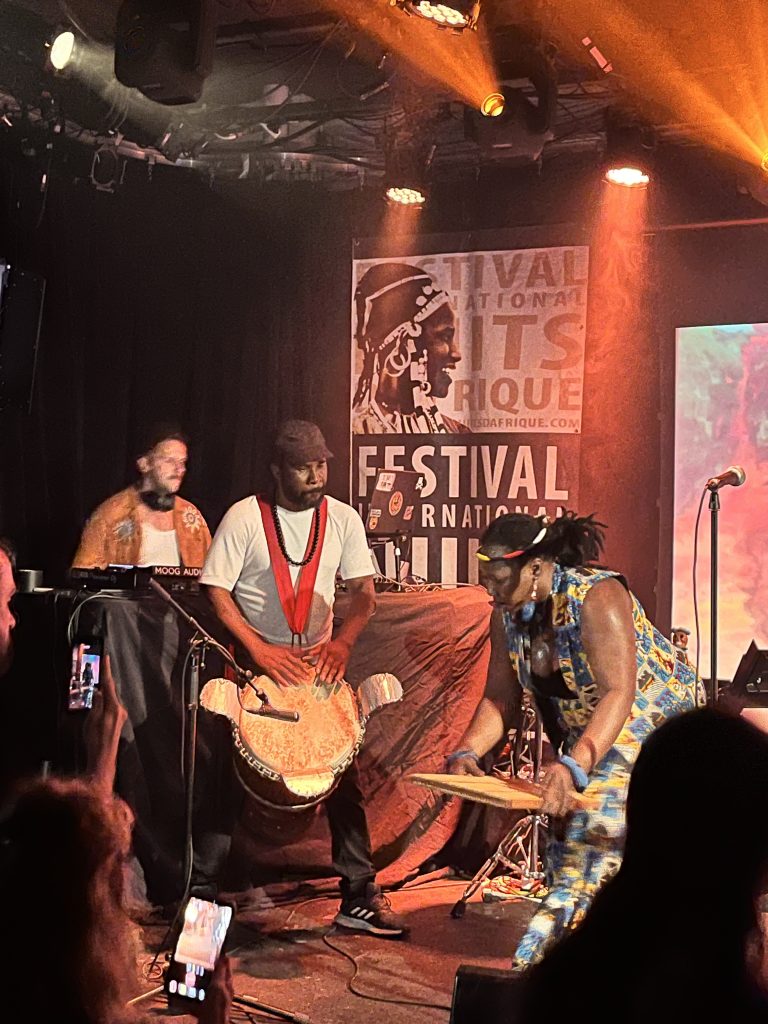
There are three of them on stage, but they seem like ten because of the intense energy they project, particularly percussionist Hilder Brando Osorno, who also works the console to create electrifying Afrobeats and Afrohouse sounds mixed with Colombian rhythms from the Caribbean and Pacific regions of Colombia. He is accompanied by Guadalupe, a young musician who also plays percussion, maracas, and the traditional Colombian flute. The third member is the band’s drummer, with a gigantic drum in front of him on which he goes wild throughout the performance. After a few songs, the rhythm is so frenzied that it feels like being in a nightclub. They even had the chance to add a song to their repertoire when one of the members suggested it to the audience.

Kin’Gongolo Kiniata

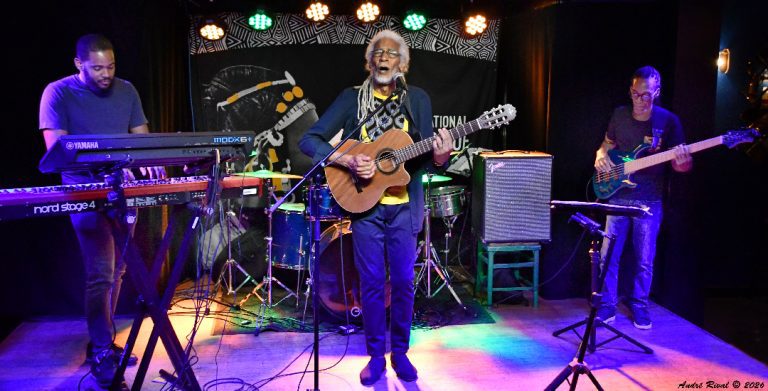
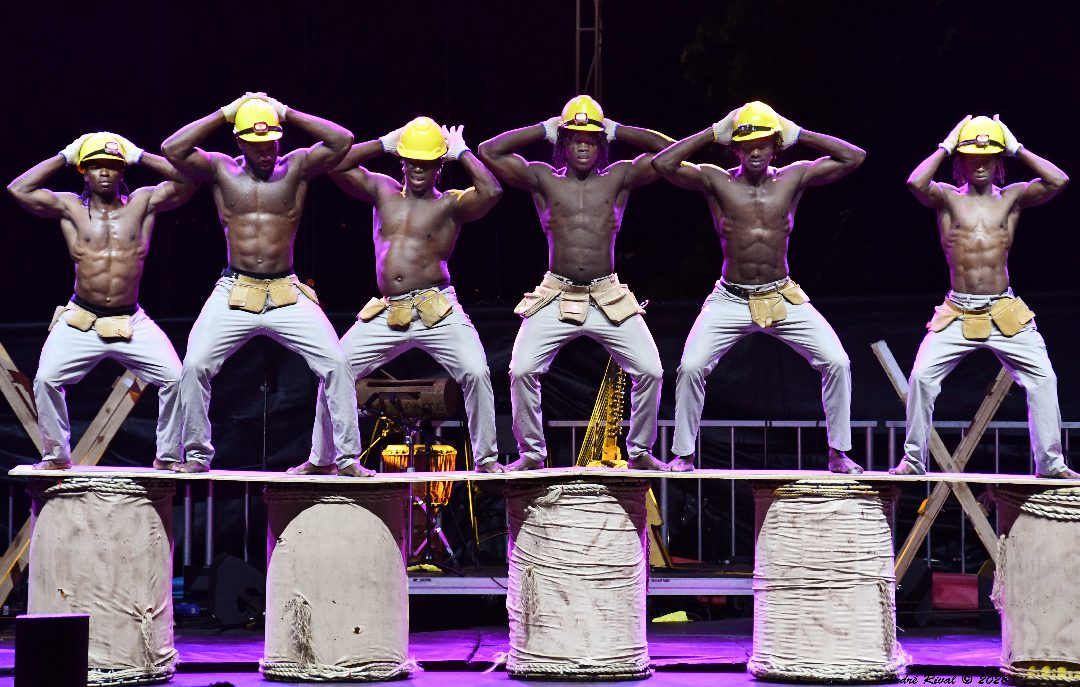
The second night of Mundial ended with the long-awaited performance by Kin’Gongolo Kiniata, the band we talked about in PAN M 360 when they played at the Nuits d’Afrique festival. Known for using stuff they find on the street and recycling it to make their instruments, they show us that you can make music with anything. Composed of five members from the Democratic Republic of Congo, they all take turns singing and know how to get the crowd going. The bassist, a true showman, had an instrument that looked like a banjo, but he played it perfectly while interacting with the audience. The electric guitar was much smaller than what we usually see, but it was just as powerful. In the center of the stage, two musicians played on a wooden box into which they had inserted metal and plastic percussion instruments. Ah, there was even a tin can that served as an instrument and added ambient noise. They got the audience singing by having them repeat their name, while the drummer played on boxes, using an old 1980s TV as a support. Despite the fact that the activities had started at 8 a.m. that day, the participants still had energy to burn at 11 p.m. thanks to this group that kept them awake. Like Killabeatmaker, Kin’Gongolo Kiniata was treated to an extra song as the audience demanded more. And since it was the 15th, some rules were more flexible, allowing the fun to last a little longer.

“Measures for a Funeral’s” Sonic Grief

by Stephan Boissonneault

Sofia Bohdanowicz’s feature film Measures for a Funeral arrives like a dirge played backwards. Not as a resurrection, mind you, but as a slow archaeological and archival excavation. This is a film about researching the dead that becomes, through some cruel alchemy of form and grief, an autopsy of research itself. Bohdanowicz has expanded her 2018 short into something that feels lengthened and deepened—a hole dug further into frozen Canadian ground.

The story begins with Audrey Benac (Dreagh Campbell), a graduate student consumed by the life of the real-life classical violinist, Kathleen Parlow. Born in 1890, Kathleen Parlow rose to become one of the early twentieth century’s most accomplished violinists, though her name has largely faded from public memory. Her extraordinary skill earned her recognition as a virtuoso among her contemporaries, with admirers dubbing her “The lady of the golden bow.”

Audrey is trying to finish her thesis on Parlow, but has a dying mother at home. Regardless, she follows Parlow’s life, strapped with a violin on her back, leading her to England and Oslo. The score by Olivier Alary, who has worked with artists like Björk and Cat Power, establishes a moody, ominous tone immediately, using extensive repetitive notes that heighten tension and summon a horror atmosphere lurking beneath the drama. What makes the music so devastating is its patience. The film features an almost thriller-like buzz of static frequently on the soundtrack, creating an aural texture that suggests archival decay, the sound of history itself degrading on wax cylinders and magnetic tape.

The score immerses viewers in the world of classical music, but it never romanticizes it. Instead, it exposes classical music’s capacity for haunting—how sound persists differently than material objects, how recordings become containers for the dead, how music can be both preservation and curse. Audrey and the film itself understand something profound about archival work: that listening to recordings of the deceased is a form of séance.

Cinéma du Musée | Sunday, November 23 | 2 PM Mesures Funèbres – presented in collaboration with the Orchestre Métropolitain de Montréal
This special event includes a screening of the film and a Q&A with members of the production team (producer Andreas Mendritzki, composer Olivier Alary and archival lead Hourman Behzadi) and members of the OM (CEO Fabienne Voisin and Artistic Programming Director Mathilde Lemieux), moderated by Head of Short Films & Programmer of Feature Films at FNC Émilie Poirier.

musique contemporaine

Two anniversaries celebrated with Quebec’s musical genius

by Frédéric Cardin

Saturday evening at the Claude-Champagne Hall of the University of Montreal, a concert was held to celebrate the anniversaries of two venerable Quebec musical institutions: the 60th of the Quebec Society of Contemporary Music (SMCQ) and the 75th of the Faculty of Music of the University of Montreal (UdeM). Contemporary Confluences, the title of the concert, highlighted the many intersections between the two organizations. The program honoured the various musical directors of the SMCQ throughout history (Serge Garant, Gilles Tremblay, Walter Boudreau, Ana Sokolovic), who have all also been teachers at UdeM. As a bonus, a creation by a young composer, Maxime Daigneault, because we must not forget that the mission of both institutions is also to ensure the future of contemporary classical music. It was the SMCQ ensemble, led by Christian Gort, and the UdeM Contemporary Music Ensemble, led by Jean-Michaël Lavoie, who shared the stage and the pieces, sometimes in tandem.

READ THE INTERVIEW ABOUT THIS CONCERT

The program showed the depth of scholarly creation in Quebec music. Boudreau’s Coffre III(a) (Le Cercle Gnostique I {}) launched the evening with the composer’s usual mark, his stunning colours and sparkling energy. The trio of young students from UdM, composed of Jérémie Arsenault on clarinet, Alona Milner on piano, and Leîla Saurel on cello, was impressive in terms of technical quality, precision, and timbral beauty.

Following was Serge Garant’s Quintet for flutes, oboe/English horn, percussion, piano, and cello, a true marvel of arch construction, whose expressive beauty relies on an exceptional sense of colour and thematic metamorphosis. Ana Sokolovic’s Five Locomotives and Some Animals bears the mark of the Montreal composer’s efficient style. Descriptive episodes including rhythmic and stylistic motifs from Balkan folklore, interspersed with short interventions driven by exciting motor energy. Ironically, it was the work that seemed the most fragmented of the evening in terms of sonic coherence, whereas the others were rather seeking to create an integrated, morphic and organic whole despite their omnipresent pointillism. Nevertheless, Sokolovic’s writing remains irresistible.

Souffle (Champs II) by Gilles Tremblay reminded us of how the formal and intellectual complexity of the composer’s works is equally matched by a fascinating mastery of expression and discourse. The abundance of colours and the stunning poetry of this seductive abstraction never fail to move. Very great art, as Lavoie and the UdeM Ensemble reminded us.

I really enjoyed the last piece of the evening, Sensations: Lueurs du néant (Sensations and glimmers of nothingness) by Maxime Daigneault. This commission, performed by the largest number of musicians in the program, testified quite explicitly to the nature of contemporary language in 2025, compared to that of its predecessors, concentrated in the years 1978 to 1996. Daigneault’s music is organic, metamorphic in the sense of a moving fluid that almost never contains sound breaks. This fluidity is very representative of current music in scholarly creation, probably informed by post-minimalism and neo-romanticism. In the 21st century, we seek to fill the expressive field, to cover it entirely. It is very different from the atomism that dominated avant-garde and institutional musical thought in the second half of the 20th century.

Daigneault told me before the concert that the idea of this piece was to translate the compositional process that characterizes his own approach. At the moment of starting to write a work, there is nothing. A blank page, or rather a dark void. Then, through persistent searching, a few luminous threads appear, ideas, intuitions. He pulls on them, sees what he can do with them, ties them together, and eventually transforms the darkness into light. Sensations: Lueurs du néant is totalitarian music, in the sense of a total monopolization of the sound space, without breaks, or almost. It is also a very strongly expressive music, and one that has an almost physical impact on the listener. As far as I’m concerned, a great success. Why did it then seem to me that the applause was a bit too polite?

The musicians of both ensembles were at the forefront of the numerous demands of the scores. With perhaps the advantage going to that of the SMCQ, which is also the most experienced.

The celebration of the two anniversaries took place in a sober manner while highlighting the very essence of their missions: to promote the excellence and endurance of local musical genius.

Moyen-Orient / Levant / Maghreb / Raï

FMA 2025 | Chazil Charms Montreal

by Sandra Gasana

Right from the start, Chazil chose to open the show with the song Twahchete Shabi w Bladi, in which he talks about his mother and friends whom he misses when he is far from home. Indeed, exile plays an important role in his repertoire, as if raï music lends itself well to this kind of theme.

For his first show in Canada, Chazil made quite an impression. The National was filled with young people, but not only them—some had come with their parents to listen to the young prodigy of raï 2.0, as he calls it.

By the second song, the audience was up dancing, even though the venue wasn’t really suited to it. As the evening wore on, more and more people joined in, transforming the National into a veritable nightclub.

Wearing his signature scarf around his neck and a beige suit, Chazil has a Montreal fan club that was there to support him, chanting his name several times throughout the evening.

With a full band made up entirely of Montrealers, Chazil delivered a performance worthy of the name, displaying a particularly strong rapport with his guitarist. Some songs start off softly, highlighting his deep voice, before the darbouka and drums kick in with power. Despite his young age—he is only 25—he seems to have the soul of an old sage.

“Are you ready for more?” he asks the crowd before continuing with Algerian music classics that everyone seems to know by heart, alternating with his own hit songs. He got the audience involved, turning them into a choir and getting them to clap along to the rhythms of the darbouka, adding call-and-response songs. His dance moves were a hit with the young girls in the audience, who began to cheer.

After a few songs, a member of the audience gave him an Algerian flag, which he attached to his microphone, declaring himself a nationalist and very proud of his country. A song dedicated to love was particularly popular with the audience, who sang along at the top of their voices.

Sometimes, raï blended with rock on certain tracks, while on others it was more raw, with breathtaking keyboard and electric guitar solos. He took the opportunity to present his new song Katba, which many in the audience already knew by heart, as well as Khelouni, which means “Let me” in Arabic and features in his live session Raï Rayi on YouTube.

The darbouka gave way to congas on certain tracks, notably during his cover of Abdelkader Ya Boualem by Cheb Khaled, the true king of raï. Seeing the crowd go wild, he treated them to a non-stop medley of raï classics. Not very talkative between songs, he addressed the audience mainly in Arabic, slipping in little jokes here and there. He often asked for the spotlight to be turned on the audience so he could see them better, and they kept asking for more and more. Even after the selfie at the end of the concert, the audience didn’t want to leave. Chazil had no choice but to take one last photo before closing his very first show in Montreal, which is certainly not his last.

Publicité panam
Indie Rock / Psych-Rock

Coup de Cœur Francophone | Rare Opportunity: Bon Enfant at L’Esco

by Justine Charland

Coup de Cœur Francophone, an eagerly awaited annual festival, kicked off its 39th edition on Thursday, in the cold and darkness of a harsh autumn. Three shows, all roughly 50 meters apart, marked the start of a long series that runs until November 16.

In the catacombs of the Triangle, the band Bon Enfant was based, ready to take to the stage at L’Esco, which its members affectionately call home. Fresh from winning a Félix Award for Rock Album of the Year the day before, Bon Enfant, tired but determined, were about to open the show, a unique way to celebrate a well-deserved victory.

A look back at an intimate performance in a venue frequented by the fringes of the music scene.

Bon Enfant is scheduled for 10 p.m., a late-night show that’s generating a lot of excitement. This excitement is palpable: there are at least four people on video, the venue is packed, and tickets are sold out. Seeing Bon Enfant in a place as small as L’Esco, when the band can normally fill a Club Soda, is a prime opportunity, a rare treat. The audience knows it.

The group finally takes the stage, gently beginning their show with popular tracks from their most recent album. Four of them follow one another, with the musical elements we know them for: the guitar lines bathed in a layering of dreamlike effects, the synthesizer interventions recalling the Fender Rhodes and the organs of the psych-rock years, the danceable grooves of the drums and bass are true to form, together they are firmly rooted.

Porcelaine finally arrives, a cult classic from Diorama. Daphné’s vocal style, unmistakably reminiscent of 70s nostalgia, is impossible to ignore. It’s during this first major hit that the audience truly joins in the sonic immersion. The lyrics are shouted out. The party officially begins.

Shortly after, the group bravely launched into Enfant de l’air, an instrumental suite reminiscent of Alain Goraguer, which they approached like a long jam session. While few artists allow themselves an instrumental interlude in the middle of their setlist, Bon Enfant executed this nod to the prog and psychedelia with finesse, a nod to the genres they are so often associated with.

The show then features those songs we play on repeat in our living rooms, including the ever-popular “Aujourd’hui” and “Magie.” The atmosphere builds until the end of the evening, proving that fatigue can be fought with music. Some comments make us feel close to the band: “We won rock album at the ADISQ awards yesterday, and we had a blast here right after. Life is good. Yesterday we paid to be here, today we’re paid to be here.” Unsurprisingly, it’s following an encore request that the band closes this long epic of partying and performance with two solidly delivered songs. The message is clear: this edition of Coup de Cœur Francophone is one to watch.

Publicité panam

Violons du Roy | Flawless performance from the orchestra, impeccable soloist

by Chloé Rouffignac

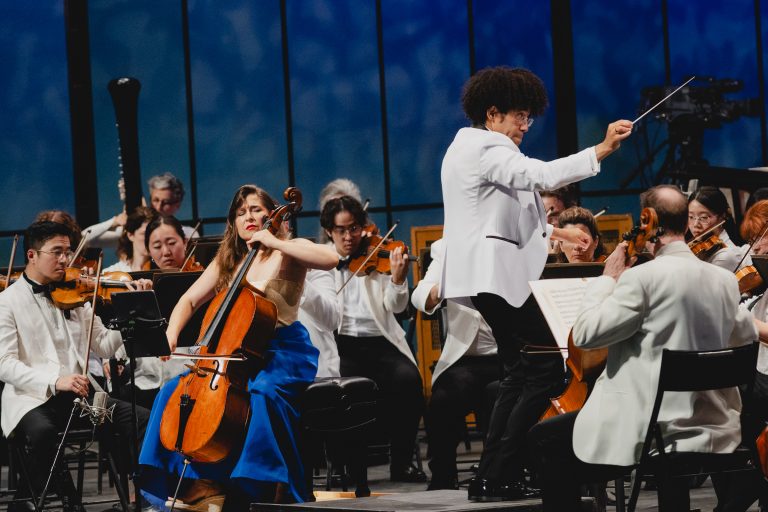
With the renowned Bach Festival in Montreal fast approaching, the composer’s aura is already palpable: this past Friday, November 7th, Les Violons du Roy presented a highly thematic concert (Bach Lessons) at Salle Bourgie. Under the direction of conductor Bernard Labadie, who stepped in for his colleague Robert Levin, the original program curator, we were treated to a concert worthy of the orchestra’s reputation.

Indeed, pianist Inon Barnatan, stepping in at the last minute for Robert Levin (who was also scheduled to perform as soloist), captivated us with his mastery of a complex and demanding text, particularly in the Concerto in D minor, BWV 1056, which concluded with an immediate and enthusiastic ovation. Despite several phone calls being interrupted in the hall, the pianist’s committed approach to the meticulously orchestrated performance was an experience in itself.

A welcome approach in the world of Bach, which demands not only rhythmic precision and impeccable intonation but also a physical dialogue between sections. The galvanizing energy of the soloist and his musicians was transmitted to the audience from the very first notes of the allegro. This synergy continued in the Concerto No. 5 in F minor and its famous Largo, a work of delicate detail and profound emotion.

The sentimental value is also found alone with the Italian Concerto BWV 97, revealing a pianist alone on stage who pours out a stream of notes without error and above all without losing character or precision under the difficulty of the text.

The concert began with excerpts from The Art of Fugue, a fine opening for the orchestra, which showcased a unified sound under a conductor who was very close to his musicians. The cello’s entrance in Contrapunctus II was particularly memorable, as it soared over the flow of the first movement without interrupting the violins’ delicate touch. Beautiful waves of nuance were also found even in the more technical and acrobatic passages of Contrapunctus IX, made possible, in part, by the dynamic presence of first violinist Katya Poplyansky.

She and her section offer a very high-quality sound, and in Offrande musicale, she conducts a very fluid conversation of the melodic current, which could often result in a breathless, strained performance. On the contrary, we observe a light and highly focused interpretation.

In short? A flawless performance from Les Violons du Roy, who nevertheless had to adapt to changes in direction and soloist, and an impeccable performance by soloist Inon Barnatan that won over the entire audience. See you on November 22nd for the chamber orchestra, which will be performing Vivaldi under the direction of Jonathan Cohen.

Alt-Pop / Alternative / Electro-Pop / Electro-Rock

Quai Des Brumes turns into a “club” to the sound of Bibi Club

by Simon Gervais

Energetic and spellbinding, Bibi Club captivated us on November 6, immersing us in a unique universe where the gentleness of a naturalist soul blends with the vibrant power of electro-rock.

I had already seen the duo Adèle Trottier-Rivard and Nicolas Basque in 2023 during the Taverne Tour at Le Quai des Brumes. This legendary venue of Quebecois music is celebrating its 40th anniversary, as programmer Noémie Laniel reminded us. This time, I was driven by a curiosity sparked by their latest song, Amaro, a track far more danceable and edgy than anything they’ve released so far—a song that, I hope, hints at a new direction for Bibi Club.

A breath of new wave

From the very first songs, this shift is noticeable: slightly darker material, more distortion, and a touch drawing from new wave and downtempo. The lyrics retain the natural, elemental poetry that is quintessentially Bibi Club, imbued with love and solidarity. The atmospheres, meanwhile, feel more dramatic than before, with mysterious tones and cinematic guitar strikes reminiscent of Ennio Morricone. Listening to older tracks like Le feu, I realize that this new wave breath has always been there—only tonight, it feels less diaphanous and more direct, even more assertive.

At times, you’re hit with a true wall of sound: heavy drum machine beats, textured synth tones, layered vocals, and fiery guitar solos. Basque frequently lifts his guitar above his head like a rock star. The chemistry between the two artists is effortless and instinctive, forming an almost inseparable unit—reminiscent of Janus—when they stand side by side.

Beneath the multicolored lasers, the crowd sways gently at times, nods vigorously at others, caught in the hypnotic rhythm of the beat.

Then comes Amaro

The highlight of the show. The stage at Le Quai ignites under scarlet lighting. Mystical tones signal a tense build-up. The oppressive character of the track almost evokes phonk, that brazen electro subgenre born from web culture. For Bibi Club, it’s the discovery of a new, danceable horizon—and the crowd follows suit.

The show’s high point. The stage at Le Quai blazes under scarlet lights. Mystical tones signal a tense, electrifying build-up. The track’s oppressive character almost evokes phonk, that audacious electro subgenre born from web culture. For Bibi Club, it’s the discovery of a new, danceable horizon—and the crowd eagerly follows.

The penultimate song evokes a bit of War On Drugs, before returning to a finale that is pure new wave, pure rock. After the concert, Adèle confides that Amaro was originally an experiment, almost a joke. They created the beat for fun, liked how it turned out, and now it’s the title track of their upcoming album, set to be released next February. It goes to show that sometimes a playful, carefree creation can lead to real nuggets of gold. I sincerely hope that Amaro becomes their guiding star moving forward—a way to bring even more “club” into Bibi Club.

🔗 Also check out our review of Bibi Club at FME!

Photos: Marie-Michèle Bouchard | Luna Choquette Loranger

arabo-andalou / Maghrebi

FMA 2025 | The Great Class of Lila Borsali

by Alain Brunet

A singer of great talent, Lila Borsali explored the complexities of thought surrounding exile on Saturday. Her introductions to each song on the program evoked various states of exile through the melodies, rhythms, and lyrics of the artists who created them.

This time, she highlighted Ya Ghorbati, “a centuries-old song where the wounded memories of exile throb.” This refined repertoire also included a Kabyle component (Algerian Amazigh or Algerian Berber), an indigenous language that existed before the Arab invasions and colonization beginning in the 7th century. And which still exists today. Given that a large portion of Algerian-speaking Quebec is Kabyle, and many still speak their native language, one can understand the interest of the festival-goers who filled the 5th hall at Place des Arts this past Saturday, November 8th.

Originally from Tlemcen, Lila Benmansour adopted the name Borsali when she married Selim Borsali, from whom she has been widowed since 2013. A specialist in the Arab-Andalusian repertoire, she didn’t speak the Kabyle language, which she explored in depth for this program, she told us. Her musical director and oud player assisted her in mastering the pronunciation and stress patterns of the Amazigh language. We won’t comment on the results, but we can assure you that the audience thoroughly enjoyed it.

For any Westerner who only has a theoretical knowledge of this culture, the exoticism is complete: the (2) violins are played vertically, the qanun is a plucked string instrument requiring a complex technique, ney (traditional flute), two ouds (Arab lute) and two percussion instruments – darbuka, cymbals, frame drums, etc.

Of Arab and North African origin, the modal melodies of these Arab-Andalusian songs can lie on soft and silky accompaniments, but also involve real rhythmic impulses, strong pulses arousing hand clapping and even high-pitched ululations from galvanized spectators.

Two full hours, concluded without the euphoria generated by this excellent singer, whose timbre recalls voices with very different careers but united by their vocal texture and their mezzo-soprano tessitura – Joan Baez, Edith Butler, Nana Mouskouri.

Proud and very elegant in her traditional white dress adorned with oriental gold trim, Lila Borsali delighted the FMA audience, who were clearly already won over.

Publicité panam
classique / Moyen-Orient / Levant / Maghreb

FMA 2025 | Cantiques de l’amour, Between East and West

by Sandra Gasana

Thirty-six choir members. Seven musicians. A musical director. A whirling dervish. And of course, there were the two stars of the evening: Syrian singer Khaled Al-Hafez and Quebec contralto Gabrielle Cloutier.

The Fifth Hall at Place des Arts was almost full, but this time, unlike the other concerts of the Arab World Festival, there was a predominantly Quebec audience, mostly older, the families of the choir members were probably numerous.

The choir, composed of the Vox Ensemble, provided a backdrop. It returned between the songs performed sometimes by Khaled, sometimes by Gabrielle, and sometimes by both. In fact, Gabrielle sang in Arabic for Khaled’s songs and in French for her own. Dressed in a long red dress, she stood out in the hall, as everyone else was dressed in black. Her voice was breathtaking, especially when she stood in the middle of the stage and let it out freely.

Khaled’s chants had the feel of prayers, a bit like those that resonate through mosques, while the choir immersed us in the atmosphere of a church service. And we waltzed between these two worlds throughout the evening. Before the end of the first part, we saw the whirling dervish arrive and illuminate the room with his spinning meditation. He seemed completely in a trance, and all the while, I wondered how he didn’t get dizzy at the end of it all.

The musicians each had their turn to shine. They made sure to take their time during their solos, without rushing, so that the audience could enjoy it to the very end.

Images were projected throughout the evening, sometimes letters of the Arabic alphabet, other times geometric images or decorations that blended well with the music.

I would say the only drawback was perhaps the length of the concert. A spectator sitting very close to me thought the show was over at the intermission, since we had just enjoyed an hour and a half of performance. The second half was admittedly a bit shorter, but for fans of this kind of music, they were well served.

Publicité panam
Électro / Electroacoustic / musique acousmatique

AKOUSMA | Caught between the talons of James O’Callaghan

by Loic Minty

There is something oddly unique about a gathering of people sitting on the floor in the middle of a pitch-black room. From the outside, it could appear to be a strange cultish ceremony, but at Akousma, it’s also a way to experience the finest pleasures of listening.
When purged from all other senses, even the most microscopic sonic detail can redirect thought. That’s why it takes someone who understands the silence of these large, empty spaces to make them speak.

This is where James O’Callaghan comes in.

He walked, unperturbed, to his laptop, which was centered in the room, and gazed down at the screen with the eyes of a falcon. With precision, he began.
Under the softest breaths of wind, the quietest shuffle of people shifting in their seats could be heard. Everyone froze, their ears attuned. The wind picked up and sounds accumulated, scattering across the dome of speakers. A clatter of knives, a far-distant cricket, and creaking doors set the scene for a disaster.

O’Callaghan caught our imaginations in his talons and swept us away. In one instant we were drowned in glitchy breaks that moved violently around the room; in the next, we bathed in the rich harmonies of noisy sawtooth pads reminiscent of witch house. But we always came back to the eerie narrative of a soundscape buried deep in the forest. When finally our mind’s eye could make out a path, his hypnotizing voice began guiding us back through this maze of obscure mysteries, back to the wind, and to that distant cricket. He left us as we had been found: sitting in the dark.

Publicité panam
Arabic / arabo-andalou / Chaâbi / Moyen-Orient / Levant / Maghreb

FMA 2025 | Nostalgic Evening With Lamia Aït Amara

by Sandra Gasana

Montreal’s Algerian community turned out in large numbers to see Lamia Aït Amara, who was making her first appearance in the city. She was accompanied by her eight musicians, a condition she stipulated for her first participation in the Arab World Festival.

Dressed all in black, with a gold jacket that matched those of the musicians, she appeared on stage and the audience erupted in cheers, a cry of celebration, from the very first notes.

The musicians also sang in the choir, which added intensity to the show and contrasted with Lamia’s soft voice. She was draped with the Algerian flag from the very first song, which she then removed for the rest of the concert.

“Tonight is even more special because it is the date so dear to our hearts, the day that symbolizes courage, resistance, the thirst for freedom for our dear Algeria,” referring to the beginning of the Algerian War.

Some songs begin with just the oud, while others start with the flute or piano, before the other instruments join in one after another. We were treated to a medley of several Algerian music classics that the audience knew by heart. Although the seats at the National are usually seated, many people stood up to dance, so strong was the urge to join in.

The hall was almost full, with spectators of all ages but mainly in their forties and older. His songs speak a lot about Algeria but also about love, about what I was able to get out of it with the little Arabic I have left.

Lamia primarily addresses her audience in French, but also speaks in Arabic, throwing in a few jokes along the way. While she is rather reserved during the first few songs of the show, you can sense her becoming more and more relaxed, even breaking into dance at times.

The evening becomes increasingly festive after the short intermission. “We’re going to do a very nostalgic program,” she announces to her audience before launching into a song in French with the feel of a bolero but sung in an oriental style, beginning with a piano solo.

“I was afraid to come to Montreal, I wondered if there would be many people. But now, it makes me want to come back,” she admits.

She performs the famous song “Historia de amor,” singing it in Spanish and Arabic with great precision. Some songs begin calmly, gradually accelerating as the crowd applauds and cheers, culminating in an explosive finale. Among the well-received covers was Rachid Taha’s famous song, “Ya Rayah,” with Lamia letting the audience sing along. The number of dancers increases, leaving their seats to move to the sides of the stage to create more space for dancing.

But the dancer who stole the show was a young girl of about ten who found herself on stage at the very end of the performance and began to dance with class and great confidence. She was also given an Algerian flag draped over her shoulders, as if the torch had been passed to her.

Publicité panam
Electroacoustic / musique acousmatique

Akousma | IRL Dissolves Time in The Big Room

by Marc-Antoine Bernier

On October 31 at Espace C, during the third night of the Akousma festival, Montreal sound artist IRL, also known as Amanda Harvey, presented Big Room, an immersive piece where sound becomes space, memory and sensitive matter.

IRL’s practice revolves around listening, sound architecture, and the body as receiver. With Big Room, they shape an auditory landscape that gradually envelops the audience. The room opens like a breath: a slow vortex of bass, drones, and radio frequencies that seems to transform the space, bending and stretching it. The sound doesn’t simply fill the space; it reconfigures it. We no longer know if we are moving within the music or if it is the music that is circulating around us.

A Lynchian atmosphere quickly takes hold. The dark, grainy layers of analog synthesizer breathe like nocturnal entities. Their slow modulation suspends time and creates a floating state where the music imposes no emotion, but opens up an inner, available, floating space. The lo-fi textures, the deep, enveloping bass, and the delicate melodies reveal a subtle, almost secret, ambient beauty.

On stage, IRL deliberately effaces themselves. No spectacular gestures, no imposing presence: only the sound remains, autonomous. As they emphasize in their interviews, they want the audience to be able to close their eyes and hear only the soundscape.

Big Room is not simply something to be listened to. It transforms the room into a memory and makes the interior space vibrate, offering an immersive experience that transcends performance to become an intimate journey into the heart of imaginary spaces shaped by memory and sound.

Publicité panam
Subscribe to our newsletter

Inscription
Infolettre

"*" indicates required fields

Type of Suscribers