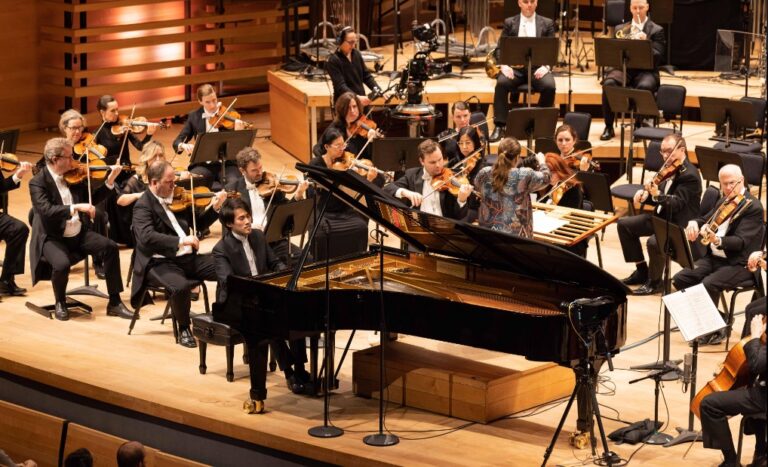
On Thursday night in Montreal, two halls at Place des Arts were almost sold out: at the Maison symphonique, Montreal pianist Bruce (Xiaoyu) Liu, the winner of the 2021 Frederic Chopin International Piano Competition in Warsaw, considered by many to be the most prestigious piano competition on the classical planet, performed Chopin’s Concerto No. 2 for piano and orchestra, with an encore of a baroque excerpt by French composer Jean-Philippe Rameau (Les Sauvages).
Since this historic victory, the young Quebec-trained prodigy has performed for a second time with the Orchestre symphonique de Montréal since last summer, this time under the direction of Finnish maestra (who also has Ukrainian origins) Dalia Stasevska, who also led the OSM in a more than acceptable performance of the Scandinavian composer’s (late 19th century) Symphony No. 6 in D minor, Op.104 by Scandinavian (and Finnish) composer Jean Sibelius, preceded by a contemporary work by Russian composer Sofia Gubaidulina, demanding and full of substance.
Chopin’s Concerto No. 2 was the main course, given the audience’s expectations of the young virtuoso with the huge international prize that has propelled his career onto stages around the world. Back home, Bruce Liu did not disappoint anyone in his performance.
Already at 25 years of age, one feels free to express his already singular personality, to impose his own style. We felt not only an exceptional fluidity in the execution but also an ability to reach grace without ever pressing his effects too much. We are not talking here of casualness, but of grace, agility and suppleness in the service of a work that can lend itself to excesses of affect even if great virtuosity is present.
And let’s not compare Bruce Liu to Charles Richard Hamelin, another winner of the Chopin Competition (2nd place in 2015) whose playing meets the same standards of excellence. Two distinct personalities of the piano here stand out, let’s applaud the diversity of pianistic expressions at this level of performance, even in this world of written music where the parameters suggested by the score still leave a space of freedom to its most eminent players.
And back to Thursday night: right next door to the Maison symphonique, in Salle Wilfrid-Pelletier, German pianist and electronic producer Nils Frahm offered a new performance involving classical, romantic and impressionist music, with improvisations and synthesizer additions. I wasn’t there personally, but I’ve already attended two Nils Frahm concerts with audiences who were amazed, transported, conquered, and who seemed to be living a remarkable first experience in piano or keyboard music.
Is there a link between these two worlds? If there is, it is still very thin.
Today, we can see that symphonic music composed for film and video games is attracting increasingly large audiences. We can also see that neo-classical composers who drink from European tonal and consonant music, romantic and post-romantic, have already conquered large audiences. The new album by Thomas Bangalter, the illustrious half of Daft Punk, is a new example among many others. We can also observe that neo-classical pianists offering “compositions” clearly inspired by Chopin, Liszt, Brahms, Rachmaninov, Satie, Ravel or Debussy, are filling their halls and enjoying an immense love rating, we are obviously thinking of the new album and the new recital of Montreal pianist Alexandra Stréliski.
Needless to say, these two worlds seem to remain relatively sealed.
On the one hand, the neoclassical public does not question the stylistic origins of the recent works that transport them. it only loves it ! What is more, this audience may disapprove of the tense decorum of the classical world, its absolute silence, the gala clothes of its performers, the rigidity of the performances, the virtual absence of freedom in the interpretation, etc.
On the other side of the coin, the public of the classical world deplores the neo-classical watering down of the “true” romantic, post-romantic or pre-modern repertoire, as well as the technical inferiority of its interpreters, whose inability to make a career in “great music” is suspected.
Do classical music lovers despise those of neoclassicism? In some cases, absolutely.
In turn, do neoclassical fans despise classical music snobs? In some cases, absolutely.
Is the truth to be found elsewhere? In all cases, absolutely.
One thing is certain, the dispute is far from resolved and we will have many more opportunities to discuss it.