Additional Information
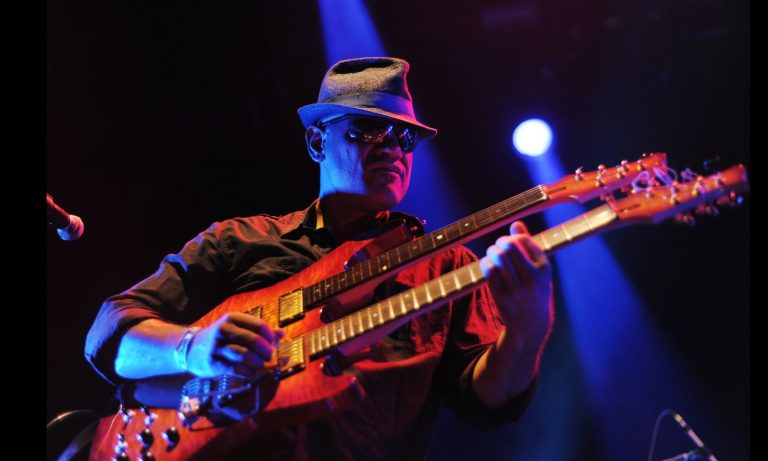
Following Angine de Poitrine’s regional breakthrough in Saguenay, followed by their global conquest (quite literally), the Festival des musiques de création (FMC)’s focus on microtonal music continues with a performance by American virtuoso David Fiuczynski, frontman of the legendary Screaming Headless Torsos, a furious blend of funk, punk, metal, jazz, and reggae. The double-necked guitarist (just like AdP, wouldn’t you know it…) will also present his Kif project, whose microtonal inspiration dates back to the 1990s. Formerly based in New York, the virtuoso guitarist has become a professor at Berklee College of Music, where he continues his creative work, which he presents to audiences around the world whenever time permits. Music lovers flocking to Saguenay have reason to rejoice: the guitarist’s two performances will take place on May 15 and 16 at the FMC. PAN M 360 caught up with him in Boston ahead of his trip to Quebec.
David Fiuczynski: Your face looks familiar…
PAN M 360: That’s possible—we spoke a few times back in the ’90s, and I remember running into you in person in New York about thirty years ago. We’ve had more than one conversation about Screaming Headless Torsos. Personally, I’ve seen you perform several times, notably with Me’Shell Ndegeocello and Hiromi Uehara. Your media presence has declined over the past few years. Why is that?
David Fuiczynski : I’m now based in Boston. In the 2000s, I had reached a point where I wasn’t making enough money in New York with my own music. And I wasn’t comfortable with the compromises I’d have to make to make a living from music, and I didn’t like the idea of chasing after every little gig. I had the opportunity to teach and learn in an academic setting, so I made that choice.
PAN M 360: For some people, it is indeed more fulfilling to teach and create their own music without compromise.
David Fiuczynski : I still remember one of my teachers, a long time ago, telling me, “You know, there’s a spectrum when it comes to teaching.” I know that some musicians just love to play, whether it’s a wedding band or an avant-garde project. They just love being behind their instrument, and I respect that. Of course. There are some people, like me, who have financial and family responsibilities—a house, an ex-wife, a child in college, and so on. So I no longer have the time or money for that lifestyle. At the very least, I’d rather be free in my music, even if it means I have to serve hamburgers. I’m not the only one who wants to focus exclusively on my art. So I teach at Berklee during the day, and in the evenings I tinker with microtonal music; I’ve also played with Hiromi, Nikki Glaspie, MonoNeon, Louis Cato, Hasidic New Wave, Paradox Trio, Micro Jazz with saxophonist Philipp Gerschlauer and the late drummer Jack DeJohnette, etc.
PAN M 360: Are you exploring microtonality these days?
David Fiuczynski : Yes, I listen to, study, and learn these old melodies. I examine them and learn them. These melodic lines sound new and fresh to my ears. What really interests me in microtonality is the Middle East, West Asia (Persian and Turkish music), South Asia—in short, the music developed along the Silk Road. This interest dates back to my early days at Berklee in 2002. I then shifted from jazz to world music, welcoming various artists who use microtonality. I also learned from the Indian guitarist and composer Prasanna, who fuses jazz with Indian classical music. I’ve also been in contact with sarod players Amaan and Ayaan Ali Bangash Khan. At age 42, I went back to study at the New England Conservatory, where I studied the sitar and the sarod, and I also took classes in microtonality with Joe Maneri.
PAN M 360: You’re playing two different concerts at the FMC. First up is Kif on May 15.
David Fiuczynski : The idea dates back to a trip in the early ’90s. I was lucky enough to record in Marrakech, Morocco, for about 7–8 days, and then I recorded at the World Federation in Seville, Spain. It was an absolutely amazing experience. I was brand new to the jazz scene; no one knew me. We were musicians from New York, Los Angeles, and Paris—several groups, ranging from 3 to 20 artists during those sessions—and sometimes several Moroccan musicians. One of them came up to me and said, “Did you know that Jimi Hendrix came to Morocco?” And I replied, “No, I didn’t know that.” And he said, “Yes, he was here. And then he left.” Then another one came up to me and said the same thing, and so on. I then realized that this was important to them, and I asked myself, “What would Jimi Hendrix have done if he had continued the Moroccan experience?” We knew he wanted to learn so many things beyond what he had already accomplished.
PAN M 360: We do know that he was moving toward genres of music other than rock and blues. Gil Evans and Miles Davis took an interest in him, not to mention the Moroccan musicians you mentioned, and several others.
David Fiuczynski : Exactly. And that’s why I developed an interest in microtonal scales, including those from Morocco. So this time I’m working with musicians who are passionate about this exploration, including the magnificent microtonal keyboardist Hidemi Akaiwa, along with bassist Wes Wirth and drummer Cristian Acevedo. We’re playing with a keyboard designed for quarter-tones, and my fretless guitar allows me to vary the intervals.
PAN M 360: It’s difficult, if not impossible, to harmonize with microtonal scales, isn’t it? At best, we end up with two-note chords—the basso continuo and the melodic phrase…
David Fiuczynski : The idea is to have two keyboards. One is in semitones and the other in quarter-tones, so there are 24 notes per octave. That’s where we differ from Western musicians. As for microtonal harmony, I think it’s possible to develop it, but there’s still work to be done!
PAN M 360: Yes, it is possible. We have a young composer in Montreal, Geneviève Ackerman, who is working hard on this. She is conducting extensive research into the possibility of modulating using microtonal scales. For now, there are practices like yours, involving the alternation of chromatic keyboards in semitones and quarter-tone keyboards within the same piece. It’s clear that there is still much work to be done.
David Fiuczynski : I am interested in Arabic or Turkish maqams, Indian ragas, and the Persian dastgah.
PAN M 360: Throughout Asia and North Africa, the concept revolves around ragas, maqams, and dastghs: complex rhythms and melodies supported by drones, with no harmonic progressions or modulations. The melodic scales are all modal, with unequal melodic intervals; chords are based on two notes if one includes the drone or the occasional superimposition of two distinct melodic lines.
David Fiuczynski : I don’t compose maqams per se. I adapt my melodies to microtonal modes and experiment with them. I’m also interested in what microtonal harmony might be. I’m also interested in the work of Stephen Weigel, an American pianist and composer who is also interested in microtonal modulation and who has, in fact, posted an analysis of the Quebec group Angine de Poitrine online.
PAN M 360: The next day, it’ll be The Screaming Headless Torsos, your favorite band, which we’ve known since the ’90s. You’re relaunching your band with singer (and Berklee College of Music professor) Debo Ray, keyboardist Hidemi Akaiwa, bassist Wes Wirth, drummer Cristian Acevedo, and Malian percussionist Joh Camara. A lineup completely different from previous configurations.
David Fiuczynski : I founded this group with Charles Mingus in mind, in the sense that he said he played with the musicians he had access to. Having grown up partly in Germany, I was interested in the energy of the operatic punk singer Nina Hagen. I also liked the Afro-descendant metal of Bad Brainss, who were all Rastafarians. I wanted to present a reggae, punk rock, and jazz group with operatic vocals.
PAN M 360: Where are you now, almost 4 decades later?
David Fiuczynski :There are some microtonal peculiarities; I explored some of them with Debo Ray, from West Africa and Haiti. We’ll play some old Screaming Headless Torsos songs, and we’ll showcase new global sounds. So there will be new ideas and old references, from Charlie Parker to Charles Mingus. I can say I’m still inspired by all of that.
PAN M 360: And you still play with your double-necked guitar?
David Fiuczynski : Absolutely, she’s right here by my side right now!