Additional Information
Presented this Monday, March 23 at 7:30 p.m. at Chapelle Saint-Louis – Le Saint-Jean-Baptiste, Battements brings together three emerging artists in creative music. PAN M 360 has chosen to introduce them one by one before the concert; we conclude with Geneviève Ackerman, who presents Rimes défaites par le Sphinx for soprano and alto voices and two guitars in just intonation, 2026 (25’).
“Rimes défaites par le Sphinx” is a project of songs in “just intonation” for two voices and two guitars in just intonation (according to the design of Simon Martin). When we listen to sounds (the sounds of music, the sounds of life), we hear them through the prism of culture. Perhaps through songs (a form that is overly familiar!) sung in an unusual yet intoxicating temperament?
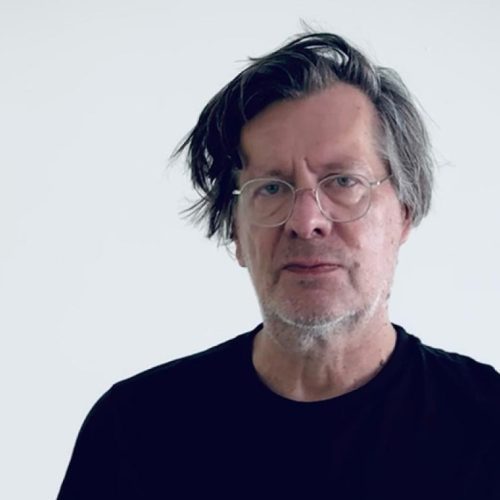
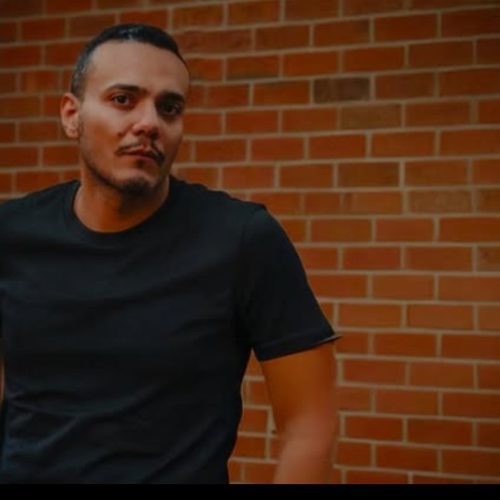
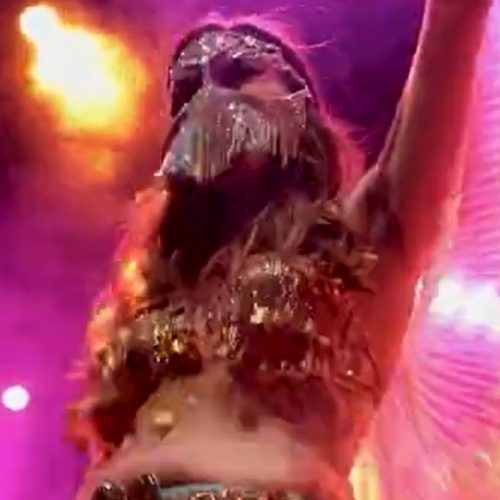
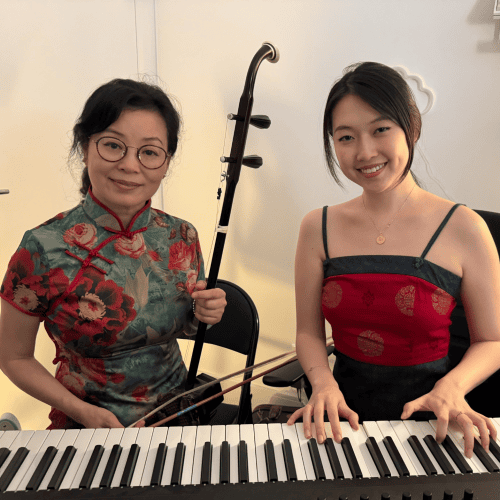
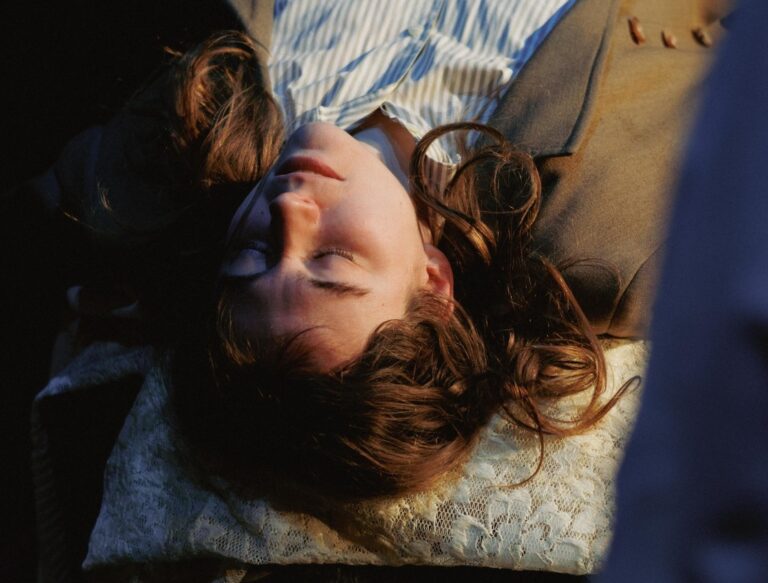
Geneviève Ackerman, composition and voice
● Florence Tremblay, voice
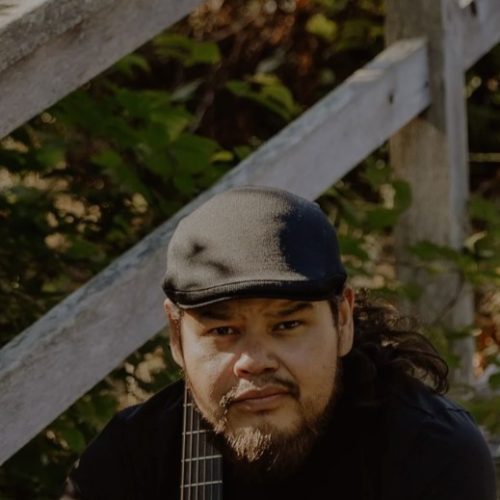
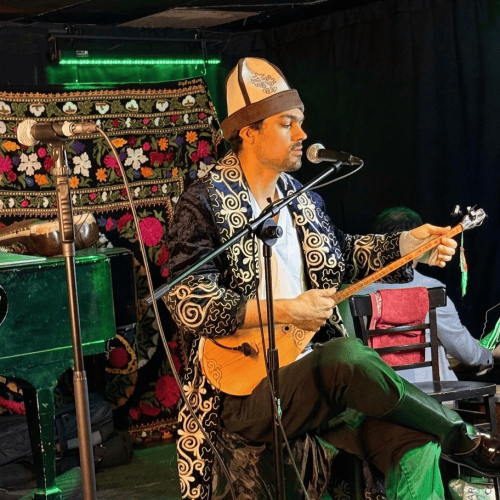
● Alexandre Éthier, guitar
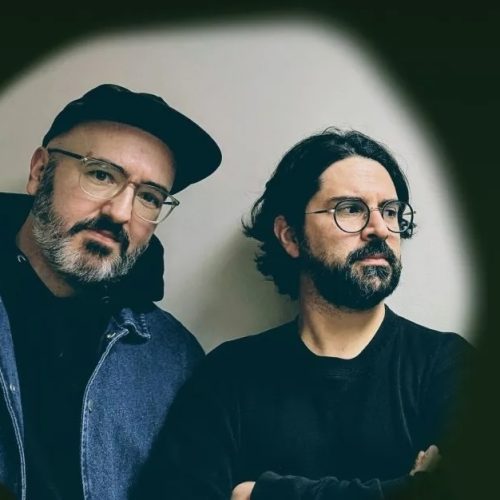
● Francis Brunet-Turcotte, guitar
PAN M 360: Remind us who you are, your training, how you came to composition, and what you have created so far.
Geneviève Ackerman: Every day of this strange life, I myself try to remember who I am! So let’s attempt the exercise once again: I do not come from a family of musicians, and we did not listen to music when I was a child. The arrival of music in my life is a great mystery. Yet from as far back as I can remember, there were sounds playing in my mind, endlessly looping in ever-changing variations.
I received a classical musical education. At the age of 18, exhausted by the constraints of that world, I left it. Several years later, haunted in spite of myself by the muses, I returned—this time not as a performer, but as a composer. Since returning to music, I have essentially devoted my life to the muses, and they keep me bound hand and foot. I have been composing for almost ten years now, and it has become the heart, the very essence of my reality. I compose concert music, music for (experimental) cinema, theatre, installations, and dance, and from time to time I perform myself, using my voice. I am particularly interested in the meeting point between poetry, the voice, and music.
PAN M 360: We know the work of Harry Partch (1901–1974) and others on just intonation and the microtonal approach—60 years before Angine de Poitrine, haha! This time we are talking about songs. How does one go about composing and writing songs in just intonation?
Geneviève Ackerman : Harry Partch is truly my guiding spirit! He himself composed many songs, and his music is inseparably linked to the inflections of spoken and sung voice. This music fills me with wonder to the highest degree.
A song composed in “just intonation” is simply a song—but one that hides behind it a whole host of carefully concealed mathematical calculations. If everything goes well, no one will notice anything—only… perhaps a certain ineffable magic, like a light, intangible cloud, rising gently among the listeners.
PAN M 360 : More specifically, what will be the role of the guitars and the voice?
Geneviève Ackerman : All the modes expressed by the guitars and the voices are in just intonation. The guitarists play on specialized guitars with asymmetrical frets, which requires some adjustment compared with their usual playing habits. For the voices, the effort is more demanding, since it involves reconstructing solfège on a scale of 22 notes per octave (rather than 12), 22 unequal notes, each interval unique and very precise. To my great surprise, this work proved easier than expected. When one sings a just interval, the sound aligns itself in a very perceptible way. By trusting this acoustic phenomenon—in other words, by trusting our ear and our sensation—we find solid reference points.
PAN M 360 : I’ll take up your question: how can we free our ears from the overly familiar and allow ourselves to be carried by the charm of the unknown?
Geneviève Ackerman: Well, if I have done my job well… all one has to do is come and hear this new music! The journey between the familiar and the unknown is part of its internal reality, part of its aesthetic experience.
PAN M 360 : Would a listener who does not know that these are songs performed with guitars in just intonation notice the difference?
Geneviève Ackerman: I hope that listeners will notice nothing at all. That they simply allow themselves to be carried by the immediacy of their senses, letting their minds wander freely into the intimate place of their dreams.
PAN M 360 : What do you think your contribution to the microtonal language is through this specific project?
Geneviève Ackerman : Most of the time, microtonality is used in musical contexts that are already complex, which makes it difficult to hear, because too many sonic events are happening at once for us to really dwell on it. In these songs, I try to keep things as simple as possible so that we can truly take the time to savor each interval, each chord, each modulation. This is also true for the musicians; this music proves that it is entirely possible to work with just intonation by ear. That seems essential to me. In music, the musicians must first be able to hear it themselves before they can offer it to the listeners.
PAN M 360 : Could you elaborate on the theme of these songs, Rimes défaites par le Sphinx? How does it become a prism for your song texts?
Geneviève Ackerman : The lyrics of the songs were written by the poet Frédérik Dufour, with whom I have collaborated for many years. He is a magician. The music was composed first, and then I gave him carte blanche (or almost!). I must admit that the title of the cycle is something of a UFO: Rimes défaites par le Sphinx. These words together disorient me in a euphoric way. That is a bit of the feeling I would like to offer listeners. The texts themselves are thematically free: algae under water, an old wound, a star seen in a dream, a returning moon, a woman who leaves…