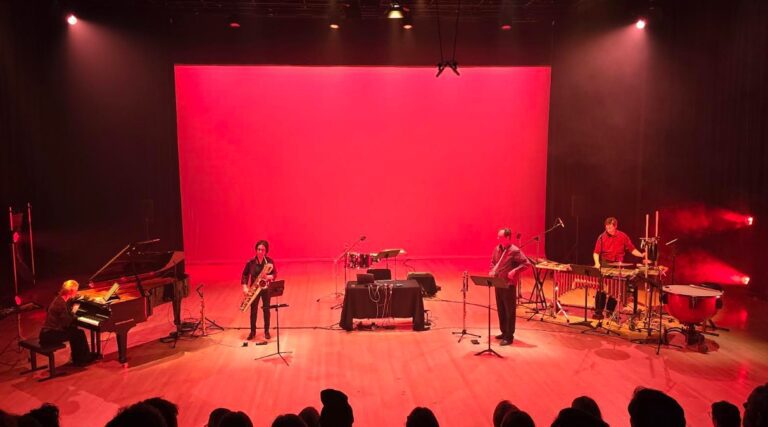
From Bordeaux, the ensemble Proxima Centauri was in Montreal this week to present its concert Mouvements. It was a flawless performance by the ensemble, in which the dialogue between electronics and instrumental performers stood at the center of the presentation.
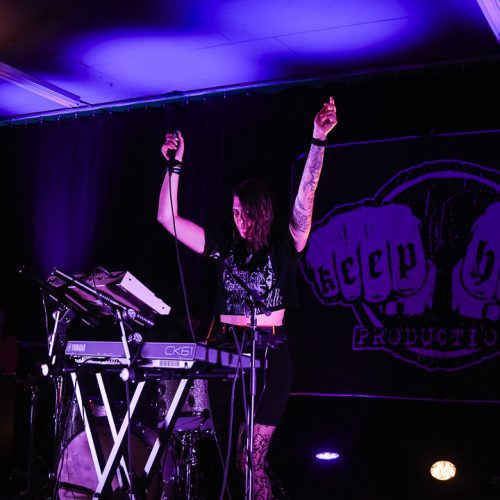
The concert opens with DEATH TALES, spurred, by Quebec composer Corie Rose Soumah, part of the emerging artists program of Le Vivier. The piece begins in near darkness, with a spotlight primarily focused on the snare drum player seated at the center of the stage. The roll initiated by the percussionist serves as a guiding line throughout the piece, developing in tandem with the electronic component, which in turn gradually enriches itself through the sounds being played. The other instrumentalists present (saxophone, piano, and flute) develop their own textures in dialogue with the snare drum, blending sustained and multiphonic sounds with the snare’s rolling rhythm. These layers of superimposed sounds gradually create a kind of irregular rhythmic pattern that evolves throughout the piece, establishing a certain stability within instability.
The concert continues with Away by French composer Brendan Champeaux, a duo for timpani and piano accompanied by live electronics. The piece unfolds as a dialogue between the piano and the timpani, facilitated by the electronics, which capture the sounds of both instruments and bring out a third mediating voice—the electronics themselves. It is a restrained yet effective work that sets the stage for what is certainly the most daring piece of the concert.
That piece is Nemorensis by Argentine composer Demian Rudel Rey, written for tenor saxophone, electronics, and video. The saxophonist enters the stage wearing a futuristic outfit equipped with a helmet featuring a tinted visor. The saxophone itself is modified with an extension containing three additional mouthpieces as well as an extension at the neck. From what could be perceived, this device serves to filter the sound of the instrument and invites us to rediscover the saxophone through unfamiliar sonic textures.
The fourth piece on the program, Ombres by French composer Raphaèle Biston, marks a complete break from what preceded it with Nemorensis. Here, the four instrumentalists share the stage with pre-recorded electroacoustic sounds that evolve alongside the instruments with the aim of reproducing their timbre and creating a unified texture across the ensemble and the electronics.
The concert concludes with La cité du son by Mexican composer Arturo Fuentes, a piece just as compelling as the rest of the program. In it, the composer layers sound recordings from the cities of Bordeaux and Mexico City. It is therefore up to Christophe Havel, responsible for the electronics during the concert, to interact with the instrumentalists in order to create a dialogue between these two cities, so different from one another.