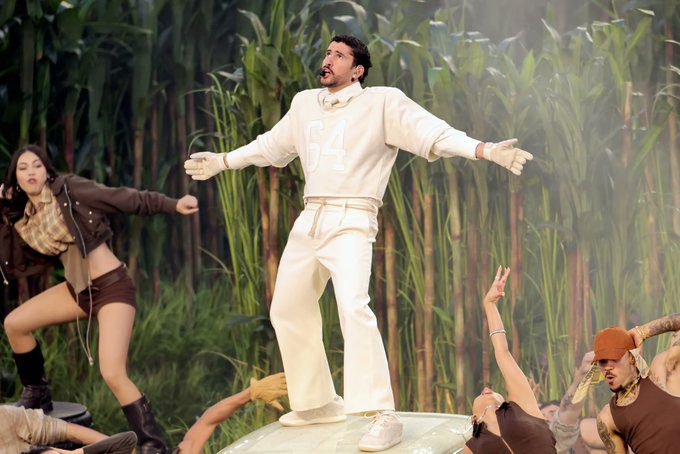
Bad Bunny’s excellent Super Bowl halftime show opened many ears and minds to Puerto Rican culture, but also to Latin culture more broadly. A mini-concert performed almost entirely in Spanish that very subtly demonstrated the resilience of Latinos across the Americas, not only in the United States.
My colleague Alain Brunet very effectively described the importance of this moment in a previous article. I would like to take advantage of this moment of openness to invite you to listen more closely to contemporary Latin music, which has reached an incredible level of diversity and richness over the past decade.
If you read me from time to time, you will have noticed that I regularly review albums and concerts from the Latin world. I have made it something of a specialty, although I sometimes consider myself an impostor: I am not of Latin origin. I lived in Brazil for two years and have traveled through much of Latin America in recent years.
I speak a mixture of Portuguese and Spanish, very imperfectly. But I have been deeply moved by all the music I was able to hear during those stays. And I am more moved than ever at a time when Bad Bunny, Rosalía, Natalia Lafourcade, Shakira and Ana Tijoux, among others, have become global phenomena. And behind them, there are hundreds, even thousands, creating all kinds of music: from norteña in Mexico to cumbia in Colombia, to rock, trap and electronic music.
Of course, many of us are familiar with Cuban salsa, Brazilian bossa nova, Argentine tango, Portuguese fado and Spanish flamenco. But there are so many other forms and crossovers between tradition and modernity. These blends are one of the great strengths of this adventurous music.
In Puerto Rico, as Bad Bunny quickly demonstrated, there is an infinity of genres beyond reggaetón. Jíbara, danza, bomba and plena, which I heard extensively in Florida at electoral events within that community while working as a journalist. Endless percussion. There are also highly engaged rap groups that resonate across Latin America. Calle 13 is a fascinating group, darker than Bad Bunny but complementary. The same goes for Residente, one of the group’s founding members, who has a very rich solo career.
In the Southern Cone, there is a rock tradition dating back to the 1980s that today blends with folklore, tango, hip-hop and electronic music. Extremely fertile.
Brazil is a musical planet in itself, incredibly diverse and far beyond samba and bossa nova. I recently wrote a review of an album that brings together a jazz musician, a rapper and a Cape Verdean pop singer who reinvents R&B. A fabulous blending of genres.
Portugal also has a captivating contemporary ecosystem where former African colonies intersect with Portuguese guitars and synthesizers.
What can be said about Mexico? Spain? Colombia? And Quebec, which counts more and more bicultural or immigrant artists weaving a dense Latin tapestry that enriches our music. Lapeluda, Boogat, Maritza, Less Toches and many others.
Do you not speak Spanish or Portuguese? Let yourself be immersed in these distinctive sounds. Sometimes, the music is purely instrumental.
Muchas gracias to Bad Bunny for opening this window, ventana, onto this plural universe that we are far from done discussing in our pages.