Additional Information
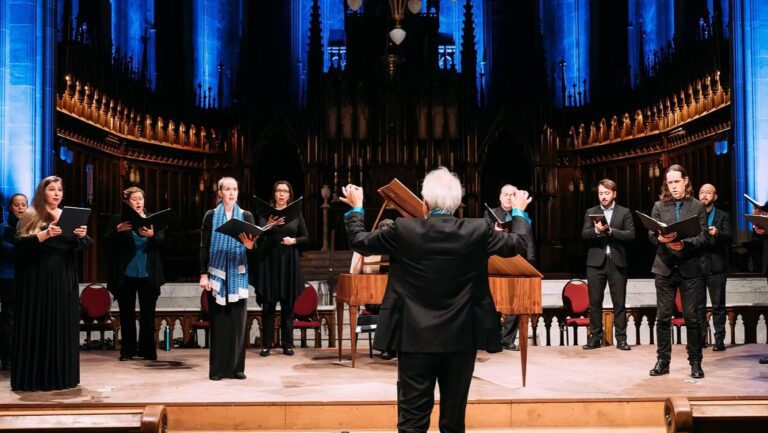
Under the direction of Matthias Maute, the ArtChoral Ensemble delves into the Jewish choral tradition in relation to Western cultures. Their album, Hallelujah, has just been released on the Atma Classique label and will be performed this Tuesday, February 3rd, at noon in Le 9edu concert hall at the Eaton Centre.
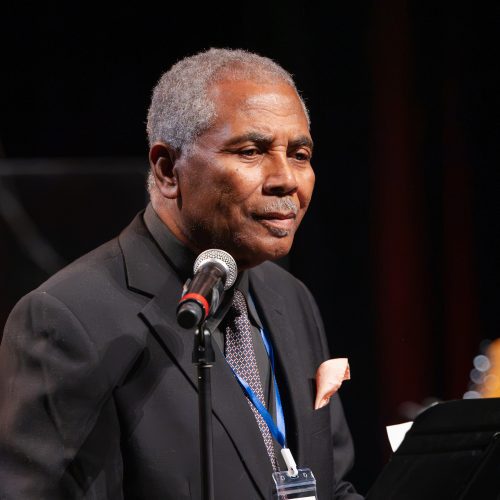
ArtChoral will welcome for this occasion the cantor Gideon Zelermyer, who distinguished himself ten years ago in some songs of You Want It Darker, the last offering of the late Leonard Cohen which earned the cantor international renown.
The experience of the album Hallelujah and this intercultural relationship between Jewish and Western cultures produced polyphonic songs that are both close to the sacred music of the Christian world and also to Jewish vocal traditions, formerly monophonic and then converted to polyphony from the 18th century.
Thus, this opus reveals sacred and secular songs, works composed in the 19th, 20th and 21st centuries by well-known Jewish artists such as Leonard Cohen, Leonard Bernstein or Kurt Weill, to which are added those of renowned composers in the more specialized world of Jewish choral singing – Salomone Rossi (Italy), Fromental Halévy (France), Giacomo Meyerbeer (Germany, France) or Rona Nadler (Canada).
Reached on the eve of the concert, Matthias Maute explains this material from the recording programme of the 9th as well as the works also on the programme (and not recorded) by Jaap Nico Hamburger (Montreal composer), Ernest Bloch, Naftali Herstik (mentor of Gideon Zelemyer) and Raymond Goldstein.
PAN M 360: What are the characteristics of these composers? How do they differ from Western sacred chant, for example? Where do the differences lie? It’s not so obvious, is it?
Matthias Maute : No, because generally, it’s part of Western music. Whether it’s Lutheran, Catholic, or European Hebrew, we immediately recognize ourselves in it. For example, Salomone Rossi writes motets with Hebrew texts. Discovering his work, you realize that it was once very difficult, even dangerous, to be Jewish in Italy, to live or work there. So, it was revolutionary in itself that Salomone Rossi’s music could express Hebrew texts. That’s where the Hebrew influences really emerge. That’s where this album truly finds its meaning, with the difficulty of living in the background.
This music is very expressive, and in a very different way from what Leonard Bernstein offers, who stands out for his choice of themes, the depth of his symphonies, or in this Mass: Almighty Father. For Bernstein, Jewish identity is a quest for self. And composers like Giacomo Meyerbeer are known and appreciated by music lovers of all Judeo-Christian faiths.
PAN M 360: But if we isolate the music from the text, it’s not so different from the rest of European music, is it?
Matthias Maute : There are differences, but we can still find our way around because we’re more familiar with this music than we realize. There are many familiar elements, just as we know Italian, French, or Indian cuisine well. The pieces by composer and singer Rona Nadler are expressed in Yiddish, others in Hebrew or Old German. Fromental Halévy expresses a Hebrew language reflecting sacred Jewish music in 19th-century France.
We did more of this kind of piece where a cantor is accompanied by us; it was new for us, for me as conductor, as well as for the choir members.
PAN M 360: Let’s move on to more modern pieces. Take Lost in the Stars by Kurt Weill, a German Jew who composed music influenced by modern European music and American jazz of the time. You also have Leonard Bernstein’s Mass and Leonard Cohen’s well-known anthem, Hallelujah, arranged by the South African choirmaster André van der Merwe. So this repertoire is very diverse! You’ve also chosen modern pieces from the, in quotes, popular repertoire, but not as popular as one might think, because Bernstein was a great conductor and a great classical composer. The same goes for Kurt Weill, who wrote a lot of music for the theatre, but also for a repertoire that could be described as sophisticated. Or Leonard Cohen, an eminent Jewish artist of Montreal origin.
Matthias Maute : We wanted to reflect the vast scope of the Jewish universe; it’s not just one thing or one element. So I really appreciate this variety, but beyond that, the incredible quality across all the genres highlighted in this album. Whether it’s secular or sacred music, Jewish composers and musicians have been able to showcase incredible talent. In this album, we see the range of musical colors that the composers have found, inspired in part by their own culture.
PAN M 360: Why did you choose to do this, Matthias? You are of German origin, you are not Jewish, and we know the atrocious history of the Jews in Germany. So?
Matthias Maute : We know that Germany was terrible for the Jews, and this humbly led me to find ways to rebuild a bridge between our cultures, at least musically. So we began a collaboration with Montreal cantor Gideon Zelermyer, with a spirit of respect and a hope that all cultures can remain true to themselves without being overshadowed by those of their neighbors.
PAN M 360: In your case, it’s a way of Truth and reconciliation with Jewish culture.
Matthias Maute : For me, absolutely. When you see what’s happening in the world, it’s terrifying, but you have to start somewhere. So, with the Caprice ensemble, we work a lot with musicians from different cultures, musicians from Palestine or Lebanon, for example. We establish contacts on all sides. I think that’s important because music can truly reach everyone, and it’s very important in our world today to find ways, to find harmony among all these cultures that are at war.
PAN M 360: And we mustn’t forget that, in each of these cultures, there are many human beings who are completely opposed to the conflicts that afflict them. Who instead want peace and reconciliation.
Matthias Maute : It’s really not easy to convince people with this peaceful approach. But we’re actively working with Caprice and ArtChoral, reaching out in every direction to create lasting connections, a platform for understanding that could ultimately work for everyone. Because we have no other choice but to live in peace.
PAN M 360: Indeed, war is no longer conceivable as it has been since the dawn of human civilization. With the power of today’s weapons, war becomes an existential threat to humanity rather than a means of domination.
Matthias Maute : And that’s why we’ve invited Gideon Zelermyer to sing with us for this concert on the 9th floor. The cantor sang with the Shaar Hashomayim choir on the album You Want It Darker, Leonard Cohen’s last album, which earned him international acclaim and a Grammy Award by association. We just rehearsed Hallelujah the day before our concert on Tuesday, February 3rd, at noon.
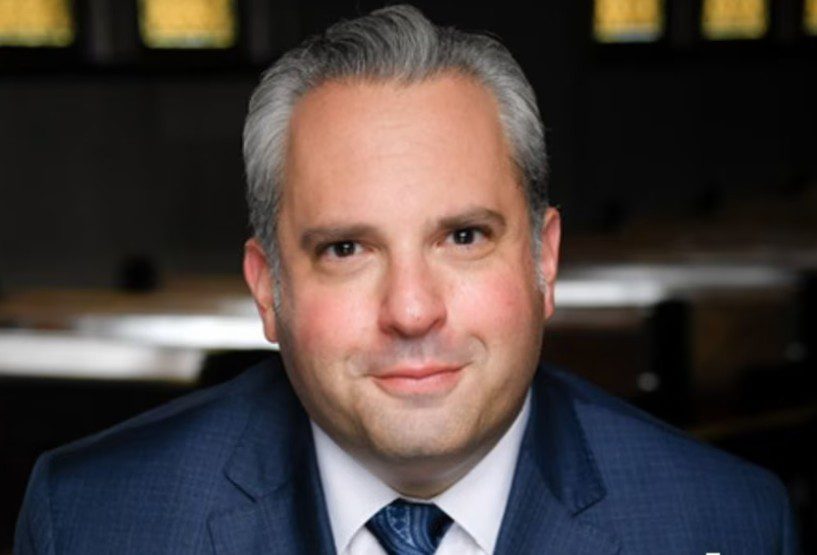
Cantor Gideon Zelermyer