The venerable National Theatre on Sainte-Catherine Street East was packed for the opening of the 26th Montreal Arab World Festival (FMA). A wonderfully diverse crowd—it felt like stepping into Alain Farah’s novel, Mille secrets mille dangers, or its film adaptation. Among the spectators of Iranian origin were Nima Mashouf, recently released from an Israeli prison, and Amir Khadir. A multitude of languages could be heard, sometimes spoken simultaneously. We were in Montreal, without a doubt. And we felt right at home.
But then, in her opening speech, the festival spokesperson sent us a dark message:
“You can’t imagine the outpouring of hate on our social media,” she said, referring to the difficulty a festival like this faces in navigating an era where rising exclusion complicates matters. This isn’t the first time, however: I remember how much the aftermath of September 11, 2001, weakened the festival. It’s resilient, though, and it responds with the quality of its shows.
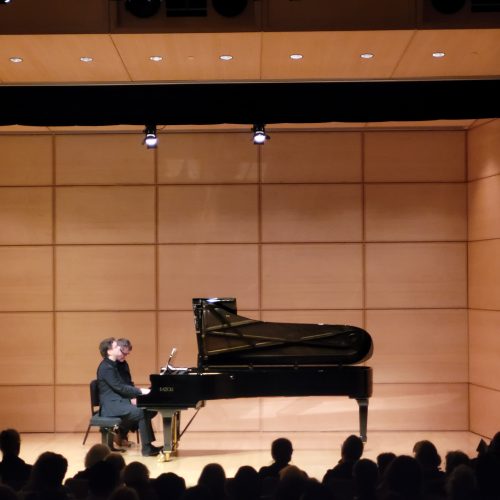
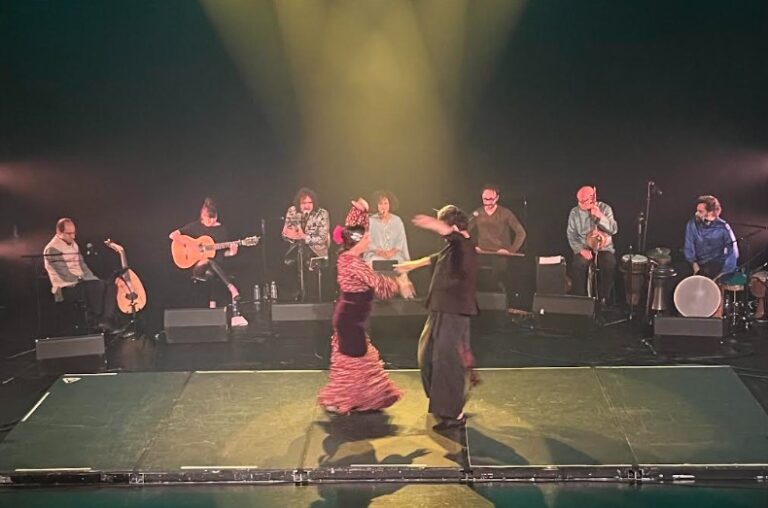
The FMA thus begins with an original creation: Olé Persia, which aims precisely to unite cultures rather than divide them. Under the musical direction of Saeed Kamjou, we witnessed a blend of Arabic, flamenco, and Persian music and dance. We are already familiar with the links between flamenco and Arabic music, due to conquests and coexistence in Andalusia. But classical Persian and Arabic music have also influenced each other, as Saeed Kamjou explained in an interview you can listen to on PAN M 360.
We were treated to a musical journey that lasted almost two hours.
On the flamenco side, there was the formidable guitarist Caroline Planté and the fiery singer Fernando Gallego. From the Arabic side, there was Montreal oud player Abboud Kayyali, originally from Jordan; from the Persian side, the accomplished percussionist Pejman Hadadi, the tar (a Persian guitar) player Behfar Bahadoran, and Saeed Kamjou on the kamancheh, a bowed instrument, who orchestrated the show. Singing in both Persian and Arabic, a rare feat, was Mina Deris with her sweet and melodious voice.
Let’s say it right away: we were dealing with highly talented instrumentalists, perfectly masters of their instruments, including vocals. And then, the dancers joined us: Rosanne Dion from Quebec, who studied for a long time in Spain, and Shahrokh Moshin Ghalam, a Franco-Iranian master choreographer of Persian and contemporary dance.
The idea behind the show was to juxtapose these three cultures, to illustrate their similarities as well as their differences. The repertoire consisted of works from the different cultures. It was a series of dialogues or “trialogues” rather than a fusion of styles. And, in that sense, it was a complete success.
The audience clearly enjoyed it, judging by the level of applause. I also had a lot of fun, especially when a mini fusion of genres took place. When Behfar Bahadoran started improvising on the tar over Caroline Planté’s rhythm, I started to look away. I would have been curious to hear the Spaniard Fernando Gallego sing in harmony with the Californian-Iranian Mina Deris. Perhaps it’s the uninitiated improvisation enthusiast in me who would have liked the fusion to go even further.
But it was a fantastic inaugural concert. Let’s wait and see what’s next for FMA.