Additional Information
In her latest album, T.R.A.N.C.E., Julia E. Dyck highlights her experience as a hypnotherapist. The captivating rhythm of her voice creates vivid images in the mind. Her spellbinding voice, oscillating between command and reverie, floats above minimalist drones that subtly follow the emotions, traveling through love, fear, pain, and then returning to love. After listening to this album in the morning, I felt pleasantly awake and open to the world.
I had also heard Julia’s work with Audio Placebo Plaza and A Kind of Harmony, two projects that had given me a similar feeling of underlying calm. It seems that these projects share a similar sensitivity towards sound as a social actor and spiritual means of healing. I wondered where Julia fit into this evolving microcosm that is deep listening. Ahead of her performance at Akousma, I wanted to understand the roots of this unique practice, and Dyck generously answered, diving deep into the lessons that made her the artist she is today.
PAN M 360: Hello, Julia. Thank you for agreeing to do a phone interview with me this morning. I’ve spent a lot of time listening to your album T.R.A.N.C.E. One thing that really struck me, and it may seem obvious, is that your voice is truly mesmerizing. Have you always spoken in such a hypnotic way, or is it something you learned?
Julia E. Dyck: I love talking about this. Hypnotherapy training involves a lot of work and vocal exercises. However, long before that training, I was already very interested in my own voice. My very first experience was singing in a choir; as soon as I could walk, I sang in the church choir. I then moved on to musical theatre, then sang in a band, before returning to choir. I also worked for seven years at CKUT, where I did live radio. All of these experiences definitely made me very curious about the voice. I consider my voice, both in singing and speaking, to be my primary instrument.
That said, I really had to work on the hypnotic power of my voice. I was trained by a wonderful Montreal-based hypnotherapist, Andrea Young. One might think that the role of the hypnotist’s voice is to be relaxing. To a certain extent, this is true, but according to Andrea Young, the voice is a lantern that guides the conscious mind or keeps it occupied, while words, visualizations, metaphors, and symbols speak directly to the subconscious. It is therefore important to have a rhythmic voice and not be too relaxing, as people may fall asleep or not be as receptive to what you are saying.
PAN M 360: After all these years, would you say that your approach to sound is closer to that of a therapist or a musician?
Julia E. Dyck: Neither, and both at the same time. I would say that I trained in hypnosis and hypnotherapy from a truly artistic perspective. So I approached it as artistic research, even though it has now gone beyond what I initially planned to do with it. I am happy to be situated at the frontier between a more therapeutic practice and a more artistic or musical practice.
PAN M 360: What do you focus on when writing a text that makes it so vivid?
Julia E. Dyck: The album T.R.A.N.C.E. isn’t really a reading of the text. I have a few notes, then I improvise in a way. When I practice hypnosis, whether with a client one-on-one, in a group session, or for a recording, I too have to enter a trance state. Obviously, I couldn’t memorize and reproduce this 25-minute narrative. Often, it’s even longer than that. So I really rely on my subconscious, and the images that come to me follow a sensory thread of metaphors. It’s really the result of a very relaxed trance state that I find myself in, and the fact that I simply trust the voice, the words, and the story.
PAN M 360: That’s wonderful. I think the key word you just mentioned is trust—not only for yourself, so that you believe in the story and the words, but also for the listener, so that they can let themselves go into this trance state with you. Is there anything you or the listener can do to create that safe and open environment in which trance can occur?
Julia E. Dyck: What I love about doing something quite hypnotic in an artistic or performative setting is that people already approach these settings with an open mind and a certain curiosity. That’s all I can really ask for and hope for from any kind of audience. Often, people who might not be drawn to hypnotherapy or even meditation find themselves in a context and state of mind that allows them to be touched by something. At Akousma, I will be performing part of my latest album, Introduction to Somnambulism. So it’s not a hypnosis album in the same way as the album T.R.A.N.C.E., but it is clearly inspired by my training in hypnotherapy.
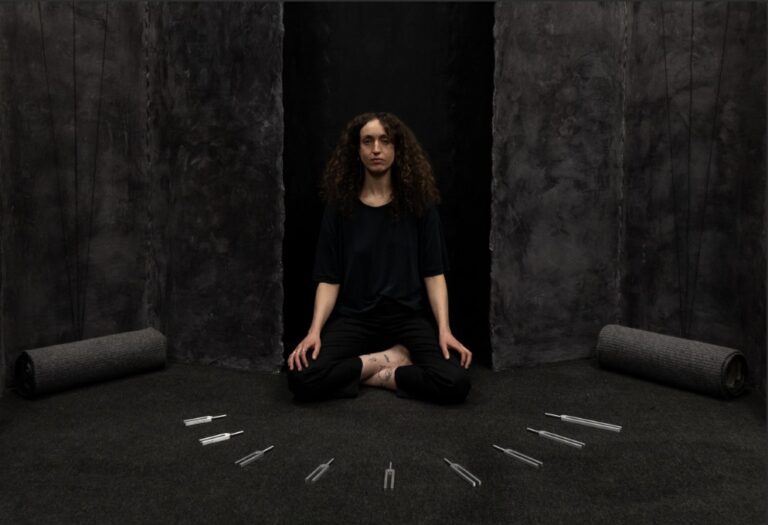
I don’t expect people to be completely hypnotized, especially since the set is quite short. However, I think they should come with an open mind, as they would for any other artistic event. Of course, my voice will be present and all the sounds I produce will be very precise and influenced by a translation of these hypnosis techniques. I will also be playing my set of giant chimes, which resonate throughout the room and should have an effect on the body. I find it fun to bring this giant, resonant instrument to a festival like Akousma, which is really focused on an electronic and acousmatic experience. However, I think the combination of these two elements should be quite effective and immersive.
PAN M 360: I’d like to talk about the podcast you did with Amanda Harvey, A Kind of Harmony. There’s a question I asked Amanda that I’d also like to ask you: What do you think is the most important lesson you’ve learned from your guests?
Julia E. Dyck: There are so many. In terms of something very specific that stood out to me and that I think about almost every day, it was a conversation we had with Beverly Glenn-Copeland. He was talking to us about his theory of the universal broadcasting system and his belief that everything he has created and everything great that has been created in this world, whether through art, science, or innovation, is somehow a co-creation between the creator and this larger consciousness of the universal broadcasting system.
So, the idea that the most incredible ideas and inspirations come to you as a transmission and that you can’t necessarily control them, that they are not necessarily the result of repetition, discipline, or research, but rather of an open mind, a willingness, and also a taking seriously of these transmissions. So it’s this idea that the artist can be more of a channel, a receiver for something that already exists in the ether. And that really changed my relationship with my own practice, because it’s something I’ve kind of experienced, but never been able to put into words. Hearing that from Glenn really made a lot of sense to me. I think I’ve become much more open to the universal broadcasting system and all these transmissions.
PAN M 360: That’s interesting, because this idea that transmission is at the heart of creation is much closer to the practice of listening, which is one of the main topics of the podcast. How has your listening changed since you became familiar with the universal broadcasting system?
Julia E. Dyck: We fill our ears, our perception, with so much media that it is rare to have the opportunity to receive or even notice a transmission that reaches us. But if we think about it in terms of listening to the environment and resonating with our surroundings, the Earth is constantly transmitting. If you are present and open to your immediate environment, you are more likely to receive these messages and signals, whether in an urban or natural setting. There is so much information around us at all times that it takes deliberate intention to tune in, be truly present, and really listen.
PAN M 360: We would like to thank Julia E. Dyck for introducing us to the hypnotic space that distinguishes art from therapy. We are now more ready than ever to listen. Come and experience this unique performance on the final evening of Akousma.