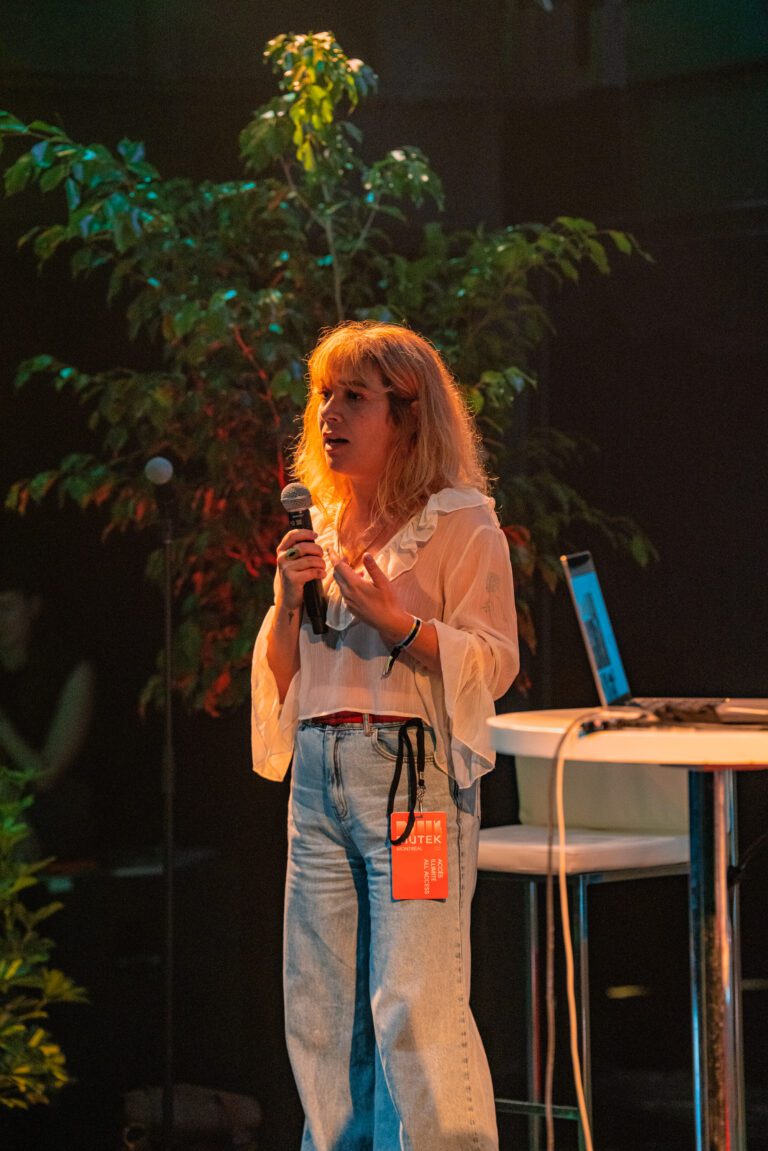
As part of Mutek Forum 2025, PAN M 360 met with Pauline Bourdon, who helps festivals in their socio-ecological transition. Founder of Soliphilia and with 17 years of experience in the British festival industry, she works notably with TEAM Love Productions on events like Glastonbury Festival. Specializing in team support and implementing sustainable strategies, she also works as a trainer in several English universities to raise awareness among future professionals about today’s and tomorrow’s challenges. A meeting with an expert who sees festivals as experimentation laboratories for a more sustainable society.
PAN M 360: What journey led you to help festivals in their socio-ecological transition?
Pauline Bourdon: I have quite a unique path. I started in artistic logistics for festivals 17 years ago, then moved to England 11 years ago to work on events like Glastonbury. Gradually, I realized I was losing that authentic relationship with art due to an industry that had become very commercial. There was a moment when I realized there was a disconnect between my personal ethics and the career I was pursuing. In 2019, I created Soliphilia to combine artistic logistics and sustainable development, bringing my expertise in cultural policy and artistic logistics with the goal of systemic change in the festival industry.
PAN M 360: How would you define your day-to-day work?
Pauline Bourdon: My work is very diverse. First, there’s a lot of data collection and analysis to quantify practices, whether negative or positive. This is essential to measure impact and justify changes. Then there’s an entire educational component: creating tools for teams and ensuring their training. I favor long-term systemic change rather than one-off solutions. The idea is to help each person understand their role in this ecological transition and the creative solutions they can implement in their area of expertise. Concretely, this means spending time with teams, listening to their challenges, providing resources, staying informed about best practices elsewhere, and developing strategies adapted to each context.
PAN M 360: What was your presentation about at MUTEK Forum?
Pauline Bourdon: I presented the concept of using imagination as a tool for climate action, through two concrete projects we’ve developed. The first is called “Town Anywhere”: it’s a 6-hour immersive game that projects participants into the future, in 2035, to help them imagine and prepare for upcoming changes. The second project involves using mycelium – mushroom roots – to replace polystyrene in stage design with a compostable material created from agricultural waste. For me, festivals are true idea laboratories: they constitute a temporary small city with all the necessary infrastructure. If a solution works for 45,000 people at a festival, it can potentially be replicated on a societal scale. This is my vision of cultural events as experimentation spaces between imagination, systemic change, and just transitions.
PAN M 360: Where do festivals stand today regarding reflection and implementation of eco-responsible strategies?
Pauline Bourdon: Progress varies enormously by territory, notably due to audience behaviors that are linked to local cultures. The UK has positioned itself as a global leader in sustainable event management, with a very strong network of actors and tools that are now being replicated elsewhere in the world. However, there’s constant tension between commercial imperatives – particularly private sponsors – and teams’ environmental ethics. The reality is that festivals are complex ecosystems with socio-political and economic links that make solutions much more complicated than simply “replacing plastic cups with reusable ones.” An intersectional approach is crucial to avoid reproducing the extraction errors we observe in other sectors of the ecological transition.
PAN M 360: We’re seeing a growing number of partial or complete festival cancellations that must deal with increasingly difficult weather conditions. How do you perceive this evolution?
Pauline Bourdon: It’s a major challenge that perfectly illustrates current climate issues. England, for example, was historically prepared to handle rain, but today we must face heat waves on terrain that isn’t adapted to these new conditions. Weather predictions become crucial – we’ve experienced situations where 30% chance of rain turned into torrential downpours for three hours. Organizations like the Met Office now work with the industry to develop more precise predictions and adaptation tools. I think we also need to create professional unions because, unlike cinema, the festival industry isn’t unionized. This would allow for collective adaptation and better protection of workers facing increasingly unpredictable climate changes.
PAN M 360: With the pandemic, several technologies like livestreams or the metaverse have enabled certain cultural accessibility, but they also have an ecological impact. Between taking a plane to go to a festival in Europe and participating in a virtual festival, how should we position ourselves?
Pauline Bourdon: It’s a complex question because we still lack reliable data on the real impact of digital technology. The main problem is that consumption behaviors change completely depending on context. For example, a toilet flush at home consumes much more water than dry toilets at a festival. At home, during a virtual event, people will cook, leave lights on longer, invite friends – all factors that modify the environmental equation. At festivals, we have a controlled space where we can precisely measure consumption. Paradoxically, a four-day festival where you don’t shower can have a lower environmental impact than classic all-inclusive vacations. A specificity of festivals is that they make our environmental impact visible, unlike other cultural industries like cinema where production waste remains invisible to the public.
PAN M 360: As festival-goers, what simple actions can we adopt?
Pauline Bourdon: First, we must understand that organizing teams often reach plateaus – for example in recycling rates – and going further requires active public participation. A few simple actions can make a difference: coming with an open and curious mind, bringing your own water bottle, exploring vegetarianism even temporarily to show there’s demand, favoring carpooling and never traveling alone in a car. But above all, I think we need to develop more empathy toward teams who work enormously, often with considerable personal sacrifices. Rather than systematically criticizing on social media as soon as something doesn’t go perfectly, it would be constructive to understand the complexity of organizing an event and encourage the efforts being made.
PAN M 360: And what about artists in all this? Tell us about “green riders” or “eco riders.”
Pauline Bourdon: Artists operate in a very difficult economic context, where monetization has shifted toward live concerts. The rider – this contractual document where artists express their technical, logistical, and personal needs – is seen by all industry players: managers, promoters, concert venues. It’s therefore a very powerful tool that can be used to convey ecological and social values. A green rider can include requests like non-gendered toilets, no plastic, accessibility measures, or even requirements for gender parity in programming. At TEAM Love, we observe that green riders double each year. It’s the power of numbers that allows these practices to be normalized and gradually become standard in the industry. The goal is for these ecological and social concerns to become natural in contractual negotiations.