Additional Information
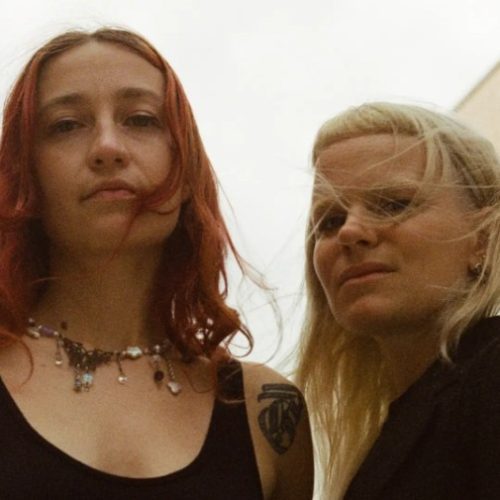
Transcending time and space, the music of God’s Mom sounds simultaneously ancient yet futuristic. This darkwave electronic duo consists of Bria Salmena and Andrew Matthews joining forces to make haunting, high BPM tracks. Salmena, who has sung with Orville Peck and whose solo catalog leans more towards country, explores a different type of folk singing with this project. Her vocals are inspired by Italian folk music from Calabria, while Matthews’ electronic production has frenetic, industrial rhythms fitting for a warehouse rave.
God’s Mom released their debut album in September 2024, titled As It Was Given. Recorded between Rome and Toronto, this album is stuck somewhere in the darkness of the future past. Self-described as a “reactive clenched fist to the suppression of female identity in southern Italian culture,” its sonic world includes ancient melodies calling out through waves of electronic noise and drum beats. A week before their Taverne Tour show, we discussed Italian folk influences, hysteria, tarantulas, and dream movies.
—
PAN M 360: What’s the origin of your band name? I like that it’s both sacred and super casual.
God’s Mom: We like the name for the same reason. Its origin is a secret.
PAN M 360: Your music’s got the pulsing oontz-oontz drums that’d fit right in at a rave, but then you’ve got these grandiose Italian vocals floating over it all. Your Bandcamp alludes to Calabrian folk singing as the inspiration for these vocals. Did you grow up listening to this music?
GM: Bria’s family is from the Calabrian region of Italy. She discovered this tradition of music from the region as an adult and we have both bonded over it ever since.
PAN M 360: I started reading about the tarantellas you mention on Bandcamp, which are fast-paced folk dances from Southern Italy. In As It Was Given, what elements from the tarantellas resonated with you?
GM: The style of singing is the first thing that stuck out to us. It is polyphonic and atonal in a way that feels incredibly emotional and also dissonant. Also, the lyrics of many of the tarantellas come from women who are responding to gender and class strife in rural Italy. In many ways, the tarantellas share a common quality to punk music.
PAN M 360: Wikipedia says the word tarantella might have come from “tarantism,” the hysteria that comes from a tarantula bite, and the music is meant to revive the victims. I thought that description was cool – it captures that dark, possessed side of dancing and raving, but also the salvation it can bring. How do you view the spiritual role of your music?
GM: Our music doesn’t have a spiritual agenda. You referenced tarantism and the idea of hysteria. If our music and performance come across as hysterical, it is about owning it in a way that we are in control, rather than in the past where that word was used to oppress women.
PAN M 360: The synths on “Vespa e Spina” kind of remind me of a fuzzy tarantula. How would you describe the textures of the synths on this album?
GM: “Vespa e Spina” is one of our oldest songs. At the time, I wanted to use synths in the way that Public Image Ltd. uses guitars. I failed. But I definitely also wanted the synths to buzz and dart like insects.
PAN M 360: “Niente Davanti” is one of my favuorite tracks from the album. What’s the story with that sample at the beginning?
GM: That is an acapella from a tarantella that jump-started the energy for the rest of the song. One of our earliest songs where tarantellas influenced the spirit that we were forming. We thought about how these voices that were calling out in such an emotional way could travel from the 1950s into a future era and sound.
PAN M 360: As It Was Given was a culmination of four years of work. What was your creative process like over the years?
GM: Bria and I work very manically and in prolific spurts. When the ideas come we try to capture them as quickly as possible and finish things in the moment. So after about four years of working on material quite continuously, we have found ourselves with a surplus of songs that we feel are worthy.
PAN M 360: You recorded the album between Toronto and Rome – cities with wildly different histories, cultures, and climates. How did the two cities shape the sound of God’s Mom?
GM: Something we talk about often is how a place like Rome or other European cities will repurpose, often ancient, condemned, or forgotten cultural spaces into new ones. Toronto seems to have more of a habit of demolishing its history to build something new. Things should always move forward, but if you can maintain the history of a space or energy and redress it, rather than destroy and recreate it, it holds much more meaning. This concept is a huge influence on God’s Mom.
PAN M 360: Lastly… if you were tasked with creating the soundtrack for a movie, what would it be like? What’s the genre, the plot, and who’s directing it?
GM: The movie would be about a person who has a sexual relationship with their own clone. It takes place at Club Voodoo in Toronto in the 80s. The music would be either drone or 190 bpm+. Bria and I would direct it. It would be a tragedy.